

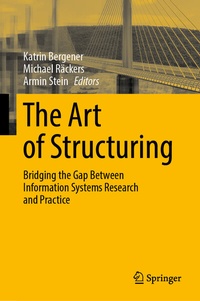
The Art of Structuring
Bridging the Gap Between Information Systems Research and Practice
1st Edition
Published on 25. January 2019
XXVIII, 536 pages
978-3-030-06234-7 (ISBN)
Description

Structuring, or, as it is referred to in the title of this book, the art of structuring, is one of the core elements in the discipline of Information Systems. While the world is becoming increasingly complex, and a growing number of disciplines are evolving to help make it a better place, structure is what is needed in order to understand and combine the various perspectives and approaches involved. Structure is the essential component that allows us to bridge the gaps between these different worlds, and offers a medium for communication and exchange.
The contributions in this book build these bridges, which are vital in order to communicate between different worlds of thought and methodology - be it between Information Systems (IS) research and practice, or between IS research and other research disciplines. They describe how structuring can be and should be done so as to foster communication and collaboration. The topics covered reflect various layers of structure that can serve as bridges: models, processes, data, organizations, and technologies. In turn, these aspects are complemented by visionary outlooks on how structure influences the field.More details
Other editions
Additional editions
Katrin Bergener | Michael Räckers | Armin Stein
The Art of Structuring
Bridging the Gap Between Information Systems Research and Practice
Book
02/2019
Springer
€160.49
Shipment within 7-9 days
Persons
Katrin Bergener holds a PhD in Information Systems from the University of Münster, Germany. Since 2013, she works as Assistant Professor at the Chair of Information Systems and Information Management at the University of Münster and is actively involved in the organization of the ERCIS network. Since 2016, she is coordinator of the WWU Centre for Europe, a university-wide institution for encouragement and support of all EU-related activities within the University of Münster.
Michael Räckers holds a PhD in Information Systems from the University of Münster, Germany. Since 2012, he is working as Associate Professor at the Department of Information Systems. Before, he was a Research Assistant and PhD Student and an Assistant Professor at the Department of Information Systems. Michael actually serves as CFO of the Department of Information Systems and leads the competence center E-Government of the ERCIS network.
Armin Stein holds a PhD in Information Systems from the University of Münster, Germany. Since 2012, he is working as Associate Professor at the Department of Information Systems. Before, he was a Research Assistant and PhD Student and an Assistant Professor at the Department of Information Systems. Armin is Managing Director of the ERCIS network, coordinating more than 25 international partners as well as the associated members of ERCIS.
Michael Räckers holds a PhD in Information Systems from the University of Münster, Germany. Since 2012, he is working as Associate Professor at the Department of Information Systems. Before, he was a Research Assistant and PhD Student and an Assistant Professor at the Department of Information Systems. Michael actually serves as CFO of the Department of Information Systems and leads the competence center E-Government of the ERCIS network.
Armin Stein holds a PhD in Information Systems from the University of Münster, Germany. Since 2012, he is working as Associate Professor at the Department of Information Systems. Before, he was a Research Assistant and PhD Student and an Assistant Professor at the Department of Information Systems. Armin is Managing Director of the ERCIS network, coordinating more than 25 international partners as well as the associated members of ERCIS.
Content
Part I: Visions.- Part II: Models.- Part 3: Processes.- Part IV: Data.- Part V: Organizations.- Part VI Technologies.
