

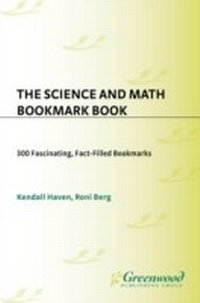
Science and Math Bookmark Book
300 Fascinating, Fact-Filled Bookmarks
1st Edition
Published on 15. March 1999
115 pages
978-0-313-07873-6 (ISBN)
Description

Use these 300 reproducible bookmarks of fascinating facts, concepts, trivia, inventions, and discoveries to spark student learning. They cover all major disciplines of physical, earth, and life sciences, ready to copy, cut out, and give to your students.
More details
Edition
1. Auflage
Language
English
Place of publication
New York
United States
Publishing group
Bloomsbury Publishing Plc
Target group
Professional and scholarly
ISBN-13
978-0-313-07873-6 (9780313078736)
Copyright in bibliographic data and cover images is held by Nielsen Book Services Limited or by the publishers or by their respective licensors: all rights reserved.
Schweitzer Classification
Other editions
Additional editions
Book
03/1999
Libraries Unlimited Inc
€39.90
Shipment within 3-4 weeks
Persons
KENDALL HAVEN is a nationally recognized master storyteller and the author of numerous books, including Marvels of Math, Write Right!, and Close Encounters with Deadly Dangers. A former research scientist, he is based in Fulton, California.
RONI BERG is a professional graphic designer in the same city.
RONI BERG is a professional graphic designer in the same city.
Content
- Intro
- Contents
- Introduction
- PHYSICAL SCIENCES
- Branches of the Physical Sciences
- How Big Is the Universe?
- The Sun
- Planet Earth
- Solar System Facts
- How Far Is the Sun?
- How Big Are the Planets in Our Solar System?
- If the Sun Were a Beach Ball
- Planetoid Factoids
- Jupiter
- Asteroids
- Meteors and Meteorites
- What Else Is in the Solar System?
- What Is the Universe?
- What Is the "Big Bang"?
- What Is a Galaxy?
- Milky Way Facts
- What Are Stars?
- Can a Star Die?
- What's Left After a Star Dies?
- Neutron Stars and Pulsars
- Black Holes
- Who Was First in Space?
- First Animals in Space
- Measuring Distance Among the Stars
- How Close Are the Nearest Stars?
- The Mighty Telescope
- The Mysterious Moon
- Element Facts
- Acids and Bases
- What Is pH?
- Common Acids and Bases
- Carbon
- The Miracle of Salt
- Atoms and Molecules
- Some Common Molecules
- What Is Inside an Atom?
- Protons and Neutrons
- The Temperature Scales
- What Is Electricity?
- "Natural" Electricity
- Ben Franklin's Kite
- Measuring Electricity
- "Artificial" Electricity
- Electricity and Magnetism
- What Is Magnetism?
- Nuclear Fission and Fusion
- Why Does a Light Bulb Glow?
- What Is a Transformer?
- Semiconductors
- Matter and Energy
- Measuring Matter
- Mass and Weight
- Basic Physics Terms
- What Is a Rainbow?
- What Is Gravity?
- The Four Forces of the Universe
- What Is Friction?
- What Is Light?
- The Parts of the Frequency Spectrum
- Lasers
- How Does a Microwave Work?
- Time Trivia
- Time Terms
- What Is Radioactivity?
- Inorganic and Organic Chemistry
- What Is an Explosion?
- What Is the Scientific Method?
- What Makes a Rocket Move?
- What Is a Light Year?
- Light Facts
- Fluorescent and Luminescent Light
- What Is Heat?
- Comparing Temperature Scales
- Fire
- What Is a Vacuum?
- Pressure and Pumps
- What Makes an Airplane Fly and a Baseball Curve?
- What Is a Comet?
- Finding a Star
- The Elements
- The Periodic Table
- Mixtures and Compounds
- How Big Is an Atom?
- How Does a Power Plant Create Electricity?
- Types of Power Plants
- How Does a Telephone Work?
- The Timeline of Flight
- Your Weight on Other Planets
- Car Talk
- The History of Rockets
- Inventions Before 1800
- Inventions Between 1800 and 1850
- Inventions Between 1850 and 1900
- Inventions Between 1900 and 1940
- Inventions Between 1940 and 1980
- When Does a Full Moon Rise?
- Copernicus
- Galileo
- Roger Bacon
- Marie Curie
- Joseph Priestly
- Charles Goodyear
- Thomas Edison
- Wilhelm Roentgen
- Earth Sciences
- Branches of Earth Sciences
- World's Longest Rivers
- Waterfalls
- Driest Places
- Wettest Places
- Northernmost, Easternmost
- The Contiguous 48
- The International Date Line
- Caverns
- Stalactites and Stalagmites
- The Newest Land on Earth
- The Lowest Places on Earth
- Going Below Sea Level
- The Highest Mountains
- Highest U.S. Peaks
- U.S. Mountain Ranges
- Mountain Ranges of the World
- Islands of the World
- How Big Are the Oceans?
- What's Hot? What's Not?
- Hottest and Coldest
- Natural Disasters
- The Tropics
- Glaciers
- Glaciers During the Ice Ages
- Inside the Earth
- Rock Facts
- Where Do Rocks Come From?
- What Is a Mineral?
- Measuring Geologic Time
- Dating Ancient Rocks
- Where Did the Atmosphere Come From?
- Layers of the Atmosphere
- What Is a Cloud?
- Types of Clouds
- How Much Does Air Weigh?
- Humidity and Dew Point
- What's in Air?
- What Is Lightning?
- What Is Thunder?
- The Color of the Sky
- Snowy Places
- What Is Fog?
- What Is Wind?
- Windiest Places
- Seas and Oceans
- Naming the Seas
- Straits, Bays, Gulf, Fjords, and Estuaries
- What Is the Coastal Zone?
- What Does SCUBA Stand For?
- Where Do Beaches Come From?
- Why Are Oceans Salty?
- Major U.S. Estuaries
- Waves
- Why Do Waves Get Bigger and Break at the Beach?
- How Deep Is the Ocean?
- What Controls the Tides?
- Tsunamis
- Precipitation Words
- What Is an Ice Age?
- What Is a Continent?
- The Water Cycle
- Types of Rivers
- Bodies of Fresh Water
- Soil and Dirt
- Polar Facts
- What Is a Desert?
- What Causes Ocean Currents?
- Naming the Currents
- What Are Tectonic Plates?
- Ocean Plants
- The Inter-Tidal Zone
- Ocean Mammals
- What's the Difference Between a Bay and an Estuary?
- What's a Crustacean?
- What's a Mollusk?
- Ozone
- Tornadoes
- Typhoons, Hurricanes, and Cyclones
- How Much Rain Falls Every Year?
- What Is El Nino?
- LIFE SCIENCES
- The Branches of Life Science
- Animal and Plants
- How Do We Group Living Things?
- What's in the Animal Kingdom?
- What's in the Plant Kingdom?
- What's in the Fungi and Single Cell Kingdoms?
- What's Below a Kingdom?
- Why Do We Classify Things?
- How Many Animals Are There?
- What Is Evolution?
- Mythical Creatures
- Plant Facts
- The Biggest Things
- U.S. Trees
- Tree Tidbits
- Tree Facts
- Biggest Animals
- Biggest Carnivores
- Fastest Animals
- The Mighty Insects
- Shark Facts
- Poisonous Things
- Sleepy Animals
- What Is an Ecosystem?
- What Threatens Ecosystems?
- What Is Life?
- The Circulatory System
- Blood
- The Heart
- Where Does the Blood Go?
- The Nervous System
- What Is a Neuron?
- Brain Signals
- The Nose Knows
- The Brain
- How You Hear
- Why Two Ears and Two Eyes?
- Your Body's Biggest and Smallest
- Cell Facts
- Inside a Cell
- In the Nucleus of a Cell
- Nutrition Quiz
- The Mighty Muscles
- The Digestive System
- What Is a Liver?
- Heart Attacks and Brain Attacks
- Why Do Humans Sleep and Dream?
- Amazing DNA
- Nutrients
- Vitamins
- The Immune System
- The Types of Blood
- The Skeleton
- What's in a Skeleton?
- Tooth Talk
- The Human Factory
- The Biggest Dinosaurs
- The Triassic Period
- The Jurassic Period
- The Cretaceous Period
- Extinct Animals
- Naming Groups of Animals
- Grass Facts
- Crocodiles and Alligators, Butterflies and Moths
- Grass and Weeds, Horses and Zebras
- Animal Transformations
- The Parts of a Plant
- Tree Trivia
- The Parts of an Ecosystem
- About Niches
- What Is Diversity?
- Are Forest Fires Good or Bad?
- When One Part of an Ecosystem Is Destroyed
- Where Does Pollution Come From?
- What's in Our Garbage?
- What's the Endangered Species List?
- Dian Fossey
- Charles Darwin
- Louis Pasteur
- Gregor Mendel
- Jane Goodall
- MATH
- Zero-the Magic Number
- The Seven Parts of the Number System
- Why Were Numbers Developed?
- What Is pi (p)?
- What Is a Prime Number?
- Number Bases
- Roman Numerals
- Fractions
- Infinity
- The World's Oldest Math Puzzle
- Perfect Numbers
- What Is an Equation?
- Algebraic Symbols
- A Magic Square
- Two-Dimensional Shapes
- Four-Sided Objects
- Triangles
- Conic Sections
- Measuring Volume
- What Is Algebra?
- Finding the Area
- Finding the Volume
- Solving Equations
- Computer Trivia
- Metric and U.S. Measurements
- Archimedes
- Isaac Newton
- Pierre de Fermat
- Euclid
- Sophie Germain
- Sonya Kovalevsky
- John Napier
- Al Khwarizmi
- Index
- A
- B
- C
- D
- E
- F
- G
- H
- I
- J
- K
- L
- M
- N
- O
- P
- Q
- R
- S
- T
- U
- V
- W
- X
- Y
- Z
