

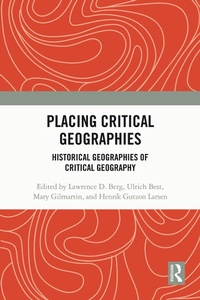
Placing Critical Geography
Historical Geographies of Critical Geography
1st Edition
Published on 29. November 2021
342 pages
978-1-317-08044-2 (ISBN)
Description

This book explores the multiple histories of critical geography as it developed in 14 different locations around the globe, whilst bringing together a range of approaches in critical geography.
It is the first attempt to provide a comprehensive account of a wide variety of historical geographies of critical geography from around the world. Accordingly, the chapters provide accounts of the development of critical approaches in geography from beyond the hegemonic Anglo-American metropoles. Bringing together geographers from a wide range of regional and intellectual milieus, this volume provides a critical overview that is international and illustrates the interactions (or lack thereof) between different critical geographers, working across a range of spaces. The chapters provide a more nuanced history of critical geography, suggesting that while there were sometimes strong connections with Anglo-American critical geography, there were also deeply independent developments that were part of the construction of very different kinds of critical geography in different parts of the world.
Placing Critical Geographies provides an excellent companion to existing histories of critical geography and will be important reading for researchers as well as undergraduate and graduate students of the history and philosophy of geography.
It is the first attempt to provide a comprehensive account of a wide variety of historical geographies of critical geography from around the world. Accordingly, the chapters provide accounts of the development of critical approaches in geography from beyond the hegemonic Anglo-American metropoles. Bringing together geographers from a wide range of regional and intellectual milieus, this volume provides a critical overview that is international and illustrates the interactions (or lack thereof) between different critical geographers, working across a range of spaces. The chapters provide a more nuanced history of critical geography, suggesting that while there were sometimes strong connections with Anglo-American critical geography, there were also deeply independent developments that were part of the construction of very different kinds of critical geography in different parts of the world.
Placing Critical Geographies provides an excellent companion to existing histories of critical geography and will be important reading for researchers as well as undergraduate and graduate students of the history and philosophy of geography.
More details
Edition
1. Auflage
Language
English
Place of publication
London
United Kingdom
Publishing group
Taylor & Francis Ltd
Target group
College/higher education
Illustrations
2 Tables, black and white; 1 Line drawings, black and white; 2 Halftones, black and white; 3 Illustrations, black and white
ISBN-13
978-1-317-08044-2 (9781317080442)
Copyright in bibliographic data and cover images is held by Nielsen Book Services Limited or by the publishers or by their respective licensors: all rights reserved.
Schweitzer Classification
Other editions
Additional editions
Lawrence D. Berg | Ulrich Best | Mary Gilmartin
Placing Critical Geography
Historical Geographies of Critical Geography
Book
11/2021
1st Edition
Routledge
€207.10
Shipment within 10-20 days
Lawrence D. Berg | Ulrich Best | Mary Gilmartin
Placing Critical Geography
Historical Geographies of Critical Geography
Book
11/2021
1st Edition
Routledge
€66.00
Shipment within 10-20 days
Persons
Lawrence D. Berg is Professor of Critical Geography at the University of British Columbia in Canada. His research focuses on neoliberalism and the cultural politics of academic knowledge production He is co-founder of ACME: An International Journal for Critical Geographies.
Ulrich Best is based at a federal research institute in Germany, where he works on labour conditions and workers' health and safety. He has published on borders, migration, urban exclusion and racism and on the history of critical geography in Germany.
Mary Gilmartin is a Professor in the Department of Geography at Maynooth University, Ireland. Her research focusses on contemporary migration and mobilities.
Henrik Gutzon Larsen teaches Human Geography at Lund University. His research addresses urban geography and housing, political geography and history of geographical thought.
Ulrich Best is based at a federal research institute in Germany, where he works on labour conditions and workers' health and safety. He has published on borders, migration, urban exclusion and racism and on the history of critical geography in Germany.
Mary Gilmartin is a Professor in the Department of Geography at Maynooth University, Ireland. Her research focusses on contemporary migration and mobilities.
Henrik Gutzon Larsen teaches Human Geography at Lund University. His research addresses urban geography and housing, political geography and history of geographical thought.
Content
1. Introduction: Placing Critical Geographies. 2. The Evolution of Palestinian Critical Geography in Palestine and Beyond. 3. Social Change and the (Re)radicalization of Geography in South Africa. 4. USA and Anglo-Canada. 5. Latin American Critical Geographies. 6. Critical Geographies in Japan: A Diverse History of Critical Inquiry. 7. Chinese Critical Geography: a Non-dualistic, Co-relativity informed Spatial Story. 8. Francophone Critical Geography. 9. Better Late than Never? Critical Geography in German-speaking Countries. 10. Presence and Absence: Ireland and Critical Geographies. 11. Italian Critical Geographies: a Historical Perspective. 12. Moments of Renewal: Critical Conversions of Nordic samhaellsgeografi. 13. Critical Approaches and the Practice of Geography in Spain. 14. The United Kingdom. 15. Placing Critical Geographies: Australia and Aotearoa New Zealand.
