

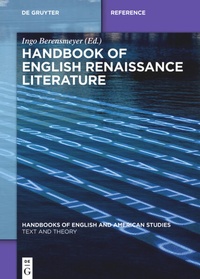
Handbook of English Renaissance Literature
Description

This handbook of English Renaissance literature serves as a reference for both students and scholars, introducing recent debates and developments in early modern studies. Using new theoretical perspectives and methodological tools, the volume offers exemplary close readings of canonical and less well-known texts from all significant genres between c. 1480 and 1660. Its systematic chapters address questions about editing Renaissance texts, the role of translation, theatre and drama, life-writing, science, travel and migration, and women as writers, readers and patrons. The book will be of particular interest to those wishing to expand their knowledge of the early modern period beyond Shakespeare.
More details
Other editions
Additional editions
Person
Ingo Berensmeyer , Ludwig-Maximilians-University Munich, Germany.
Content
- Intro
- Editors' Preface
- Contents
- Introduction
- Part I: Systematic Questions
- 1. Editing English Renaissance Texts
- 2. Forms of Translation
- 3. New Ways of Worldmaking: English Renaissance Literature as 'Early Modern'
- 4. Theatre and Drama
- 5. Life-Writing: Encountering Selves
- 6. England and its Others
- 7. Literature and Religion in Early Modern England
- 8. Renaissance Englishwomen as Writers, Readers, and Patrons
- 9. Rhetoric and Literary Theory
- Part II: Close Readings
- 10. John Skelton, The Bowge of Courte (1499?)
- 11. Thomas More, Utopia (1516/1551)
- 12. William Baldwin, Beware the Cat (1553/1570)
- 13. Richard Tottel, Songes and Sonettes (1557)
- 14. John Lyly, Euphues (1578/1580)
- 15. Philip Sidney, The Two Arcadias (1577-1584)
- 16. Thomas Kyd, The Spanish Tragedy (c. 1587)
- 17. Edmund Spenser, The Faerie Queene (1590/1596)
- 18. Christopher Marlowe, Doctor Faustus (c. 1588-1592)
- 19. Thomas Nashe, The Unfortunate Traveller (1594)
- 20. William Shakespeare, Richard II (1595)
- 21. Francis Bacon, Essays (1597-1625)
- 22. Shakespeare's Sonnets (1609)
- 23. Ben Jonson, The Alchemist (1610)
- 24. Aemilia Lanyer, "The Description of Cooke-ham" (1611)
- 25. Robert Burton, The Anatomy of Melancholy (1621-1651)
- 26. John Ford, 'Tis Pity She's a Whore (c. 1632)
- 27. John Donne, Songs and Sonnets (1633)
- 28. Thomas Carew and Inigo Jones, Coelum Britannicum (1634)
- 29. Andrew Marvell, Upon Appleton House (1651)
- 30. Margaret Cavendish, Poems, and Fancies (1653)
- 31. William Davenant, The Siege of Rhodes (1656)
- 32. John Milton, Paradise Lost (1667/1674)
- Index of Names
- Index of Subjects
- List of Contributors
