

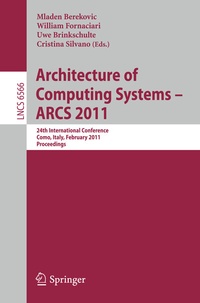
Architecture of Computing Systems - ARCS 2011
24th International Conference, Lake Como, Italy, February 24-25, 2011. Proceedings
Published on 14. February 2011
XIII, 271 pages
978-3-642-19137-4 (ISBN)
Description

This book constitutes the refereed proceedings of the 24th International Conference on Architecture of Computing Systems, ARCS 2011, held in Lake Como, Italy, in February 2011. The 22 revised full papers presented in seven technical sessions were carefully reviewed and selected from 62 submissions. The papers are organized in topical sections on customization and application specific accelerators; multi/many-core architectures; adaptive system architectures; processor architectures; memory architectures optimization; organic and autonomic computing; network-on-chip architectures.
More details
Other editions
Additional editions

Mladen Berekovic | William Fornaciari | Uwe Brinkschulte
Architecture of Computing Systems - ARCS 2011
24th International Conference, Lake Como, Italy, February 24-25, 2011. Proceedings
Book
02/2011
Springer
€53.49
Shipment within 5-7 days
Content
- Title
- Preface
- Organization
- Table of Contents
- Customization and Application Specific Accelerators
- A Code-Based Analytical Approach for Using Separate Device Coprocessors in Computing Systems
- Introduction
- Related Work
- Sample Application
- Combined Analysis
- General Concept
- Implementation
- General Result Interpretation
- Combined Analysis of the Sample Application
- Implementations
- FPGA-Based Implementation
- GPU-Based Implementation
- Conclusions
- References
- Scalability Evaluation of a Polymorphic Register File: A CG Case Study
- Introduction
- Background and Related Work
- Case Study Scenario
- Simulation Results and Analysis
- Conclusions
- References
- Experiences with String Matching on the Fermi Architecture
- Introduction
- Related Work
- CUDA GPUs
- Aho-Corasick
- Algorithm Implementation
- Experimental Evaluation
- Conclusions
- References
- Multi/Many-Core Architectures
- Using Amdahl's Law for Performance Analysis of Many-Core SoC Architectures Based on Functionally Asymmetric Processors
- Introduction
- Related Works
- Amdahl's Law and Functionally Asymmetric Many-Core Architecture
- Extensible Processor and Functionally Asymmetric Many-Core Architecture
- Combination of TLP and ILP
- Functional Asymmetric Architecture to Improve the Occupation Rate
- Constraints of the Theoretical Analysis
- Summary and Conclusion
- References
- Application-Aware Power Saving for Online Transaction Processing Using Dynamic Voltage and Frequency Scaling in a Multicore Environment
- Introduction
- Power Saving in Online Transaction Processing
- Online Transaction Processing
- Application-Aware Power Saving
- Application-Aware Dynamic Scaling for Online Transaction Processing
- Dynamic Voltage and Frequency Scaling
- Application-Aware Dynamic Frequency Scaling for Online Transaction Processing
- Experimental Environment and Basic Measurements
- Experimental Environment
- Basic Measurements
- Evaluation of Application-Aware Power Saving
- Synthetic Workload
- Real-World Workload
- Related Work
- Conclusion
- References
- Frameworks for Multi-core Architectures: A Comprehensive Evaluation Using 2D/3D Image Registration
- Introduction and Related Work
- 2D/3D Image Registration
- Application
- Parallelization Strategies
- Frameworks
- Framework Evaluation
- Usability Evaluation
- Performance Evaluation
- Overhead Estimation
- Conclusions
- References
- Adaptive System Architectures
- Emulating Transactional Memory on FPGA Multiprocessors
- Introduction
- Related Work
- Software Interface
- Architectures
- Master/Slave Architecture
- Distributed Architecture
- Experimental Evaluation
- Conclusion
- References
- Architecture of an Adaptive Test System Built on FPGAs
- Introduction
- Motivation
- System Architecture
- General Idea
- The Layer Concept
- Device Models
- Automation
- Main Hardware Components
- Implementation
- Test Scenario
- Processor, Communication Interface, and DUT Interface
- Automatic Generation Flow
- Results
- Conclusion and Future Work
- References
- An Extensible Framework for Context-Aware Smart Environments
- Introduction
- Related Work
- Framework Design
- Context Modelling
- Pipe-and-Filter Architecture
- Context Interpretation Rules
- Architecture Deployment Language
- Case Study - A Smart Classroom Scenario
- Conclusions
- References
- Processor Architectures
- Analysis of Execution Efficiency in the Microthreaded Processor UTLEON3
- Introduction
- UTLEON3 Processor Architecture
- Analysis
- Impact of the Pipelined Long-Latency Operations
- Impact of the Non-pipelined Long-Latency Operations
- Experimental Evaluation on the Microthreaded Processor
- Conclusions
- References
- A Dynamic Instruction Scratchpad Memory for Embedded Processors Managed by Hardware
- Introduction
- Related Work
- The Dynamic Instruction Scratchpad
- D-ISP Architecture
- D-ISP Implementation Details
- Evaluation of Performance Impact
- D-ISP Hardware Effort Estimation
- Conclusions
- References
- Exploring the Prefetcher/Memory Controller Design Space: An Opportunistic Prefetch Scheduling Strategy
- Introduction
- Related Work
- Prefetching
- Memory Controllers
- Prefetch Scheduling Strategies
- Opportunistic Prefetch Scheduling
- Methodology
- Results
- Performance
- Maximum Performance Regression
- Accuracy and Coverage
- Increasing DRAM Bandwidth
- Discussion
- Conclusion
- References
- Memory Architectures Optimisation
- Compiler-Assisted Selection of a Software Transactional Memory System
- Introduction
- Related Work
- Detection of Memory Access Patterns in Transactions
- Data Aggregation
- Analysis Phase
- Decision
- Evaluation
- Experimental Setup
- Test Cases
- STAMP Benchmarks
- Conclusion and Outlook
- References
- An Instruction to Accelerate Software Caches
- Introduction
- Multidimensional Software Cache
- MDSC Accelerator
- Experimental Methodology
- Experimental Results
- LookUp_SC
- GLCM Results
- MC Results
- Conclusions
- References
- Memory-, Bandwidth-, and Power-Aware Multi-core for a Graph Database Workload
- Introduction
- Clustered Multicore Architecture
- DEX Application
- Experimental Setup
- Experimental Results
- Memory Access Time
- Bandwidth
- Power Consumption
- Combined Analysis
- Related Work
- Conclusions
- References
- Organic and Autonomic Computing
- A Light-Weight Approach for Online State Classification of Self-organizing Parallel Systems
- Motivation
- Related Work
- Hierarchical, Distributed Monitoring-Infrastructure
- Low-Level Monitoring
- High-Level Monitoring
- Rule-Based State Evaluation and Classification
- Data Structures
- Rule Layout
- Online Learning Phase for Rule Creation
- State Evaluation and Classification
- Update of Rules at Runtime
- Evaluation / Results
- Initial Classification
- Overhead Evaluation
- Rule-Update at Runtime
- Optimization Example
- Conclusion and Outlook
- References
- Towards Organic Active Vision Systems for Visual Surveillance
- Introduction
- Related Work
- Architecture
- Networked System Architecture
- Active Vision Node Architecture
- The Multi-robot Routing Problem
- A Self-organizing Approach to the Multi-robot Routing Problem: ALMA
- Phase 1: Initial Assignment of Target Requests
- Phase 2: Conflict Resolving
- Experiments and Results
- Conclusion
- References
- Emergent Behaviour in Collaborative Indoor Localisation: An Example of Self-organisation in Ubiquitous Sensing Systems
- Introduction
- Experimental Evaluation
- Scenario Description
- Used Sensor Systems and Processing
- Experiment Results
- Simulation
- Scenario Description
- The Model
- Simulation Results
- Conclusion
- References
- Network-on-Chip Architectures
- An Improvement of Router Throughput for On-Chip Networks Using On-the-fly Virtual Channel Allocation
- Introduction
- Conventional On-Chip Router Architecture and Motivation
- Basic Design
- Motivation
- Proposed On-the-fly VC Allocation Architecture
- On-the-fly VC Allocation
- Operation of Packet Transfer
- Evaluation
- Implementation Results
- Latency and Throughput
- Conclusion
- References
- Energy-Optimized On-Chip Networks Using Reconfigurable Shortcut Paths
- Introduction
- The Proposed NoC
- Resource Partitioning Mechanism
- NoC Architecture
- The Reconfiguration Procedure
- Shortcut Reconfiguration Algorithm
- Experimental Results
- Synthetic Traffic Results
- SPLASH-II Results
- Conclusion
- References
- A Learning-Based Approach to the Automated Design of MPSoC Networks
- Introduction
- Goals and Contributions
- Motivating Example
- Overview
- Experimental System Architecture
- NoC Architecture
- Methodology
- Extracting Performance Data
- Machine Learning Algorithm
- Benchmarks
- Results
- Related Work
- Conclusions and Future Work
- References
- Gateway Strategies for Embedding of Automotive CAN-Frames into Ethernet-Packets and Vice Versa
- Introduction
- Related Work
- Transformation Concept
- Variant 0: Reference Design
- Variant 1: Buffered Approach
- Variant 2: Timed Approach
- Variant 3: Urgency Approach
- Test Setup
- Experimental Results
- End-to-End Latency
- Ethernet/IP Bandwidth
- Resource Utilization
- Vehicle Network Configuration
- Conclusion
- References
- Author Index
