

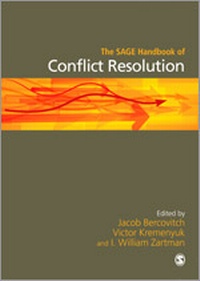
The SAGE Handbook of Conflict Resolution
1st Edition
Published on 3. December 2008
704 pages
978-1-4462-0659-1 (ISBN)
Description

'The SAGE Handbook of Conflict Resolution demonstrates the range of themes that constitute modern conflict resolution. It brings out its key issues, methods and dilemmas through original contributions by leading scholars in a dynamic and expanding field of inquiry. This handbook is exactly what it sets out to be: an indispensable tool for teaching, research and practice in conflict resolution' - Peter Wallensteen, Professor of Peace and Conflict Research, Uppsala University and University of Notre Dame
'Bercovitch, Kremenyuk and Zartman are among the most important figures in the conflict resolution field. They have pieced together, with the help of more than 35 colleagues from numerous countries, a state-of-the-art review of the sources of international conflict, available methods of conflict management, and the most difficult challenges facing the individuals and organizations trying to guide us through these conflict-ridden times. The collection is brimming with penetrating insights, trenchant analyses, compelling cases, and disciplined speculation. They help us understand both the promise of as well as the obstacles to theory-building in the new field of conflict resolution' - Lawrence Susskind, Professor and Director of the MIT - Harvard Public Disputes Program
'The last three sentences of this persuasive book: "We conclude this volume more than ever convinced that conflict resolution is not just possible or desirable in the current international environment. It is absolutely necessary. Resolving conflicts and making peace is no longer an option; it is an intellectual and practical skill that we must all posses." If you are part of that "we," intellectually or professionally, you will find this book a superb companion' - Thomas C Schelling, Professor Emeritus, Harvard University and University of Maryland
Conflict resolution is one of the fastest-growing academic fields in the world today. Although it is a relatively young discipline, having emerged as a specialized field in the 1950's, it has rapidly grown into a self-contained, vibrant, interdisciplinary field. The SAGE Handbook of Conflict Resolution brings together all the conceptual, methodological and substantive elements of conflict resolution into one volume of over 35 specially commissioned chapters. The Handbook is designed to reflect where the field is today by drawing on the contributions of experts from different fields presenting, in a systematic way, the most recent research and practice.
Jacob Bercovitch is Professor of International Relations, and Fellow of the Royal Society, at the University of Canterbury in Christchurch, New Zealand.
Victor Kremenyuk is deputy director of the Institute for USA and Canada Studies, Russian Academy of Sciences, Moscow. He is also a research associate at IIASA.
I. William Zartman is Jacob Blaustein Professor of Conflict Resolution and International Organization at the Nitze School of Advanced International Studies of Johns Hopkins University
'Bercovitch, Kremenyuk and Zartman are among the most important figures in the conflict resolution field. They have pieced together, with the help of more than 35 colleagues from numerous countries, a state-of-the-art review of the sources of international conflict, available methods of conflict management, and the most difficult challenges facing the individuals and organizations trying to guide us through these conflict-ridden times. The collection is brimming with penetrating insights, trenchant analyses, compelling cases, and disciplined speculation. They help us understand both the promise of as well as the obstacles to theory-building in the new field of conflict resolution' - Lawrence Susskind, Professor and Director of the MIT - Harvard Public Disputes Program
'The last three sentences of this persuasive book: "We conclude this volume more than ever convinced that conflict resolution is not just possible or desirable in the current international environment. It is absolutely necessary. Resolving conflicts and making peace is no longer an option; it is an intellectual and practical skill that we must all posses." If you are part of that "we," intellectually or professionally, you will find this book a superb companion' - Thomas C Schelling, Professor Emeritus, Harvard University and University of Maryland
Conflict resolution is one of the fastest-growing academic fields in the world today. Although it is a relatively young discipline, having emerged as a specialized field in the 1950's, it has rapidly grown into a self-contained, vibrant, interdisciplinary field. The SAGE Handbook of Conflict Resolution brings together all the conceptual, methodological and substantive elements of conflict resolution into one volume of over 35 specially commissioned chapters. The Handbook is designed to reflect where the field is today by drawing on the contributions of experts from different fields presenting, in a systematic way, the most recent research and practice.
Jacob Bercovitch is Professor of International Relations, and Fellow of the Royal Society, at the University of Canterbury in Christchurch, New Zealand.
Victor Kremenyuk is deputy director of the Institute for USA and Canada Studies, Russian Academy of Sciences, Moscow. He is also a research associate at IIASA.
I. William Zartman is Jacob Blaustein Professor of Conflict Resolution and International Organization at the Nitze School of Advanced International Studies of Johns Hopkins University
Reviews / Votes
'The SAGE Handbook of Conflict Resolution demonstrates the range of themes that constitute modern conflict resolution. It brings out its key issues, methods and dilemmas through original contributions by leading scholars in a dynamic and expanding field of inquiry. This handbook is exactly what it sets out to be: an indispensable tool for teaching, research and practice in conflict resolution' - Peter Wallensteen, Professor of Peace and Conflict Research, Uppsala University and University of Notre Dame'Bercovitch, Kremenyuk and Zartman are among the most important figures in the conflict resolution field. They have pieced together, with the help of more than 35 colleagues from numerous countries, a state-of-the-art review of the sources of international conflict, available methods of conflict management, and the most difficult challenges facing the individuals and organizations trying to guide us through these conflict-ridden times. The collection is brimming with penetrating insights, trenchant analyses, compelling cases, and disciplined speculation. They help us understand both the promise of as well as the obstacles to theory-building in the new field of conflict resolution' - Lawrence Susskind, Professor and Director of the MIT-Harvard Public Disputes Program
'The last three sentences of this persuasive book: "We conclude this volume more than ever convinced that conflict resolution is not just possible or desirable in the current international environment. It is absolutely necessary. Resolving conflicts and making peace is no longer an option; it is an intellectual and practical skill that we must all posses." If you are part of that "we," intellectually or professionally, you will find this book a superb companion' - Thomas C. Schelling, Professor Emeritus, Harvard University and University of Maryland
All prices
More details
Language
English
Place of publication
London
United Kingdom
Target group
Professional and scholarly
ISBN-13
978-1-4462-0659-1 (9781446206591)
Copyright in bibliographic data and cover images is held by Nielsen Book Services Limited or by the publishers or by their respective licensors: all rights reserved.
Schweitzer Classification
Other editions
Additional editions
Jacob Bercovitch | Victor Kremenyuk | I. William Zartman
The SAGE Handbook of Conflict Resolution
Book
12/2008
1st Edition
SAGE Publications Inc
€201.00
Shipment within 10-20 days
Persons
Jacob Bercovitch is professor of international relations and Head of the School of Politics at the University of Canterbury in Christchurch, New Zealand. He was a senior fellow at the U.S. Institute of Peace in 2001-2002 and is widely regarded as one of the leading scholars in the field of international conflict management.
Content
Introduction: The Nature of Conflict and Conflict Resolution - Jacob Bercovitch, Victor Kremenyuk and I William Zartman
PART I: History and Methods of Study
The Evolution of Conflict Resolution - Louis Kriesberg
Diplomacy and Conflict Resolution - Christer Joensson and Karin Aggestam
Conflict Resolution in the International System: A quantitative approach - J. David Singer and Shahryar Minhas
Case Studies and Conflict Resolution - Jack S. Levy
Game Theory as an Approach to Conflict Resolution - Rudolf Avenhaus
Experimental Research on Social Conflict - Dean G. Pruitt
Doing Conflict Research Through a Multi-Method Lens - Daniel Druckman
Problem Solving Approaches - Tamra Pearson d'Estree
Constructivism and Conflict Resolution - Richard Jackson
PART II: Issues and Sources of Conflict
Territory as a Source of Conflict and a Road to Peace - John A. Vasquez and Brandon Valeriano
Economic and Resources Causes of Conflicts - Philippe Le Billon
Resolving Ecological Conflicts: Typical and special circumstances - Gunnar Sjoested
Ethnicity, Negotiation and Conflict Management - Donald Rothchild
Ethno-Religious Conflicts: Exploring the role of religion in conflict resolution - S. Ayse Kadayifci-Orellana
PART III: Methods of Managing Conflict
Conflict Prevention: Theory in pursuit of policy and practice - Michael Lund
Conflict Resolution and Negotiation - I. William Zartman
Mediation and Conflict Resolution - Jacob Bercovitch
The Settlement of International Disputes by Legal Means - Arbitration and Judicial Settlement - Franz Cede
Dialogue as a Process for Transforming Relationships - Harold H. Saunders
NGOs and Conflict Resolution - Andrea Bartoli
United Nations Mediation Experience: Practical lessons for conflict resolution - Connie Peck
PART IV: Current Features and Dilemmas in the Study of Conflict Resolution
Terrorism and Conflict Resolution - William A. Donohue
Media and Conflict Resolution - Eytan Gilboa
Democracy and Conflict Resolution - David Kinsella and David L Rousseau
Why Mediation Matters: Ending intractable conflicts - Chester A. Crocker, Fen Osler Hampson and Pamela Aall
Culture and Conflict Resolution - Guy Olivier Faure
Peacekeeping and Beyond - Paul F. Diehl
Reconciliation as a Peace-Building Process: Scope and limits - Valerie Rosoux
Assessing Outcomes: Conflict management and the durability of peace - Scott Sigmund Gartner and Molly M Melin
Peace versus Justice - and Beyond - Cecilia Albin
The Spread of Civil War - Kristian Skrede Gleditsch
Conflict Resolution and Human Rights: The state of the art - Eileen F. Babbitt
Resolution of Military Conflicts and Confrontations (Force and Arms Control) - Victor Kremenyuk
Training and Education - Paul Meerts
Conclusion: Emerging Problems in Theory and Practice - Jacob Bercovitch, Victor Kremenyuk and I. William Zartman
PART I: History and Methods of Study
The Evolution of Conflict Resolution - Louis Kriesberg
Diplomacy and Conflict Resolution - Christer Joensson and Karin Aggestam
Conflict Resolution in the International System: A quantitative approach - J. David Singer and Shahryar Minhas
Case Studies and Conflict Resolution - Jack S. Levy
Game Theory as an Approach to Conflict Resolution - Rudolf Avenhaus
Experimental Research on Social Conflict - Dean G. Pruitt
Doing Conflict Research Through a Multi-Method Lens - Daniel Druckman
Problem Solving Approaches - Tamra Pearson d'Estree
Constructivism and Conflict Resolution - Richard Jackson
PART II: Issues and Sources of Conflict
Territory as a Source of Conflict and a Road to Peace - John A. Vasquez and Brandon Valeriano
Economic and Resources Causes of Conflicts - Philippe Le Billon
Resolving Ecological Conflicts: Typical and special circumstances - Gunnar Sjoested
Ethnicity, Negotiation and Conflict Management - Donald Rothchild
Ethno-Religious Conflicts: Exploring the role of religion in conflict resolution - S. Ayse Kadayifci-Orellana
PART III: Methods of Managing Conflict
Conflict Prevention: Theory in pursuit of policy and practice - Michael Lund
Conflict Resolution and Negotiation - I. William Zartman
Mediation and Conflict Resolution - Jacob Bercovitch
The Settlement of International Disputes by Legal Means - Arbitration and Judicial Settlement - Franz Cede
Dialogue as a Process for Transforming Relationships - Harold H. Saunders
NGOs and Conflict Resolution - Andrea Bartoli
United Nations Mediation Experience: Practical lessons for conflict resolution - Connie Peck
PART IV: Current Features and Dilemmas in the Study of Conflict Resolution
Terrorism and Conflict Resolution - William A. Donohue
Media and Conflict Resolution - Eytan Gilboa
Democracy and Conflict Resolution - David Kinsella and David L Rousseau
Why Mediation Matters: Ending intractable conflicts - Chester A. Crocker, Fen Osler Hampson and Pamela Aall
Culture and Conflict Resolution - Guy Olivier Faure
Peacekeeping and Beyond - Paul F. Diehl
Reconciliation as a Peace-Building Process: Scope and limits - Valerie Rosoux
Assessing Outcomes: Conflict management and the durability of peace - Scott Sigmund Gartner and Molly M Melin
Peace versus Justice - and Beyond - Cecilia Albin
The Spread of Civil War - Kristian Skrede Gleditsch
Conflict Resolution and Human Rights: The state of the art - Eileen F. Babbitt
Resolution of Military Conflicts and Confrontations (Force and Arms Control) - Victor Kremenyuk
Training and Education - Paul Meerts
Conclusion: Emerging Problems in Theory and Practice - Jacob Bercovitch, Victor Kremenyuk and I. William Zartman
