

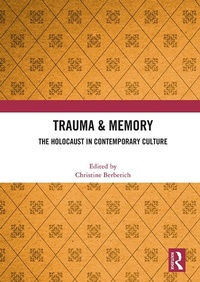
Trauma & Memory
The Holocaust in Contemporary Culture
1st Edition
Published on 30. March 2021
236 pages
978-1-000-36862-8 (ISBN)
Description

Over the past decades, the memory of the Holocaust has not only become a common cultural consciousness but also a cultural property shared by people all over the world. This collection brings together academics, critics and creative practitioners from the fields of Holocaust Studies, Literature, History, Media Studies, Creative Writing and German Studies to discuss contemporary trends in Holocaust commemoration and representation in literature, film, TV, the entertainment industry and social media.
The essays in this trans-disciplinary collection debate how contemporary culture engages with the legacy of the Holocaust now that, 75 years on from the end of the Second World War, the number of actual survivors is dwindling. It engages with ongoing cultural debates in Holocaust Studies that have seen a development from, largely, testimonial presentations of the Holocaust to more fictional narratives both in literature and film. In addition to a number of chapters focusing in particular on literary trends in Holocaust representation, the collection also assesses other forms of cultural production surrounding the Holocaust, ranging from recent official memorialisation in Germany to Holocaust presentation in film, computer games and social media. The collection also highlights the contributions by creative practitioners such as writers and performers who use drama and the traditional art of storytelling in order to keep memories alive and pass them on to new generations.
The chapters in this book were originally published as a special issue of Holocaust Studies: A Journal of Culture and History.
The essays in this trans-disciplinary collection debate how contemporary culture engages with the legacy of the Holocaust now that, 75 years on from the end of the Second World War, the number of actual survivors is dwindling. It engages with ongoing cultural debates in Holocaust Studies that have seen a development from, largely, testimonial presentations of the Holocaust to more fictional narratives both in literature and film. In addition to a number of chapters focusing in particular on literary trends in Holocaust representation, the collection also assesses other forms of cultural production surrounding the Holocaust, ranging from recent official memorialisation in Germany to Holocaust presentation in film, computer games and social media. The collection also highlights the contributions by creative practitioners such as writers and performers who use drama and the traditional art of storytelling in order to keep memories alive and pass them on to new generations.
The chapters in this book were originally published as a special issue of Holocaust Studies: A Journal of Culture and History.
More details
Edition
1. Auflage
Language
English
Place of publication
London
United Kingdom
Publishing group
Taylor & Francis Ltd
Target group
College/higher education
ISBN-13
978-1-000-36862-8 (9781000368628)
Copyright in bibliographic data and cover images is held by Nielsen Book Services Limited or by the publishers or by their respective licensors: all rights reserved.
Schweitzer Classification
Other editions
Additional editions
Book
09/2023
1st Edition
Routledge
€52.07
Shipment within 15-20 days
Book
03/2021
1st Edition
Routledge
€192.21
Shipment within 15-20 days
Person
Christine Berberich is Reader in Literature at the University of Portsmouth, UK. She has published widely in the field of national identity construction, especially Englishness, and in twentieth-century and contemporary literature. She is the author of The Image of the English Gentleman in Twentieth-Century Literature: Englishness & Nostalgia (2007), co-editor of These Englands: Conversations on National Identity (2011), Land & Identity: Theory, Memory, Practice (2012) and Affective Landscapes in Literature, Art & Everyday Life (2015), and editor of The Bloomsbury Introduction to Popular Fiction (2014). She is currently editing a collection on Brexit and the migrant experience, entitled Brexit and the Migrant Voice, as well as writing a monograph tentatively entitled Nazi Noir and a public interest book on P.G. Wodehouse and the Nazi Internment Camp at Tost.
Content
Part I: Introduction
Introduction: the Holocaust in Contemporary Culture
Christine Berberich
1. 'To tell the story': cultural trauma and holocaust metanarrative
Anna Clare Hunter
Part II: New Trends in Holocaust Fiction
2. No laughing matter: humor and the Holocaust in Woody Allen, Shalom Auslander, and Howard Jacobson
Christopher Madden
3. From silence to testimony: performing trauma and postmemory in Jonathan Safran Foer's Everything is Illuminated
Audrey Bardizbanian
4. Whose trauma is it? A trauma-theoretical reading of The Book Thief by Marcus Zusak
Zuzana Burakova
5. 'I think I'm beginning to understand. What I'm writing is an infranovel': Laurent Binet, HHhH and the problem of 'writing
history'
Christine Berberich
6. 'Beyond words': representing the 'Holocaust by bullets'
Sue Vice
7. Still struggling with German history: W.G. Sebald, Gunter Demnig and activist memory workers in Berlin today
Kirsten Grimstad
Part III: The Holocaust in Contemporary Culture
8. Remembering the 'unwanted' victims: initiatives to memorialize the National Socialist euthanasia program in Germany
Caroline Pearce
9. Figuring the Grey Zone: the Auschwitz Sonderkommando in contemporary culture
Dominic Williams
10. Instagram and Auschwitz: a critical assessment of the impact social media has on Holocaust representation
Gemma Commane and Rebekah Potton
11. Encountering Auschwitz: touring the Auschwitz-Birkenau State Museum
Claire Griffiths
Afterword: Conclusion
Christine Berberich
Introduction: the Holocaust in Contemporary Culture
Christine Berberich
1. 'To tell the story': cultural trauma and holocaust metanarrative
Anna Clare Hunter
Part II: New Trends in Holocaust Fiction
2. No laughing matter: humor and the Holocaust in Woody Allen, Shalom Auslander, and Howard Jacobson
Christopher Madden
3. From silence to testimony: performing trauma and postmemory in Jonathan Safran Foer's Everything is Illuminated
Audrey Bardizbanian
4. Whose trauma is it? A trauma-theoretical reading of The Book Thief by Marcus Zusak
Zuzana Burakova
5. 'I think I'm beginning to understand. What I'm writing is an infranovel': Laurent Binet, HHhH and the problem of 'writing
history'
Christine Berberich
6. 'Beyond words': representing the 'Holocaust by bullets'
Sue Vice
7. Still struggling with German history: W.G. Sebald, Gunter Demnig and activist memory workers in Berlin today
Kirsten Grimstad
Part III: The Holocaust in Contemporary Culture
8. Remembering the 'unwanted' victims: initiatives to memorialize the National Socialist euthanasia program in Germany
Caroline Pearce
9. Figuring the Grey Zone: the Auschwitz Sonderkommando in contemporary culture
Dominic Williams
10. Instagram and Auschwitz: a critical assessment of the impact social media has on Holocaust representation
Gemma Commane and Rebekah Potton
11. Encountering Auschwitz: touring the Auschwitz-Birkenau State Museum
Claire Griffiths
Afterword: Conclusion
Christine Berberich
