

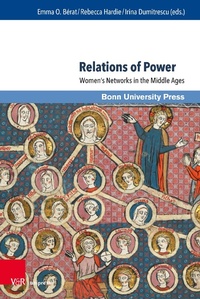
Relations of Power
Women's Networks in the Middle Ages
1st Edition
Published on 18. January 2021
199 pages
978-3-8470-1242-9 (ISBN)
Description

Women's networks - their relations with other women, men, objects and place - were a source of power in various European and neighbouring regions throughout the Middle Ages. This interdisciplinary volume considers how women's networks, and particularly women's direct and indirect relationships to other women, constituted and shaped power from roughly 300 to 1700 AD. The essays in this collection juxtapose scholarship from the fields of archaeology, art history, literature, history and religious studies, drawing on a wide variety of source types. Their aim is to highlight not only the importance of networks in understanding medieval women's power but also the different ways these networks are represented in medieval sources and can be approached today. This volume reveals how women's networks were widespread and instrumental in shaping political, familial and spiritual legacies.
More details
Other editions
Additional editions
Emma O. Bérat | Rebecca Hardie | Irina Dumitrescu
Relations of Power
Women's Networks in the Middle Ages
Book
01/2021
1st Edition
Brill Deutschland
€45.00
Shipment within 7-9 days
Persons
Dr Emma O. Bérat is a former post-doctoral research fellow in the SFB 1167 "Macht und Herrschaft" at the University of Bonn and an independent scholar.
Content
- Intro
- Title Page
- Copyright
- Table of Contents
- Body
- Series Editors' Preface
- Emma O. Bérat / Rebecca Hardie: Introduction
- Bibliography
- Julia Hillner / Máirín MacCarron: Female Networks and Exiled Bishops between Late Antiquity and the Early Middle Ages: The Cases of Liberius of Rome and Wilfrid of York
- 1. Women, Networks and the Return of Liberius of Rome
- 2. Presences and Absences of Women in Wilfrid of York's Network
- 3. Conclusions
- Bibliography
- Sources
- Secondary literature
- Lucy K. Pick: Networking Power and Gender at Court: An Eleventh-Century Diploma and 'Las Meninas'
- 1. Social Networks and Medieval Documents
- 2. Urraca Fernández's Diploma for Túy
- 3. Las Meninas
- Bibliography
- Sources
- Secondary literature
- Jitske Jasperse: With This Ring: Forming Plantagenet Family Ties
- 1. Introduction
- 2. Rings: Status, Senses and Animated Stones
- 3. Eleanor of Aquitaine: Friendship and Beyond
- 4. Heirs and Heirlooms
- 5. The Personal is Political: Family Ties and Political Allies
- 6. Conclusion: Material Items Shaping Ties
- Bibliography
- Sources
- Secondary literature
- Abigail S. Armstrong: English Royal Family Ties: Edward I and his Breton Nieces
- 1. Marie: A Courtly Education
- 2. Eleanor: The Religious Life
- 3. Peace-weavers and Intermediaries?
- 4. Married to the Enemy
- 5. Indifferent and Unbending
- 6. Conclusion: Political and Affective Ties
- Bibliography
- Sources
- Secondary literature
- Mercedes Pérez Vidal: Female Aristocratic Networks: Books, Liturgy and Reform in Castilian Nunneries
- 1. Introduction
- 2. New Sources, New Perspectives: Liturgical Books and Luxury Items
- 3. Sub Regularis Observantia: Circulation of Observant Ideals through Books and Artefacts
- 4. Conclusion
- Bibliography
- Sources
- Secondary literature
- Stephanie Hollis: Dynastic Visions: Founder Abbesses of Wilton and Barking and their Eleventh-Century Successors
- 1. Introduction
- 2. Contextual Background
- 3. The Visions of St Edith of Wilton
- 4. The Vision of St Wulfhild of Barking
- 5. Alfgifu of Barking's Visions of St Ethelburg
- 6. Conclusion
- Bibliography
- Sources
- Secondary literature
- Alyssa Gabbay: Mothers, Liver-Eaters and Matrilineal Descent: Hind bint 'Utba, Mu'awiya and Nasab (Filiation) in Early Islam
- Bibliography
- Sources
- Secondary literature
- Karen Dempsey: Herstory: Exploring the Material Life of Gundrada de Warenne
- 1. Introduction
- 2. Who was Gundrada de Warenne?
- 3. A Home from Home? Castle Acre in Context
- 4. Creating Connections: From Caen to Cluny and Castle Acre
- 5. The Curious Case of Gundrada's Tomb Slab: Memory, Materiality and Marriages
- 6. Fashion and Politics: Who Wears Castles in their Hair?
- 7. 'Binding' Books: The Crowland Psalter
- 8. Senses of the Past: Protective Charms and Anxieties of Childbirth
- 9. Material Lives
- Acknowledgements
- Bibliography
- Sources
- Secondary literature
- List of Contributors
