

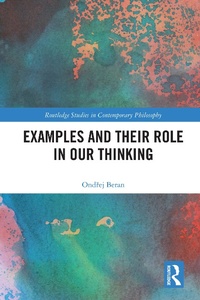
Examples and Their Role in Our Thinking
1st Edition
Published on 4. March 2021
208 pages
978-1-000-35201-6 (ISBN)
Description

This book investigates the role and significance that examples play in shaping arguments and thought, both in philosophy and in everyday life. It addresses questions about how our moral thinking is informed by our conceptual practices, especially in ways related to the relationship between ethics and literature, post-Wittgensteinian ethics, or meta-philosophical concerns about the style of philosophical writing.
Written in an accessible and non-technical style, the book uses examples from real-life events or pieces of well-known fictional stories to introduce its discussions. In doing so, it demonstrates the complex way examples, rather than exemplifying philosophical points, inform and condition how we approach the points for which we want to argue. The author shows how examples guide or block our understanding in certain directions, how they do this by stressing morally relevant aspects or dimensions of the terms, and how the sense of moral seriousness allows us to learn from examples. The final chapter explores whether these kinds of engagement with examples can be understood as "thinking primarily through examples."
Examples and Their Role in Our Thinking will be of interest to scholars and graduate students working in ethics and moral philosophy, philosophy of language, and philosophy of literature.
Written in an accessible and non-technical style, the book uses examples from real-life events or pieces of well-known fictional stories to introduce its discussions. In doing so, it demonstrates the complex way examples, rather than exemplifying philosophical points, inform and condition how we approach the points for which we want to argue. The author shows how examples guide or block our understanding in certain directions, how they do this by stressing morally relevant aspects or dimensions of the terms, and how the sense of moral seriousness allows us to learn from examples. The final chapter explores whether these kinds of engagement with examples can be understood as "thinking primarily through examples."
Examples and Their Role in Our Thinking will be of interest to scholars and graduate students working in ethics and moral philosophy, philosophy of language, and philosophy of literature.
Reviews / Votes
"Beran's book is the most detailed philosophical study of examples with which I am familiar . . . Everyone interested in the role of examples in philosophy will benefit from his lively study." - Robert B. Louden, Distinguished Professor of Philosophy, University of Southern Maine, USAMore details
Series
Edition
1. Auflage
Language
English
Place of publication
London
United Kingdom
Publishing group
Taylor & Francis Ltd
Target group
College/higher education
Illustrations
8 Halftones, black and white
ISBN-13
978-1-000-35201-6 (9781000352016)
Copyright in bibliographic data and cover images is held by Nielsen Book Services Limited or by the publishers or by their respective licensors: all rights reserved.
Schweitzer Classification
Other editions
Additional editions
Ondrej Beran
Examples and Their Role in Our Thinking
Book
05/2023
1st Edition
Routledge
€63.00
Shipment within 15-20 days
Ondrej Beran
Examples and Their Role in Our Thinking
Book
03/2021
1st Edition
Routledge
€206.20
Shipment within 15-20 days
Person
Ondrej Beran is a researcher at the Centre for Ethics as Study in Human Value (University of Pardubice). His recent publications include Living with Rules (2018) and From Rules to Meanings (Routledge 2018, co-edited with V. Kolman and L. Koren).
Content
1. Introduction: Why Examples
2. Examples and Understanding
3. The Moral Bearing of Examples
4. Examples and Learning
5. Conclusion: Thinking Through Examples?
2. Examples and Understanding
3. The Moral Bearing of Examples
4. Examples and Learning
5. Conclusion: Thinking Through Examples?
