

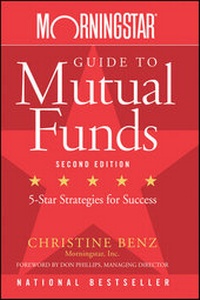
Morningstar Guide to Mutual Funds
Five-Star Strategies for Success
2nd Edition
Published on 10. March 2011
304 pages
978-1-118-04614-2 (ISBN)
Description

GUIDE TO MUTUAL FUNDS
SECOND EDITION
"Picking actively managed mutual funds is no mean challenge. And asthe recent era underscores, past performance is of little help. TheMorningstar Guide to Mutual Funds helps cut through the fog with asolid volume of constructive information. The centralmessage--'truly diversify, keep it simple, focus on costs, andstick with it'--is not only timeless, it is priceless."
--John C. Bogle, founder and former CEO, The Vanguard Group
"Successful investors know they must do their own due diligence.Morningstar has done much of that homework in this guide. Leave itto Morningstar to get it right, offering smart ways to pick, buildand monitor a portfolio. It's a commonsense guide that should graceevery investor's shelf."
--Ted David, CNBC Anchor
"There's nothing Morningstar doesn't know about mutual funds. Andat last, for ready reference, there's a book. You'll findeverything here you need to know about managing fund investments,inside or outside a 401(k)."
--Jane Bryant Quinn, Newsweek columnist and author of Making theMost of Your Money
More details
Other editions
Additional editions
Book
11/2007
2nd Edition
Wiley
€21.00
Shipment within 10-20 days
Book
09/2005
2nd Edition
Wiley
€19.83
Article exhausted; check different version
Person
Christine Benz is Director of Mutual Fund Analysis atMorningstar, where she manages a staff of thirty-five mutual fundanalysts. Previously, she was the editor of Morningstar®FundInvestor, a monthly newsletter, as well as Morningstar®Funds 500, an annual publication covering 500 top mutual funds.
Morningstar, Inc., is a leading provider of investment researchin the United States and in major international markets. Thecompany offers an extensive line of Internet, software, andprint-based products and services for individuals, financialadvisors, and institutional clients. Morningstar provides data onmore than 125,000 investment offerings, including stocks, mutualfunds, ETFs, closed-end funds, and much more. The company hasoperations in sixteen countries.
Content
Foreword.
Acknowledgements.
Introduction.
Part One: How to Pick Mutual Funds.
Chapter 1. Know What Your Fund Owns.
Chapter 2. Put Performance in perspective.
Chapter 3. Understand the Risks.
Chapter 4. Get to Know Your Fund Manager.
Chapter 5. Keep a Lid on Costs.
Part Two: How to Find Ideas For Y our Portfolio.
Chapter 6. Find the Right Core Stock Funds for You.
Chapter 7. Move Beyond the Core: Using Specialized StockFunds.
Chapter 8. Find the Right Core Bond Fund for You.
Chapter 9. Move Beyond the Core: Using Specialized BondFunds.
Part Three: How to Build a Portfolio.
Chapter 10. Match Your Portfolio to Your Goals.
Chapter 11. Put Your Portfolio Plan into Action.
Chapter 12. Simplify Your Investment Life.
Chapter 13. Be Savvy When Seeking Advice.
Part Four: How to Monitor Your Portfolio.
Chapter 14. Schedule Regular Checkups.
Chapter 15. Know When to Sell.
Chapter 16. Keep a Cool Head in Turbulent Markets.
Part Five: More on Mutual Funds: Frequently AskedQuestions.
Recommended Reading.
Other Morningstar Resources.
Index.
1 Know What Your Fund Owns MOST OF US wouldn't buy a new home just because it looked good from the outside. We would do a thorough walk-through first. We'd examine the furnace, check for a leaky roof, and look for cracks in the foundation. Mutual fund investing requires the same careful investigation. You need to give a fund more than a surface-level once-over before investing in it. Knowing that the fund has been a good performer in the past isn't enough to warrant risking your money. You need to understand what's inside its portfolio-or how it invests. You must find out what a fund owns to know if it's right for you. The stocks and bonds in a fund's portfolio are so important that Morningstar analysts spend a lot of their time on the subject; news about what high-profile fund managers are buying is a constant source of e-mail chatter in the office. Our analysts examine fund portfolios of stocks or bonds, talk with the managers about their strategies in picking those holdings, and check on recent changes to the portfolio. Knowing what a fund owns helps you understand its past behavior, set realistic expectations for what it might do in the future, and figure out how it will work with the other investments you might own. At the most basic level, a fund can own stocks, bonds, cash (usually money market securities), or a combination of the three. (Funds might also own other securities, including other funds and stock/bond hybrid securities, but let's stick with the basics for now.) If it invests in stocks, it could focus on U.S. companies or venture abroad. If the fund owns U.S. companies, it might invest in giants such as General Electric or Microsoft or seek out tiny companies that most of us have never heard of. If a fund invests in bonds, it could focus only on those issued by companies with rock-solid finances and a high probability that they'll make good on their debts or it could venture into higher-yielding bonds issued by firms with shaky future prospects. How a manager chooses to invest your money has a big impact on performance. For example, if your manager devotes much of the portfolio to a single volatile area such as technology stocks, your fund may generate high returns at times, but there's also a greater likelihood that you'll lose money at other times. Stocks have historically generated higher returns than cash or bonds. Because you take the least risk when you invest in cash, those securities also tend to generate lower returns than you'd get with stocks or bonds. A fund's name doesn't always reveal what a fund owns because funds often have generic handles. Take the intriguingly named Janus Olympus and American Century Veedot funds. If you were to skim over only their names, you would be hard-pressed to glean that the former focuses on mid- and large-sized companies that are growing quickly (think Yahoo! and eBay), whereas the latter is a fund that uses computer models to help direct investments to whatever type of stocks look like they could be strong performers in the future. Nor will a fund's prospectus-a legal document filed with the Securities and Exchange Commission (SEC) that lays out the basics of an investment-necessarily be of much help in determining what a given fund is up to. While fund prospectuses do include information about who's running a fund and its basic investment parameters, prospectuses are typically written in very broad terms to give managers the latitude to invest as they see fit. In their prospectuses, funds are also required to state their objectives-a one- or two-word description of their basic goals, such as "Growth," "Equity-Income," "Growth & Income," and so on. You'd think these so-called prospectus objectives might help you sort out who's doing what, but in reality funds with the same prospectus objectives can be pursuing radically different investment approaches and end up with very different returns. For example, both Aegis Value Fund and AllianceBernstein Large Cap Growth have prospectus objectives of "Growth." But the former focuses on tiny, budget-priced stocks, whereas the Alliance fund focuses on fast-growing stocks of large companies. When the bear market struck between 2000 and 2002, the Aegis fund returned 18% annually, whereas the Alliance fund lost 26% over that stretch.
A desire to help investors choose funds based on what they really own-instead of on what funds call themselves, how they classify themselves, or how they've performed recently-was precisely what inspired Morningstar to develop its investment style box in the early 1990s. The style box provides a quick visual summary of a given fund's portfolio, showing you, using a nine-box investment-style grid, where most of your fund's portfolio is invested. (To check out a fund's current style box, go to Morningstar's Web site, www.morningstar.com, and type in a fund's name or ticker.) While investors needn't own a fund from each and every square of the style box, the tool can help you know whether your portfolio is diversified. If all of your funds are huddled in a single corner of the style box, that's a tip-off that you'll probably want to spread your bets around more. The style box also helps investors keep track of whether a fund has changed its approach, because we update each fund's style-box placement every time we receive a new portfolio. If a fund that you bought to bring your portfolio exposure to the fast-moving technology and telecom industries is suddenly delving into the securities of small manufacturing firms, you'll see that change reflected in your fund's style-box placement. For stock funds, the style box isolates two key factors that drive its performance: the size of the stocks the fund invests in and the type of companies it buys-rapidly growing companies for which investors are willing to pay a pretty penny, slower growers that trade at lower prices, or a combination of the two (see Figure 1.1). Those two factors-company size and investment style-form the two axes of the stock, or equity, style box. For bond funds, the style box focuses on the two key determinants of bond-fund behavior: a fund's sensitivity to changes in interest rates and the credit quality of the bonds in which it invests. Those two factors form the axes of the bond-fund style box (see Figure 1.2). Once we have determined the size and investment-style coordinates for a stock fund and the interest-rate sensitivity and credit-quality coordinates for a bond fund, we can use our nine-square style box grid to show investors-visually-where their fund lands. Figure 1.1 The Morningstar stock style box is a nine-square grid that provides a quick and clear picture of a stock fund's investment style.
To figure out which square of our stock style box a fund portfolio lands in, we first analyze each and every stock in that portfolio. We begin by grouping each stock in a portfolio into one of seven regions: the United States, Latin America, Canada, Europe, Japan, Asia ex-Japan, and Australia/New Zealand. Once we've placed a stock within one of our regional zones, we then go on to evaluate how it stacks up relative to other firms within that same zone. We start that process by determining whether a security is small, medium, or large within its region. In investing parlance, stock size is often called market capitalization, or market cap. Market cap sounds like a technical term, but it's not particularly hard to understand-essentially, it's the current dollar value of all of a given company's stock shares. So if a stock is selling for $30 and there are a million shares of it floating around in the market, the company has a market cap of $30 million. We consider companies whose market caps land within the largest 70% of their region to be large cap; the next 20% are midcap; and the smallest 10% are small caps. Although small-cap stocks only account for 10% of each region's market, there are actually many more of them than there are large-cap companies. Figure 1.2 The Morningstar bond style box is a nine-square grid that provides a quick and clear picture of a bond fund's investment style. Having determined a security's regional and size classification, we turn our attention to its investment style. Investing aficionados typically group stocks into one of two major buckets-growth stocks or value stocks-and often identify themselves as growth investors or value investors. Understanding the difference between the two styles is critical to understanding what makes a fund tick. Growth stocks typically enjoy strong growth in earnings or revenues because they've got a hot new product or service. Because the market expects good things from these fast growers, and earnings growth usually drives a higher share price, investors are willing to pay more for the shares than they will pay for slower growers. Value stocks, conversely, look like growth stocks' less successful cousins. These companies' earnings are usually growing slowly, if at all, and they often operate in industries that are prone to boom-and-bust cycles. So why does anyone bother with these underachievers? The answer is, because they're cheap. Fund managers who focus on value stocks are willing to put up with lackluster earnings growth because they think the market is being overly pessimistic about the company's future. Should things turn out better than the market thinks, the bargain-hunting fund stands to...
Understanding The Morningstar® Style BoxT
A desire to help investors choose funds based on what they really own-instead of on what funds call themselves, how they classify themselves, or how they've performed recently-was precisely what inspired Morningstar to develop its investment style box in the early 1990s. The style box provides a quick visual summary of a given fund's portfolio, showing you, using a nine-box investment-style grid, where most of your fund's portfolio is invested. (To check out a fund's current style box, go to Morningstar's Web site, www.morningstar.com, and type in a fund's name or ticker.) While investors needn't own a fund from each and every square of the style box, the tool can help you know whether your portfolio is diversified. If all of your funds are huddled in a single corner of the style box, that's a tip-off that you'll probably want to spread your bets around more. The style box also helps investors keep track of whether a fund has changed its approach, because we update each fund's style-box placement every time we receive a new portfolio. If a fund that you bought to bring your portfolio exposure to the fast-moving technology and telecom industries is suddenly delving into the securities of small manufacturing firms, you'll see that change reflected in your fund's style-box placement. For stock funds, the style box isolates two key factors that drive its performance: the size of the stocks the fund invests in and the type of companies it buys-rapidly growing companies for which investors are willing to pay a pretty penny, slower growers that trade at lower prices, or a combination of the two (see Figure 1.1). Those two factors-company size and investment style-form the two axes of the stock, or equity, style box. For bond funds, the style box focuses on the two key determinants of bond-fund behavior: a fund's sensitivity to changes in interest rates and the credit quality of the bonds in which it invests. Those two factors form the axes of the bond-fund style box (see Figure 1.2). Once we have determined the size and investment-style coordinates for a stock fund and the interest-rate sensitivity and credit-quality coordinates for a bond fund, we can use our nine-square style box grid to show investors-visually-where their fund lands. Figure 1.1 The Morningstar stock style box is a nine-square grid that provides a quick and clear picture of a stock fund's investment style.
Using the Stock-Fund Style Box
To figure out which square of our stock style box a fund portfolio lands in, we first analyze each and every stock in that portfolio. We begin by grouping each stock in a portfolio into one of seven regions: the United States, Latin America, Canada, Europe, Japan, Asia ex-Japan, and Australia/New Zealand. Once we've placed a stock within one of our regional zones, we then go on to evaluate how it stacks up relative to other firms within that same zone. We start that process by determining whether a security is small, medium, or large within its region. In investing parlance, stock size is often called market capitalization, or market cap. Market cap sounds like a technical term, but it's not particularly hard to understand-essentially, it's the current dollar value of all of a given company's stock shares. So if a stock is selling for $30 and there are a million shares of it floating around in the market, the company has a market cap of $30 million. We consider companies whose market caps land within the largest 70% of their region to be large cap; the next 20% are midcap; and the smallest 10% are small caps. Although small-cap stocks only account for 10% of each region's market, there are actually many more of them than there are large-cap companies. Figure 1.2 The Morningstar bond style box is a nine-square grid that provides a quick and clear picture of a bond fund's investment style. Having determined a security's regional and size classification, we turn our attention to its investment style. Investing aficionados typically group stocks into one of two major buckets-growth stocks or value stocks-and often identify themselves as growth investors or value investors. Understanding the difference between the two styles is critical to understanding what makes a fund tick. Growth stocks typically enjoy strong growth in earnings or revenues because they've got a hot new product or service. Because the market expects good things from these fast growers, and earnings growth usually drives a higher share price, investors are willing to pay more for the shares than they will pay for slower growers. Value stocks, conversely, look like growth stocks' less successful cousins. These companies' earnings are usually growing slowly, if at all, and they often operate in industries that are prone to boom-and-bust cycles. So why does anyone bother with these underachievers? The answer is, because they're cheap. Fund managers who focus on value stocks are willing to put up with lackluster earnings growth because they think the market is being overly pessimistic about the company's future. Should things turn out better than the market thinks, the bargain-hunting fund stands to...
