

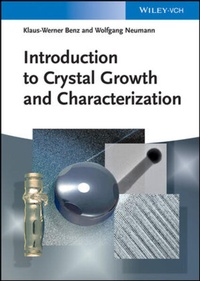
Introduction to Crystal Growth and Characterization
1st Edition
Published on 31. July 2014
438 pages
978-3-527-68436-6 (ISBN)
Description

This new textbook provides for the first time a comprehensive treatment of the basics of contemporary crystallography and crystal growth in a single volume. The reader will be familiarized with the concepts for the description of morphological and structural symmetry of crystals. The architecture of crystal structures of selected inorganic and molecular crystals is illustrated. The main crystallographic databases as data sources of crystal structures are described.
Nucleation processes, their kinetics and main growth mechanism will be introduced in fundamentals of crystal growth. Some phase diagrams in the solid and liquid phases in correlation with the segregation of dopants are treated on a macro- and microscale. Fluid dynamic aspects with different types of convection in melts and solutions are discussed. Various growth techniques for semiconducting materials in connection with the use of external field (magnetic fields and microgravity) are described.
Crystal characterization as the overall assessment of the grown crystal is treated in detail with respect to
- crystal defects
- crystal quality
- field of application
Introduction to Crystal Growth and Characterization is an ideal textbook written in a form readily accessible to undergraduate and graduate students of crystallography, physics, chemistry, materials science and engineering. It is also a valuable resource for all scientists concerned with crystal growth and materials engineering.
Nucleation processes, their kinetics and main growth mechanism will be introduced in fundamentals of crystal growth. Some phase diagrams in the solid and liquid phases in correlation with the segregation of dopants are treated on a macro- and microscale. Fluid dynamic aspects with different types of convection in melts and solutions are discussed. Various growth techniques for semiconducting materials in connection with the use of external field (magnetic fields and microgravity) are described.
Crystal characterization as the overall assessment of the grown crystal is treated in detail with respect to
- crystal defects
- crystal quality
- field of application
Introduction to Crystal Growth and Characterization is an ideal textbook written in a form readily accessible to undergraduate and graduate students of crystallography, physics, chemistry, materials science and engineering. It is also a valuable resource for all scientists concerned with crystal growth and materials engineering.
More details
Other editions
Additional editions
Klaus-Werner Benz | Wolfgang Neumann
Introduction to Crystal Growth and Characterization
Book
09/2014
1st Edition
Wiley-VCH
€119.00
Shipment within 5-7 days
Software
08/2014
Wiley-VCH
€150.27
No shipping information available
Persons
Professor Emeritus Klaus-Werner Benz was Head of the Crystallographic Institute of the University of Freiburg, Germany, and Director at the Freiburg Materials Research Center until September 2003. From 1999 on he served as Vice-President of the University of Freiburg for Communication Technologies and Science Transfer. He is a member of the International Academy of Astronautics and has authored more than 300 publications in the field of material science, crystal growth and characterization, semiconductor technology and fluid dynamics.
Wolfgang Neumann is Professor of Crystallography at the Institute of Physics of the Humboldt University of Berlin, Germany. He studied mineralogy in Berlin and obtained his Ph.D. and Habilitation degrees in Applied Physics from the Martin Luther University in Halle-Wittenberg. Since 1997, he is Editor-in-Chief of Crystal Research and Technology. He became Director of the International Centre of Advanced Materials and Electron Microscopy in 2001 and serves as Chairman of the German Society for Crystallography since 2006. His research interests focus on crystallography, materials science and electron microscopy. He performs structure investigations of nanostructured materials by means of analytical high-resolution electron microscopy.
Wolfgang Neumann (Editor-in-Chief) and Klaus W. Benz (Consulting Editor) have collaborated for many years as main scientific editors of the materials science journal "Crystal Research and Technology".
Wolfgang Neumann is Professor of Crystallography at the Institute of Physics of the Humboldt University of Berlin, Germany. He studied mineralogy in Berlin and obtained his Ph.D. and Habilitation degrees in Applied Physics from the Martin Luther University in Halle-Wittenberg. Since 1997, he is Editor-in-Chief of Crystal Research and Technology. He became Director of the International Centre of Advanced Materials and Electron Microscopy in 2001 and serves as Chairman of the German Society for Crystallography since 2006. His research interests focus on crystallography, materials science and electron microscopy. He performs structure investigations of nanostructured materials by means of analytical high-resolution electron microscopy.
Wolfgang Neumann (Editor-in-Chief) and Klaus W. Benz (Consulting Editor) have collaborated for many years as main scientific editors of the materials science journal "Crystal Research and Technology".
Content
Preface
FUNDAMENTALS OF CRYSTALLINE MATERIALS
Crystalline State
Fundamentals of Geometrical Crystallography
Morphological Symmetry of Crystals
Structural Symmetry
Crystal Structures
Crystallographic Databases and Crystallographic Computer Programs
BASICS OF GROWTH MECHANISM AND SOLIDIFICATION
Nucleation Processes
Kinetic Processes and Growth Mechanism
Phase Diagrams and Principles of Segregation
Principles of Flow Regimes in Growth Melts
GROWTH TECHNIQUES IN CORRELATION WITH RELATED GROWTH MECHANISM
Overview on Main Growth Techniques
Principles of Melt Growth Techniques
Bulk Crystal Growth of II-VI Compounds from the Vapor
Epitaxial Growth Techniques
Supplementary Material: Principles of Verneuil Technique, Growth from High and Low Temperature, Nonmetallic Solutions
CHARACTERIZATION OF CRYSTALS
Crystal Defects
Crystal Quality
Selected Methods of Crystal Characterization
Materials Engineering by Correlation of Crystal Growth and Characterization
Index
FUNDAMENTALS OF CRYSTALLINE MATERIALS
Crystalline State
Fundamentals of Geometrical Crystallography
Morphological Symmetry of Crystals
Structural Symmetry
Crystal Structures
Crystallographic Databases and Crystallographic Computer Programs
BASICS OF GROWTH MECHANISM AND SOLIDIFICATION
Nucleation Processes
Kinetic Processes and Growth Mechanism
Phase Diagrams and Principles of Segregation
Principles of Flow Regimes in Growth Melts
GROWTH TECHNIQUES IN CORRELATION WITH RELATED GROWTH MECHANISM
Overview on Main Growth Techniques
Principles of Melt Growth Techniques
Bulk Crystal Growth of II-VI Compounds from the Vapor
Epitaxial Growth Techniques
Supplementary Material: Principles of Verneuil Technique, Growth from High and Low Temperature, Nonmetallic Solutions
CHARACTERIZATION OF CRYSTALS
Crystal Defects
Crystal Quality
Selected Methods of Crystal Characterization
Materials Engineering by Correlation of Crystal Growth and Characterization
Index
