

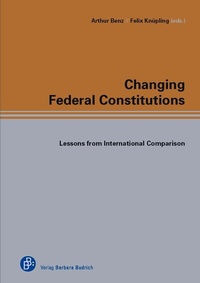
Changing Federal Constitutions
Lessons from International Comparison
1st Edition
Published on 30. May 2012
420 pages
978-3-86649-553-1 (ISBN)
Description

This book analyses constitutional change in federal and decentralizing countries from a comparative perspective. The authors identify structures, processes and strategies which have proven to favour successful constitutional amendment. Thereby, the book enables public officials, scholars, and students to learn from the constitutional reform experiences of other federal democracies and from practical suggestions how future reforms could be designed. From the Contents: The Relevance of Constitutional Change Constitutional Reform in "Co-operative" Federalism Constitutional Reform in Federal Systems with Divided Societies Devolution and Regionalisation in Federalising States Processes of Ratification Evolution after a Constitutional Reform Conclusion
Reviews / Votes
From a comparative perspective, this book analyzes constitutional change in federal and decentralizing countries. The Book identifies structures, processes, and strategies which have proven to favor successful constitutional amendment. International Specialized Book Services 3-2012 ... this book precisely informs policy makers, scholars, and students to learn from the constitutional reform experiences of various federal democracies, their weaknesses and strengths. Its practical suggestions as to how future constitutional reforms could be designed to make federalism successful are useful for policy makers and politicians. Reporter weekly 8/2012More details
Language
English
Place of publication
Leverkusen-Opladen
Germany
Target group
Professional and scholarly
College/higher education
Undergraduates, postgraduates, and post-docs in political science and public administration, governance, European Studies
File size
1,80 MB
ISBN-13
978-3-86649-553-1 (9783866495531)
Schweitzer Classification
Other editions
Additional editions
Book
05/2012
1st Edition
Verlag Barbara Budrich
€48.00
No shipping information available
Persons
Prof. Dr. Arthur Benz, Technische Universität Darmstadt, Institute of Political Science; Felix Knüpling, Head, Programs and Partnerships, Forum of Federations
Content
- Intro
- Changing Federal Constitutions
- Content
- Preface
- Welcome Address of the Secretary General of the Bundesrat
- Introduction
- 1. Federal constitutions
- 2. Varieties of federalism and their constitutions
- 3. Relevance and difficulty of constitutional change
- 4. Cases covered in this volume and contributions
- 5. Comparing incomparable cases?
- 1. The Relevance of Constitutional Change
- Unity versus Diversity. Federalism as an Ever Evolving System
- Constitutional Change in Federal Countries: Comparative Considerations
- 1. Constitutional change: normal, not exceptional
- 2. Factors associated with constitutional longevity
- 3. Issues of explicit versus implicit change
- 4. Dynamics of constitutional replacement and amendment
- 5. Conclusion
- References
- 2. Constitutional Reform in "Co-operative" Federalism
- Swiss Federalism, Fiscal Equalisation Reform and the Reallocation of Tasks
- 1. Introduction
- 2. The federalism debate in Switzerland
- 3. A "constitutional moment"
- 4. Setting the agenda: defining the constitutional problem
- 5. Negotiations
- 5.1 Phase 1 (1994-1996): Preparing the "guidelines"
- 5.2 Phase 2 (1997-2000): Fleshing out the "guidelines" and the final report of the project team
- 5.3 Phase 3 (2000-2001): Preparing the legislative proposals and the message to Parliament
- 6. Ratification
- 6.1 Parliamentary decision
- 6.2 The referendum
- 6.2.1 The instruments of direct democracy in Switzerland
- 6.2.2 The NFA referendum
- 7. Evolution after the referendum
- 8. Reasons for the successful implementation of the NFA
- References
- Why Federal Reform Succeeded in Switzerland
- 1. Introduction
- 2. The reform process
- 3. Evaluation
- 3.1 High demands on coordination
- 3.2 Opportunities for innovation and their limits
- 3.3 Comprehensive and discursive decision-making
- 3.4 The NFA: A balanced, win-win solution
- 4. Key factors of success
- References
- The "Austrian Convention": The Failure of an Ambitious Reform
- 1. Introduction
- 2. Institutions of the Austrian Convention
- 2.1 Plenum
- 2.2 Steering committee
- 2.3 Committees
- 2.4 Specific requirements for Convention discussions
- 2.4.1 The absence of designated political representatives and the formation of political camps
- 2.4.2 The role of the experts
- 2.4.3 Media coverage
- 3. Results
- 3.1 The report of the steering committee
- 3.2 The scope of the consensus reached by the Convention
- 3.2.1 Simplification and incorporation of the constitutional documents
- 3.2.2 Maintaining the status quo in the main features of the state structure
- 3.2.3 Legal protection
- 4. The conflict over federalism in the Austrian Convention
- 4.1 Previous reform attempts and the paradigm shift of the Austrian Convention
- 4.2 The attempt to throw a great pitch: the "Fiedler Draft"
- 4.3 The position of the Landeshauptleute
- 5. Other areas of conflict
- 5.1 Administrative reform caught between the resistance toinnovation and the wrong track
- 5.2 Finances
- 5.3 Fundamental Rights
- 6. Summary and future outlook
- References
- Constitutional Negotiations in Cooperative Federalism - The Case of Germany
- 1. The initial context
- 2. The process of constitutional reform
- 2.2 Federalism Reform II
- 3. Important results of the reforms
- 3.1 Federalism Reform I
- 3.1.1 Changes concerning the assent of the Bundesrat in federal legislation
- 3.1.2 Separation of legislative powers between the federal and the Länderlevel
- 3.1.3 Reduced number of instruments for joint financing
- 3.2 Federalism Reform II
- 3.2.1 Financial issues
- 3.2.2 Administrative issues
- 4. Assessment of the results
- 4.1 Federalism Reform I
- 4.2 Federalism Reform II
- 5. Conclusion
- 3. Constitutional Reform in Federal Systems with Divided Societies
- Federal Reform and Party Politics. The Case of the Fifth Belgian State Reform
- 1. Introduction
- 2. Federalism and party politics
- 3. The fifth Belgian state reform
- 4. The negotiation procedures
- 4.1 The Conference of State Reforms (COSTA/COREE)
- 4.2 The Hermes and Lambermont Agreements
- 4.3 The Lombard and Saint-Boniface Agreements
- 4.4 The parliamentary debates and votes
- 5. Conflict lines
- 5.1 Majority vs. opposition
- 5.2 Divisions between majority parties
- 5.3 Divisions within parties
- 6. Conclusion
- References
- Negotiating the Charlottetown Accord in Canada
- 1. Introduction
- 2. The constitutional moment
- 2.1 The Oka crisis
- 2.2 Quebec's reaction to Meech Lake
- 3. Consultations
- 3.1 Quebec
- 3.1.1 The Allaire Committee
- 3.1.2 Belanger-Campeau Committee
- 4. The federal government
- 4.1 The Spicer Commission
- 4.2 Beaudoin-Edwards Committee
- 5. The provinces
- 6. Aboriginal committee
- 7. The Unity Committee
- 7.1 The consultative conferences
- 7.2 A Renewed Canada
- 8. Negotiating Charlottetown
- 8.1 Multilateral negotiations
- 8.1.1 Reaching a consensus
- 8.1.2 Problems with the multilateral talks
- 9. First Ministers Conference (without Quebec)
- 10. The Pearson Accord
- 11. The Final First Ministers' Conference (including Quebec)
- 11.1 The Charlottetown Accord
- 11.2 Unity and diversity
- 11.3 Institutions
- 11.4 Roles and responsibilities
- 11.5 First peoples
- 11.6 The amending formula
- 12. The referendum
- 12.1 The campaign
- 12.2 Explaining failure
- 13. Charlottetown: A success?
- 14. Conclusion
- References
- The Limits of Flexibility for Constitutional Change and the Uses of Sub-national Constitutional Space: The Case of Spain
- 1. Introduction
- 2. The goals, process and paradoxical results of the recentround of reform: some examples from Catalonia and Andalusia
- 2.1 The Catalan and Andalusian reforms
- 2.2 The role of the Constitutional Court in sanctioning or rejectingimplicit change: the 2010 judgment on the Catalan Statute
- 3. Unravelling the positive and the negative potential ofthe system for constitutional change
- 3.1 The institutional framework for reform in Spain and itsalleged openness
- 3.2 The potential positive consequences of this institutional arrangements for reform
- 3.3 The negative flipside of too much flexibility: the possibility of unilateral reinterpretation of the constitution
- 3.4 What are then the conditions of success and failure of implicit constitutional change?
- 4. Conclusion: the problem with implicit change and the limits of flexibility in Spain
- References
- 4. Devolution and Regionalisation in Federalising States
- Britain's Constitutional Moment
- 1. Introduction: in search of the constitution
- 2. The UK's "constitutional moment" and the party system
- 2.1 Northern Ireland
- 2.2 Scotland and Wales
- 2.3 England and devolution
- 3. Devolution's impact on constitutional evolution - continuation of constitutional moment
- References
- Federalising a Regionalised State. Constitutional Change in Italy
- 1. The rise of constitutional politics
- 2. From regionalisation to federal reform
- 3. Reform attempts of the Prodi government
- 4. Federal reform of the D'Alema government
- 5. The failed "reform of the reform"
- 6. Outcomes and achievements
- Decentralisation and Territorial Reforms in France: How Constitutional Constraints impact Strategies for Reform
- 1. Introduction
- 2. The rule of constitutional amendment controlled by the Senate
- 3. The French Senate as a "demos-constraining" chamber and cornerstone of constitutional stability: the constitutionalisation of a "rotten boroughs" compromise
- 4. The consequence of the "demos-constraining" compromise: making a degree of municipal federalisation constitutional
- 5. The Senate as an agency to preserve the territorial status quo
- 6. The importance of a very costly precedent: the failed 1969 referendum
- 7. Explicit but ineffective constitutional reforms
- 8. Incremental constitutional evolution and the hidden agenda of territorial reforms
- 9. The persistently ambiguous effects of the hidden agenda of territorial reforms
- 10. Conclusion
- References
- 5. Processes of Ratification
- Constitutional Amendment Rules in Federal and Unitary States
- 1. Introduction
- 2. Right to initiate constitutional amendments
- 3. Majority requirements and other stabilising methods
- 4. Instruments to reinforce legitimacy
- 5. Exclusion of core principles from amendment
- 6. Conclusion
- References
- Constitutional Rigidity and Procedures for Ratifying Constitutional Reforms in EU Member States
- 1. Introduction
- 2. Theoretical reasons for choice of amendment rules
- 2.1 Two views on constitutional reform
- 2.1.1 The Jeffersonian view
- 2.1.2 The Madisonian view
- 2.2 Writing a constitution and ratifying it: the subject of popular sovereignty
- 3. The effect of ratification rules on amendment rates
- 3.1 The dependent variable: the amendability of constitutions
- 3.2 The independent variables: the rigity index
- 3.2.1 Preliminary considerations: entrenchment and the existence of more than one constitutional reform procedure
- 3.2.2 Indicators and scores for parliamentary requirements
- 3.2.3 Indicators and scores for veto players
- 3.2.4 Federal versus non-federal states
- 3.2.5 Summary: A European model of constitutional amendment procedure?
- 3.3 Independent variables: the length and detail of constitutions
- 4. The relation between rigidity and constitutional reform: results of empirical analysis
- References
- Regional Actors' Participation in Constitutional Reform: Opportunities, Limits and Risks
- 1. Introduction
- 2. Veto player theory and constitutional reform processes
- 3. Types of regional actors and their role in ratification processes
- 4. Impact of amendment rules on constitutional negotiations
- 5. Impact on reform results and federal developments
- 6. Conclusion
- References
- 6. Evolution after a Constitutional Reform
- Austria after the Austrian Convention
- 1. Introduction
- 2. Prevalent modes of debating, preparing and draftingconstitutional and federal reforms
- 2.1 The ongoing change of the Federal Constitution
- 2.2 Expert commissions and governmental initiatives
- 2.3 Parliamentarians and citizens?
- 3. Developments after the Convention
- 3.1 Parallel worlds
- 3.2 Keeping the reform on the agenda
- 3.3 Restoring the participation of experts
- 3.4 The last proposal for comprehensive reforms
- 3.5 Recent developments
- 4. Federalism after the Convention
- 4.1 No changes of the Federal Constitution
- 4.2 Reminiscences
- References
- Constitutional Change in Canada afterCharlottetown
- 1. Introduction
- 2. Canadian context
- 2.1 An asymmetric multinational federation
- 2.2 A complex formal constitutional amending process
- 2.3 Intergovernmental relations: increasingly important butlacking formalism or framework
- 3. Institutional evolution after the failed constitutionalreforms of the 1980's and 1990's in Canada
- 3.1 An enduring constitutional impasse
- 3.2 Incremental institutional changes
- 3.2.1 Unilateral federal measures
- 3.2.2 Administrative intergovernmental agreements
- 3.2.3 Constitutional case law
- 3.2.4 Asymmetrical bilaterally negotiated constitutional amendments
- 3.3 Some implications to be considered
- 4. Conclusion
- References
- German Federalism after Two Reforms
- 1. Introduction
- 2. Two federal reform commissions
- 3. What has been achieved by two reforms?
- 4. What effects can be measured today?
- 4.1 Limiting joint decision-making of Bundestag and Bundesrat
- 4.2 Use of new legislative powers by the Länder
- 4.3 The debt brake
- 5. Conclusion
- References
- 7. Conclusion
- Federalism and Constitutional Change: Lessons from Comparisons
- 1. Introduction
- 2. Patterns of constitutional change
- 2.1 Varieties of constitutional reform
- 2.1.1 Initiative and agenda-setting
- 2.1.2 Constitutional negotiations
- 2.1.3 Ratification
- 2.2 Constitutional evolution
- 3. Conditions influencing constitutional change
- 4. What can be learnt for future constitutional policy?
- References
- Editors and Authors
- Index
