

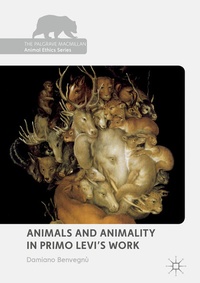
Animals and Animality in Primo Levi's Work
Description

Situated at the intersection of animal studies and literary theory, this book explores the remarkable and subtly pervasive web of animal imagery, metaphors, and concepts in the work of the Jewish-Italian writer, chemist, and Holocaust survivor Primo Levi (1919-1987). Relatively unexamined by scholars, the complex and extensive animal imagery Levi employed in his literary works offers new insights into the aesthetical and ethical function of testimony, as well as an original perspective on contemporary debates surrounding human-animal relationships and posthumanism.
The three main sections that compose the book mirror Levi's approach to non-human animals and animality: from an unquestionable bio-ethical origin ("Suffering"); through an investigation of the relationships between writing, technology, and animality ("Techne"); to a creative intellectual project in which literary animals both counterbalance the inevitable suffering of all creatures, and suggest a transformative image of interspecific community ("Creation").Reviews / Votes
"Primo Levi's remarkable explorations of 'the human', the mind and body at their limit in Auschwitz, have long been acknowledged and explored. Damiano Benvegnù's powerful and meticulously researched new book is the first to probe with real ethical and theoretical depth Levi's extensive, parallel reflections on 'the animal', as it abuts and challenges our notion of 'the human', its shared sufferings, technologies and dynamics of creation. The book is sure to make a profound impact on the field." (Robert S. C. Gordon, Professor of Italian at University of Cambridge, UK, and author of Primo Levi's Ordinary Virtues)"Few authors were able to both experience and question the human as radically as Primo Levi did. And yet, the author of If This Is a Man has given us much more than another testimony of "humanism." With accuracy and sensibility, Damiano Benvegnù illuminates Levi's disposition to see the human, the inhuman, and the nonhuman as contiguous zones, thus blurring the boundaries ofethics, ontology, and imagination. Intense, inspired, and deeply researched, Animals and Animality in Primo Levi's Work is an invaluable contribution to the fields of animal humanities, ecocriticism, and Italian studies." (Serenella Iovino, Professor of Comparative Literature at the University of Turin, Italy, and author of Ecocriticism and Italy: Ecology, Resistance, and Liberation)
"Challenging the standard anthropocentric reading of Primo Levi's work, Benvegnù compellingly argues that Levi's wide-ranging oeuvre has much to offer contemporary posthumanist theory and animal studies. Benvegnù's subtle and richly detailed analyses introduce readers to a "new" Levi, one who aims to rethink the question of human and animal suffering and ultimately reconfigure relations between humanity and animality from a planetary and cosmic perspective. This fascinating and innovative study will be welcomed by scholars across a wide range of disciplines." (Matthew Calarco, Professor of Philosophy at California State University, Fullerton, USA)
"Through the lens of human and non-human suffering, Damiano Benvegnu's brilliantly engrossing study of Primo Levi's Animals and Animality offers ground-breaking insights into the "animal question" through its sensitive exploration of the most disturbing "human question": the Holocaust. Exploring Levi's writings on his de-humanizing experience in Auschwitz while also considering our cruel treatment of animals, Benvegnu reads Levi's 'literary animals' as 'animal testimony' that shatters and re-formulates the very definition of the (in)humane human." (Heather I. Sullivan, Professor of German at Trinity University, USA)
More details
Other editions
Additional editions
Person
Damiano Benvegnù is a Lecturer in Italian at Dartmouth College, USA, and an Associate Fellow of the Oxford Centre for Animal Ethics. His current published work focuses on representations of animals, animality, and the environment in modern literature, visual art, and philosophy. He has previously published on minority languages and literatures.
