

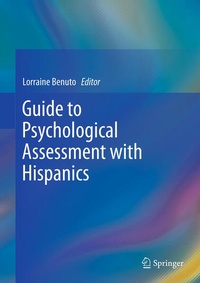
Guide to Psychological Assessment with Hispanics
Description

More details
Other editions
Additional editions
Person
Lorraine T. Benuto received her doctoral degree in psychology from the University of Nevada, Las Vegas. She is a licensed clinical psychologist and she currently works at the University of Nevada, Reno as a clinical psychologist where she provides treatment to victims of sexual assault, sexual abuse, and child physical abuse. Dr. Benuto is also the associate director of the Nevada Caregiver Support Center where she works with individuals who have dementia and their families. Finally, Dr. Benuto chairs doctoral dissertations at Northcentral University. Dr. Benuto completed her APA-accredited internship at the VA in San Juan, Puerto Rico where she delivered psychological services to a culturally diverse clientele presenting with depression, anxiety, and dementia. Dr. Benuto has extensive experience delivering evidence-based treatments and conducting psychological assessments with the Latino population. She has delivered professional presentations at state, national, and international conferences on topics related to cultural competence and is co-editing Handbook of Adolescent Health Psychology, Guidelines to Psychological Assessment with African Americans, and Guidelines to Psychological Assessment with Asian Americans for Springer.
Content
1. Guide to Psychological Assessment with Hispanics: An Introduction.- 2. Bilingualism and its Impact on Psychological Assessment.- 3. The Assessment Interview: A review of Structured and Semi-Structured Clinical Interviews available for use among Hispanic Clients.- 4. Using Projective Tests with Hispanic Clients.- 5. Assessing Personality using Self-Report Measures with Hispanic Clients.- 6. IQ Testing and the Hispanic Client.- 7. Assessing Effort & Malingering with the Hispanic Client.- 8. Assessing Mood Disorders and Suicidality in Hispanics.- 9. Special Considerations when Assessing the Hispanic Adolescent: Examining Suicide Risk.- 10. Assessing Suicidality with the Hispanic Adult.- 11. Assessment of Anxiety with Hispanics.- 12. Assessing Substance-Related Disorders in Hispanic Clients.- 13. Assessing Sexual Dysfunction in Hispanic Clients.- 14. Assessing Eating Pathology in Hispanic Americans.- 15. Assessing for Personality Disorders in the Hispanic Client.- 16. Assessment of Dementia in the Hispanic Client: A Neuropsychological Perspective.- 17. Assessing Psychosis in Hispanics.- 18. Assessing Sleep Disorders in the Hispanic Patient.- 19. Assessing Somatoform Disorders with the Hispanic Client.- 20. Assessing developmental learning and communication disorders in Hispanic children: a neuropsychological perspective.- 21. School-based Assessment with Latina/o Children & Adolescents.- 22. Neuropsychological Assessment with Hispanic Clients.- 23. Assessing Risk, Recidivism, and Dangerousness in Hispanics.- 24. Forensic Assessment with the Hispanic Client.
