

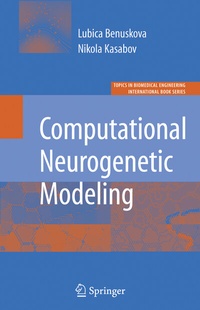
Computational Neurogenetic Modeling
1st Edition
Published on 5. May 2010
XII, 290 pages
978-0-387-48355-9 (ISBN)
Description

Computational Neurogenetic Modeling is a student text, introducing the scope and problems of a new scientific discipline - Computational Neurogenetic Modeling (CNGM). CNGM is concerned with the study and development of dynamic neuronal models for modeling brain functions with respect to genes and dynamic interactions between genes. These include neural network models and their integration with gene network models. This new area brings together knowledge from various scientific disciplines, such as computer and information science, neuroscience and cognitive science, genetics and molecular biology, as well as engineering.
More details
Other editions
Additional editions
Lubica Benuskova | Nikola K. Kasabov
Computational Neurogenetic Modeling
Book
05/2007
Springer
€160.49
Shipment within 5-7 days
Content
Computational Neurogenetic Modeling (CNGM): A Brief Introduction.- Organization and Functions of the Brain.- Neuro-Information Processing in the Brain.- Artificial Neural Networks (ANN).- Evolving Connectionist Systems (ECOS).- Evolutionary Computation for Model and Feature Optimization.- Gene/Protein Interactions - Modeling Gene Regulatory Networks (GRN).- CNGM as Integration of GPRN, ANN and Evolving Processes.- Application of CNGM to Learning and Memory.- Applications of CNGM and Future Development.
"3.2 Learning Takes Place in Synapses: Toward the Smartness Gene (p. 56-57)
For major discoveries in the field of synaptic mechanisms of learning, the 2000 Nobel Prize for medicine went to the neuroscientists Eric R. Kandel and Paul Greengard. The 3rd laureate, Arvid Carlsson, got his share of the prize for discoveries of actions of neurotransmitter dopamine. At present, it is widely accepted that learning is accompanied by changes of synaptic weights in cortical neural networks (Kandel et al. 2000). Changes of synaptic weights are also called synaptic plasticity. In 1949, the Canadian psychologist Donald Hebb formulated a universal rule for these changes: "When an axon of cell A excites cell B and repeatedly or persistently takes part in firing it, some growth process or metabolic change takes place in one or both cells so that As efficiency as one of the cells firing B is increased", which has been verified in many experiments and its mechanisms elucidated (Hebb 1949).
In cerebral cortex and in hippocampus of humans and animals, learning takes place in excitatory synapses formed upon dendritic spines that use glutamate as their neurotransmitter. In the regime of learning, glutamate acts on specific postsynaptic receptors, the so-called NMDA receptors (Nmethyl- D-aspartate). NMDA receptors are associated with ion channels for sodium and calcium (see Fig. 3.3). The influx of these ions into spines is proportional to the frequency of incoming presynaptic spikes. Calcium acts as a second messenger thus triggering a cascade of biochemical reactions which lead either to the long-term potentiation of synaptic weights (LTP) or to the long-term depression (weakening) of synaptic weights (LTD).
In experimental animals, it has been recorded that these changes in synaptic weights can last for hours, days, even weeks and months, up to a year. Induction of such long-term synaptic changes involves transient changes in gene expression (Mayford and Kandel 1999, Abraham et al. 2002). A subcellular switch between LTD and LTP is the concentration of calcium within spines (Shouval, Bear et al. 2002). We speak about an LTD/LTP threshold. In tum, the intra-spine calcium concentration depends upon the intensity of synaptic stimulation that is upon the frequency of presynaptic spikes.
That is, more presynaptic spikes mean more glutamate within synaptic cleft. Release of glutamate must coincide with a sufficient depolarization of the postsynaptic membrane to remove the magnesium block ofthe NMDA receptor. The greater the depolarization, the more ions of calcium enters the spine. Postsynaptic depolarization is primarily achieved via AMPA (amino-methylisoxasole-propionic acid) receptors, however, recently a significant role ofbackpropagating postsynaptic spikes has been pointed out (Markram et al. 1997). Calcium concentrations below or above the LTD/LTP threshold, switch on different enzymatic pathways that lead either to LTD or LTP, respectively. However, the current value of the LTD/LTP threshold (i.e. the properties of these two enzymatic pathways) can be influenced by levels of other neurotransmitters, an average previous activity of a neuron, and possibly other biochemical factors as well.
This phenomenon is called metaplasticity, a plasticity of synaptic plasticity (Abraham and Bear 1996). Dependence of the LTD/LTP threshold upon different postsynaptic factors is the subject of the Bienenstock, Cooper and Munro (BCM) theory of synaptic plasticity (Bienenstock et al. 1982) (for a nice overview see for instance (Jedlicka 2002)). The BCM theory of synaptic plasticity has been successfully applied in computer simulations to explain experience-dependent changes in the normal and ultrastructurally altered brain cortex of experimental animals (Benuskova et al. 1994)."
For major discoveries in the field of synaptic mechanisms of learning, the 2000 Nobel Prize for medicine went to the neuroscientists Eric R. Kandel and Paul Greengard. The 3rd laureate, Arvid Carlsson, got his share of the prize for discoveries of actions of neurotransmitter dopamine. At present, it is widely accepted that learning is accompanied by changes of synaptic weights in cortical neural networks (Kandel et al. 2000). Changes of synaptic weights are also called synaptic plasticity. In 1949, the Canadian psychologist Donald Hebb formulated a universal rule for these changes: "When an axon of cell A excites cell B and repeatedly or persistently takes part in firing it, some growth process or metabolic change takes place in one or both cells so that As efficiency as one of the cells firing B is increased", which has been verified in many experiments and its mechanisms elucidated (Hebb 1949).
In cerebral cortex and in hippocampus of humans and animals, learning takes place in excitatory synapses formed upon dendritic spines that use glutamate as their neurotransmitter. In the regime of learning, glutamate acts on specific postsynaptic receptors, the so-called NMDA receptors (Nmethyl- D-aspartate). NMDA receptors are associated with ion channels for sodium and calcium (see Fig. 3.3). The influx of these ions into spines is proportional to the frequency of incoming presynaptic spikes. Calcium acts as a second messenger thus triggering a cascade of biochemical reactions which lead either to the long-term potentiation of synaptic weights (LTP) or to the long-term depression (weakening) of synaptic weights (LTD).
In experimental animals, it has been recorded that these changes in synaptic weights can last for hours, days, even weeks and months, up to a year. Induction of such long-term synaptic changes involves transient changes in gene expression (Mayford and Kandel 1999, Abraham et al. 2002). A subcellular switch between LTD and LTP is the concentration of calcium within spines (Shouval, Bear et al. 2002). We speak about an LTD/LTP threshold. In tum, the intra-spine calcium concentration depends upon the intensity of synaptic stimulation that is upon the frequency of presynaptic spikes.
That is, more presynaptic spikes mean more glutamate within synaptic cleft. Release of glutamate must coincide with a sufficient depolarization of the postsynaptic membrane to remove the magnesium block ofthe NMDA receptor. The greater the depolarization, the more ions of calcium enters the spine. Postsynaptic depolarization is primarily achieved via AMPA (amino-methylisoxasole-propionic acid) receptors, however, recently a significant role ofbackpropagating postsynaptic spikes has been pointed out (Markram et al. 1997). Calcium concentrations below or above the LTD/LTP threshold, switch on different enzymatic pathways that lead either to LTD or LTP, respectively. However, the current value of the LTD/LTP threshold (i.e. the properties of these two enzymatic pathways) can be influenced by levels of other neurotransmitters, an average previous activity of a neuron, and possibly other biochemical factors as well.
This phenomenon is called metaplasticity, a plasticity of synaptic plasticity (Abraham and Bear 1996). Dependence of the LTD/LTP threshold upon different postsynaptic factors is the subject of the Bienenstock, Cooper and Munro (BCM) theory of synaptic plasticity (Bienenstock et al. 1982) (for a nice overview see for instance (Jedlicka 2002)). The BCM theory of synaptic plasticity has been successfully applied in computer simulations to explain experience-dependent changes in the normal and ultrastructurally altered brain cortex of experimental animals (Benuskova et al. 1994)."
