

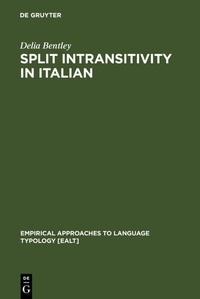
Split Intransitivity in Italian
Description

Split intransitivity has received a great deal of attention in theoretical linguistics since the formulation of the Unaccusative Hypothesis by David Perlmutter (1978). This book provides an in-depth investigation of split intransitivity as it occurs in Italian. The principal proposal is that the manifestations of split intransitivity in Italian, whilst being variously constrained by well-formedness conditions on the encoding of information structure, primarily derive from the tension between accusative (syntactic) and active (semantic) alignment. In contrast to approaches which consider the selection of the perfective operator to be the primary diagnostic of unaccusative or unergative syntax, this study identifies two morphosemantic domains in intransitive constructions on the basis of the analysis of a cluster of related phenomena (including agreement, argument suppression, ne -cliticization, past-participle behaviour, the morphosyntax of experiencer predicates and word order, as well as the selection of the perfective operator). Analysing the degree to which semantic, syntactic and discourse factors interact in determining each manifestation of split intransitivity, this work captures successfully the mismatches in the scope of the various diagnostics.
Drawing upon insights provided by Role and Reference Grammar, and relying on corpus-based evidence and crossdialectal comparison, this study makes new empirical and theoretical contributions to the debate on split intransitivity. The book is accessible to linguists of all theoretical persuasions and will make stimulating reading for researchers and scholars in Italian and Romance linguistics, typology and theoretical linguistics.
More details
Other editions
Additional editions
Person
Content
- Intro
- Acknowledgements
- Abbreviations
- 1. Introduction
- 1.1 Split intransitivity: An introduction
- 1.2 Split intransitivity in Italian
- 1.3 The diagnostics
- 1.4 Role and Reference Grammar
- 2. Perfective operators
- 2.1 The problem
- 2.2 The markedness of the Privileged Syntactic Argument
- 2.3 Avere or essere?
- 2.4 Crossdialectal and crosslinguistic variation
- 2.5 Complex predicates
- 2.6 Conclusion
- 3. Experiencer predicates
- 3.1 Introduction
- 3.2 Type-(i) experiencer predicates
- 3.3 Type-(ii) experiencer predicates
- 3.4 Type-(iii) experiencer predicates
- 3.5 Conclusion
- 4. Si-constructions and unexpressed arguments
- 4.1 Introduction
- 4.2 Reflexives
- 4.3 Impersonal si-constructions
- 4.4 Unexpressed arguments
- 4.5 Conclusion
- 5. Agreement
- 5.1 Introduction
- 5.2 The agreement of perfective and passive past participles
- 5.3 Variability and change in perfective past-participle agreement
- 5.4 Non-finite agreement in complex predicates
- 5.5 Non-finite agreement in absolute participles
- 5.6 Non-finite agreement in constructions with adjectival and nominal predicates
- 5.7 Finite agreement: Crossdialectal evidence
- 5.8 Agreement in crossdialectal perspective
- 5.9 Conclusion
- 6. Ne-cliticization
- 6.1 Introduction
- 6.2 Canonical ne-cliticization
- 6.3 Some putative exceptions
- 6.4 Constructions with non-verbal predicates
- 6.5 Ne-cliticization in si-constructions
- 6.6 Other functions of ne
- 6.7 Conclusion
- 7. Past participles
- 7.1 Introduction
- 7.2 Attributive past participles: Restrictive and descriptive constructions
- 7.3 Predicative past participles: Passive and resultative constructions
- 7.4 Passive and resultative venire 'come' and andare 'go'
- 7.5 Predicative past participles: Absolute constructions
- 7.6 Compounds with ben(e) or mal(e) plus a participle
- 7.7 Conclusion
- 8. Word order
- 8.1 Introduction
- 8.2 Word order and split intransitivity
- 8.3 The interaction of syntax with discourse
- 8.4 Intransitive constructions with a postnuclear PSA
- 8.5 Conclusion
- 9. Conclusion
- Notes
- References
- Index
