

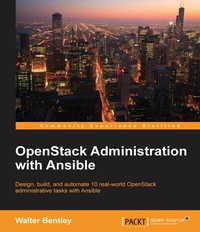
OpenStack Administration with Ansible
Design, build, and automate 10 real-world OpenStack administrative tasks with Ansible
Published on 8. July 2025
218 pages
978-1-78588-938-7 (ISBN)
Description

Design, build, and automate 10 real-world OpenStack administrative tasks with Ansible
Key Features
Automate real-world OpenStack cloud operator administrative tasks
Construct a collection of automation code to save time on managing your OpenStack cloud
Use this step-by-step tutorial to automate such tasks with Ansible
Book DescriptionMost organizations are seeking methods to improve business agility because they have realized just having a cloud is not enough. Being able to improve application deployments, reduce infrastructure downtime, and eliminate daily manual tasks can only be accomplished through some sort of automation. Packed with real-world OpenStack administrative tasks, this book will walk you through working examples and explain how these tasks can be automated using one of the most popular open source automation tools-Ansible. We will start with a brief overview of OpenStack and Ansible and highlight some best practices. Each chapter will provide an introduction to handling various Cloud Operator administration tasks such as creating multiple users/tenants, setting up Multi-Tenant Isolation, customizing your clouds quotas, taking instance snapshots, evacuating compute hosts for maintenance, and running cloud health checks, and a step-by-step tutorial on how to automate these tasks with Ansible.What you will learn
Efficiently execute OpenStack administrative tasks
Familiarize yourself with how Ansible works and assess the defined best practices
Create Ansible playbooks and roles
Automate tasks to customize your OpenStack cloud
Review OpenStack automation considerations when automating administrative tasks
Examine and automate advanced OpenStack tasks and designated use cases
Get a high-level overview of OpenStack and the current production-ready projects
Deep dive into OpenStack CLI tools and find out how to use them
Who this book is forIf you are an OpenStack-based cloud operator and/or infrastructure administrator and are interested in automating administrative functions, then this book is exactly what you are looking for. Having a functioning OpenStack environment is helpful, but most certainly not necessary.
Key Features
Automate real-world OpenStack cloud operator administrative tasks
Construct a collection of automation code to save time on managing your OpenStack cloud
Use this step-by-step tutorial to automate such tasks with Ansible
Book DescriptionMost organizations are seeking methods to improve business agility because they have realized just having a cloud is not enough. Being able to improve application deployments, reduce infrastructure downtime, and eliminate daily manual tasks can only be accomplished through some sort of automation. Packed with real-world OpenStack administrative tasks, this book will walk you through working examples and explain how these tasks can be automated using one of the most popular open source automation tools-Ansible. We will start with a brief overview of OpenStack and Ansible and highlight some best practices. Each chapter will provide an introduction to handling various Cloud Operator administration tasks such as creating multiple users/tenants, setting up Multi-Tenant Isolation, customizing your clouds quotas, taking instance snapshots, evacuating compute hosts for maintenance, and running cloud health checks, and a step-by-step tutorial on how to automate these tasks with Ansible.What you will learn
Efficiently execute OpenStack administrative tasks
Familiarize yourself with how Ansible works and assess the defined best practices
Create Ansible playbooks and roles
Automate tasks to customize your OpenStack cloud
Review OpenStack automation considerations when automating administrative tasks
Examine and automate advanced OpenStack tasks and designated use cases
Get a high-level overview of OpenStack and the current production-ready projects
Deep dive into OpenStack CLI tools and find out how to use them
Who this book is forIf you are an OpenStack-based cloud operator and/or infrastructure administrator and are interested in automating administrative functions, then this book is exactly what you are looking for. Having a functioning OpenStack environment is helpful, but most certainly not necessary.
All prices
More details
Edition
Digital original
Language
English
Place of publication
Birmingham
United Kingdom
Target group
US School Grade: College Graduate Student
Edition type
Digital original
File size
5,80 MB
ISBN-13
978-1-78588-938-7 (9781785889387)
Copyright in bibliographic data and cover images is held by Nielsen Book Services Limited or by the publishers or by their respective licensors: all rights reserved.
Schweitzer Classification
Other editions
Additional editions
Walter Bentley
OpenStack Administration with Ansible
Book
01/2016
Packt Publishing
€45.50
Shipment within 3-4 weeks
Person
Bentley Walter :
Walter Bentley is a Rackspace Private Cloud Technical Marketing Engineer and author with a diverse background in production systems administration and solutions architecture. He has more than 15 years of experience in sectors such as online marketing, financial, insurance, aviation, the food industry, education, and now in technology. In the past, he was typically the requestor, consumer, and advisor to companies in the use of technologies such as OpenStack. Today, hes an OpenStack promoter and cloud educator. In his current role, Walter helps customers build, design, and deploy private clouds built on OpenStack. That includes professional services engagements around operating OpenStack clouds and DevOps engagements creating playbooks/roles with Ansible. He presents and speaks regularly at OpenStack Summits, AnsibleFest, and other technology conferences, plus webinars, blog posts and technical reviews. His first book, OpenStack Administration with Ansible, was released in 2016.
Walter Bentley is a Rackspace Private Cloud Technical Marketing Engineer and author with a diverse background in production systems administration and solutions architecture. He has more than 15 years of experience in sectors such as online marketing, financial, insurance, aviation, the food industry, education, and now in technology. In the past, he was typically the requestor, consumer, and advisor to companies in the use of technologies such as OpenStack. Today, hes an OpenStack promoter and cloud educator. In his current role, Walter helps customers build, design, and deploy private clouds built on OpenStack. That includes professional services engagements around operating OpenStack clouds and DevOps engagements creating playbooks/roles with Ansible. He presents and speaks regularly at OpenStack Summits, AnsibleFest, and other technology conferences, plus webinars, blog posts and technical reviews. His first book, OpenStack Administration with Ansible, was released in 2016.
Content
Table of Contents
Introduction to OpenStack
Introduction to Ansible
Creating Multiple Users/Tenants
Customizing Your Clouds Quotas
Snapshot Your Cloud
Migrating Instances
Setting Up Isolated Tenants
Evacuating Compute Hosts
Inventory Your Cloud
Health Check Your Cloud
Introduction to OpenStack
Introduction to Ansible
Creating Multiple Users/Tenants
Customizing Your Clouds Quotas
Snapshot Your Cloud
Migrating Instances
Setting Up Isolated Tenants
Evacuating Compute Hosts
Inventory Your Cloud
Health Check Your Cloud

