

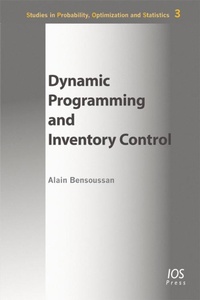
Dynamic Programming and Inventory Control
1st Edition
Published on 15. September 2011
384 pages
978-1-60750-770-3 (ISBN)
Description

This book presents a unified theory of dynamic programming and Markov decision processes and its application to a major field of operations research and operations management: inventory control. Models are developed in discrete time as well as in continuous time. For continuous time, this book concentrates only on models of interest to inventory control. For discrete time, the focus is mainly on infinite horizon models.
The book also covers the difference between impulse control and continuous control. Ergodic control is considered in the context of impulse control, and some simple rules currently used in practice are justified. Chapter 2 introduces some of the classical static problems which are preliminary to the dynamic models of interest in inventory control.
This book is not a general text on control theory and dynamic programming, in that the systems dynamics are mostly limited to inventory models. For these models, however, it seeks to be as comprehensive as possible, although finite horizon models in discrete time are not developed, since they are largely described in existing literature. On the other hand, the ergodic control problem is considered in detail, and probabilistic proofs as well as analytical proofs are provided.
The techniques developed in this work can be extended to more complex models, covering additional aspects of inventory control.
The book also covers the difference between impulse control and continuous control. Ergodic control is considered in the context of impulse control, and some simple rules currently used in practice are justified. Chapter 2 introduces some of the classical static problems which are preliminary to the dynamic models of interest in inventory control.
This book is not a general text on control theory and dynamic programming, in that the systems dynamics are mostly limited to inventory models. For these models, however, it seeks to be as comprehensive as possible, although finite horizon models in discrete time are not developed, since they are largely described in existing literature. On the other hand, the ergodic control problem is considered in detail, and probabilistic proofs as well as analytical proofs are provided.
The techniques developed in this work can be extended to more complex models, covering additional aspects of inventory control.
More details
Series
Language
English
Place of publication
London
Netherlands
Publishing group
IOS Press
Target group
Professional and scholarly
College/higher education
File size
1,92 MB
ISBN-13
978-1-60750-770-3 (9781607507703)
Copyright in bibliographic data and cover images is held by Nielsen Book Services Limited or by the publishers or by their respective licensors: all rights reserved.
Schweitzer Classification
Other editions
Additional editions
Alain Bensoussan
Dynamic Programming and Inventory Control
Book
09/2011
1st Edition
IOS Press,US
€170.84
Article exhausted; check different version
Content
- Title Page
- Contents
- Introduction
- Static Problems
- Newsvendor Problem
- EOQ Model
- Price Considerations
- Several Products With Scarce Resource
- Continuous Production of Several Products
- Lead Time
- Random Demand Rate: Unsatisfied Demand Lost
- Markov Chains
- Notation
- Chapman-Kolmogorov Equations
- Stopping Times
- Solution of Analytic Problems
- Ergodic Theory
- Examples
- Optimal Control in Discrete Time
- Deterministic Case
- Stochastic Case: General Formulation
- Functional Equation
- Probabilistic Interpretation
- Uniqueness
- Inventory Control Without Set Up Cost
- No Shortage Allowed.
- Backlog Allowed
- Deterministic Case
- Ergodic Control in Discrete Time
- Finite Number of States
- Ergodic Control of Inventories With no Shortage
- Ergodic Control of Inventories With Backlog
- Deterministic Case
- Optimal Stopping Problems
- Dynamic Programming
- Interpretation
- Penalty Approximation
- Ergodic Case
- Impulse Control
- Description of the Model
- Study of the Functional Equation
- Another Formulation
- Probabilistic Interpretation
- Inventory Control With Set Up Cost
- Deterministic Model
- Inventory Control With Fixed Cost and no Shortage
- Inventory Control With Fixed Cost and Backlog
- Ergodic Control of Inventories With Set Up Cost
- Deterministic Case
- Ergodic Inventory Control With Fixed Cost and no Shortage
- Ergodic Inventory Control With Fixed Cost and Backlog
- Dynamic Inventory Models With Extensions
- Capacitated Inventory Management
- Multi Supplier Problem
- Inventory Control With Markov Demand
- Introduction
- No Backlog and no Set-Up Cost
- Backlog and no Set Up Cost
- No Backlog and Set Up Cost
- Backlog and Set Up Cost
- Learning Process
- Lead Times and Delays
- Introduction
- Models With Inventory Position
- Models Without Inventory Position
- Information Delays
- Ergodic Control With Information Delays
- Continuous Time Inventory Control
- Deterministic Model
- Ergodic Problem
- Continuous Rate Delivery
- Lead Time
- Newsvendor Problem
- Poisson Demand
- Ergodic Case for the Poisson Demand
- Poisson Demand With Lead Time
- Ergodic Approach for Poisson Demand With Lead Time
- Poisson Demand With Lead Time: Use of Inventory Position
- Ergodic Theory for Lead Time With Inventory Position
- Inventory Control With Diffusion Demand
- Introduction
- Problem Formulation
- s, S Policy
- Solving the Q.V.I
- Ergodic Theory
- Probabilistic Interpretation
- Mean-Reverting Inventory Control
- Introduction
- Description of the Problem
- s, S Policy
- Solution of the Q.V.I
- Two Band Impulse Control Problems
- Introduction
- The Problem
- a, A, b, B Policy
- Solution of the Q.V.I.
- Computational Aspects
- Bibliography
- Appendix A
- Proof of Lemmas
- Proof of Measurable Selection
- Extension to U non Compact
- Compactness Properties
