

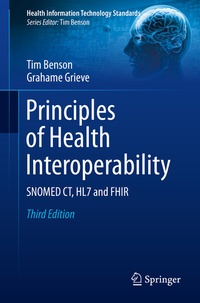
Principles of Health Interoperability
Description

This book provides an introduction to health interoperability and the main standards used. Health interoperability delivers health information where and when it is needed. Everybody stands to gain from safer more soundly based decisions and less duplication, delays, waste and errors.
The third edition of Principles of Health Interoperability includes a new part on FHIR (Fast Health Interoperability Resources), the most important new health interoperability standard for a generation. FHIR combines the best features of HL7's v2, v3 and CDA while leveraging the latest web standards and a tight focus on implementability. FHIR can be implemented at a fraction of the price of existing alternatives and is well suited for use in mobile phone apps, cloud communications and EHRs.
The book is organised into four parts. The first part covers the principles of health interoperability, why it matters, why it is hard and why models are an important part of the solution. The second part covers clinical terminology and SNOMED CT. The third part covers the main HL7 standards: v2, v3, CDA and IHE XDS. The new fourth part covers FHIR and has been contributed by Grahame Grieve, the original FHIR chief.More details
Other editions
Additional editions
Persons
Tim Benson graduated from the University of Nottingham as a mechanical engineer. He was introduced to healthcare computing at the Charing Cross Hospital, London, where he evaluated the socio-economic benefits of medical computing systems. He founded one of the first GP computer suppliers (Abies Informatics Ltd). There, with James Read and David Markwell, he helped develop the Read Codes, which became the national standard for NHS primary care and one of the two sources of SNOMED CT. Tim led the first European project team on open standards for health interoperability, which led to CEN/TC251 and collaboration with HL7, where he was a co-chair of the Education Committee for several years. He has also developed a family of short generic patient-reported outcome measures with R-Outcomes Ltd (http://www.r-outcomes.com).
Grahame Grieve graduated from the University of Auckland as a biochemist, and worked as a clinical diagnostic scientist at St Vincent's Hospital, Melbourne, before spending four years performing medical research in Diabetes, Lipid Metabolism, and Oxidation. He then switched focus, and joined Kestral Computing P/L, a Laboratory and Imaging Information Systems vendor, where he ended up as Chief Technology Officer, before leaving to establish his own consulting business, Health Intersections Ltd (http://www.healthintersections.com.au). A growing involvement in integration, and interoperability, lead him to the HL7 community where he has led committees and edited standards for HL7 v2, v3 and CDA. The outcome of this was the recognition that something new was needed, and this led to the creation of the FHIR specification, which now consumes his life.
Content
PART 1 Principles of Health Interoperability.- Chapter 1 The Health Information Revolution.- Chapter 2 Why Interoperability is Hard.- Chapter 3 Models.- Chapter 4 UML, XML and JSON.- Chapter 5 Information Governance.- Chapter 6 Standards Development Organizations.- PART 2 Terminologies and SNOMED CT.- Chapter 7 Clinical Terminology.- Chapter 8 Coding and Classification Schemes.- Chapter 9 SNOMED CT.- Chapter 10 SNOMED CT Concept Model.- Chapter 11 Implementing SNOMED CT.- PART 3 HL7 and Interchange Formats.- Chapter 12 HL7 Version 2.- Chapter 13 The HL7 V3 RIM.- Chapter 14 Constrained Information Models.- Chapter 15 CDA - Clinical Document Architecture.- Chapter 16 HL7 Dynamic Model.- Chapter 17 Sharing Documents and IHE XDS.- PART 4 FHIR.- Chapter 18 Principles of FHIR.- Chapter 19 The FHIR RESTful API.- Chapter 20 FHIR Resources.- Chapter 21 Conformance and Terminology.- Chapter 22 Implementing FHIR
