

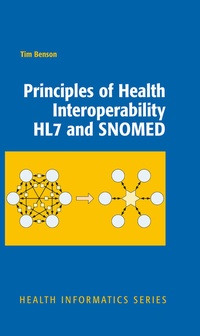
Principles of Health Interoperability HL7 and SNOMED
Description

Joined-up healthcare makes information available when and where it is needed to improve safety, efficiency and effectiveness. Politicians may take interoperability between healthcare computer systems for granted, but it is non-trivial. Healthcare integration projects are notoriously under-estimated and come in over-budget and over-time.
Joined-up healthcare depends on standards. The two leading standards are the SNOMED CT, which is a clinical terminology (semantics) and HL7 Version 3, which is a specialised healthcare interoperability language (syntax). Both are new, complex and fit for purpose.
Tim Benson believes there is an unmet need for a book on Healthcare Integration. Some health informatics textbooks include chapters on HL7 and/or SNOMED, but these are usually quite short and cannot provide even an adequate introduction. There is little of much value on the Internet, or in journals or conference proceedings.
Reviews / Votes
Aus.den Rezensionen: "... Der Autor führt in die Grundlagen der Interoperabilität ein, geht ausführlich auf Sprachen wie UML (Unified Modeling Language) und XML (Extensible Markup Language) ein und erklärt ... Benson erklärt alle relevanten Details des Standards und veranschaulicht die verschiedenen Ebenen und Hierarchien mit Diagrammen. ... Durch die klare Gliederung eignet sich das Buch ... zum schnellen Nachschlagen. ... Mit SNOMED werden Begriffe aus der Medizin nach einem hierarchischen Aufbau eindeutig beschrieben. ... Ein umfangreiches Glossar und eine lange Literaturliste runden dieses Werk ab." (in: E-HEALTH-COM, April/2010, Issue 2, S. 79)More details
Other editions
New editions
Additional editions
Person
Tim Benson is one of the most experienced teachers of both HL7 v3 and SNOMED CT.
