

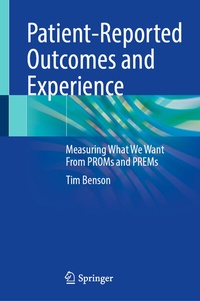
Patient-Reported Outcomes and Experience
Description

This book shows how PROMs and PREMs can help improve patient experience and outcomes. Part 1 covers the core principles of PROMs and PREMs, including their strengths and weaknesses, reporting and analysis, data sharing and valuation. Part 2 covers measures of patient experience, health status, wellbeing, self-efficacy, individualized measures, social determinants of health and impact evaluation. It concludes with a discussion of staff-reported measures, proxies and caregivers.
Patient-Reported Outcomes and Experience: Measuring What We Want with PROMs and PREMs concisely covers how to use these measures successfully to improve patient experience of healthcare services and associated outcomes. It is a critical resource for trainee and practicing clinicians, managers, analysts and policymakers seeking an up-to-date reference on the latest developments in this rapidly expanding field.
More details
Other editions
New editions
Additional editions
Person
Tim Benson has spent most of his career in health care, focusing on healthcare computing. He originally trained as a mechanical engineer at the University of Nottingham, where he designed built and tested one of the first hovercraft built outside the aerospace industry.
He joined the NHS in 1974 to lead the evaluation of new computer systems being introduced at the Charing Cross Hospital in London. There he met some of the pioneers of healthcare outcome measures and saw their potential.
In 1980, he established one of the first GP computer suppliers, which developed problem-oriented patient records for use in the consulting room and the Read Codes, which led later to SNOMED CT. From about 1990, he focused on health interoperability, HL7 and later FHIR. In the mid-2000s, he began a project to develop a short generic health outcome measure. This was followed by a patient experience and other measures, leading to founding R-Outcomes Ltd and this book.Content
Why PROMs and PREMs matter?.- History.- Terminology.- Why PROMs are Hard: People.- Noise and complexity.- Analysis.- Interoperability.- Value of health and lives.- Patient-reported measures.- Patient experience.- Health status.- Wellbeing.- Patient-centred Care.- Individualised Measures.- Social factors.- Innovation Evaluation.- Staff-reported measures.- Proxies, caregivers and care home residents.
