

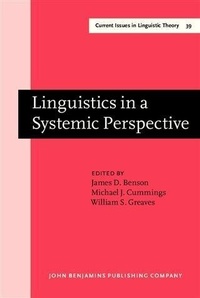
Linguistics in a Systemic Perspective
1st Edition
Published on 1. January 1988
X, 452 pages
978-90-272-7876-0 (ISBN)
Description

The purpose of this book is to provide a general introduction to Systemic Linguistics in the form of essays written by leading figures in the field. These are, with one exception, not previously published, and taken together they constitute a comprehensive coverage of the diverse interests of current systemic theory. The volume contains bibliographies and an index.
More details
Other editions
Additional editions
James D. Benson | Michael J. Cummings | William S. Greaves
Linguistics in a Systemic Perspective
Book
01/1988
John Benjamins Publishing Co
€147.34
Shipment within 10-15 days
Persons
Content
- LINGUISTICS IN A SYSTEMIC PERSPECTIVE
- Editorial page
- Title page
- Copyright page
- Table of contents
- INTRODUCTION
- INTONATIONAND MEANING IN SPONTANEOUS DISCOURSE
- NOTES
- REFERENCES
- ON THE INEFFABILITY OF GRAMMATICAL CATEGORIES
- REFERENCES
- SYSTEMIC SYNTAX FROM A LEXICAL POINT OF VIEW
- Words and Lexical Items
- Fawcett's 'Proposals'
- Word and Morpheme
- The Genesis of Lexical Items
- The 'Cluster'
- Long Lexical Items
- Conclusion
- Envoi
- NOTES
- REFERENCES
- SENSEAND STRUCTURE IN LEXIS
- Introduction
- Hypothesis
- Evidence: Main Senses
- Minor Senses
- Counterexamples: General
- Counterexamples: First Sense
- Descriptive and Prescriptive Study
- Counterexamples: Second and Third Senses
- First Minor Sense
- Conclusion
- Table 1 Co-ordination of sense and syntax: summary
- Table 2 Co-ordination of sense and syntax
- Appendix
- REFERENCES
- TEXT, TERMS AND MEANINGS: SOME PRINCIPLES OF ANALYSIS
- NOTES
- REFERENCES
- POLITENESS AND THE SEMANTICS OF MODALISED DIRECTIVES IN ENGLISH
- 1.0 Congruence and the Analysis of Directives
- 2.0 Politeness in Linguistics
- 3.0 Politeness, Speech Act Classification and the Semantics of Mood and Modalisation in English
- 3.1 Semantic Force Options
- 3.2 The Semantics of the 'Root' Modals
- 3.3 Predictions from the Semantics
- 3.31 Acceptability
- 3.32 Speech Act Classification
- 3.33 Politeness
- 3.34 Relationships between Speech Act Classification and Politeness
- 4.0 Hypothesis Testing
- 4.1 Methodology
- 4.2 Hypotheses and Results of Testing
- 4.21 Acceptability and Speech Act Classification
- 4.22 Politeness Rating
- 4.221 Hypotheses Relating Politeness to Speech Act Classification
- ON DIFFERENT POSSIBILITIES IN THE SYNTAX OF ENGLISH
- NOTES
- REFERENCES
- THE ENGLISH PERSONAL PRONOUNS: AN EXERCISE IN LINGUISTIC THEORY
- 1. The Problem
- 2. The Method of Approach
- 3. Model 1: A Purely Formal Grammar
- 4. Model 2: A Grammar Incorporating the Traditional Subcategorizations
- 5. Simplifying the Network in Model 2
- 6. Model 3: A Grammar with a Semantic System Network
- 7. Model 3: The Realization Rules
- 8. The Price to be Paid
- 9. Conclusions
- NOTES
- APPENDIX
- REFERENCES
- SEMANTICS FOR A SYSTEMIC GRAMMAR: THE CHOOSER AND INQUIRY FRAMEWORK
- 1.0 The Task of the Chooser and Inquiry Framework
- 2.0 The Chooser of a System Asks an Inquiry
- 2.1 Branching Inquiries: CommandQ
- 2.2 Identifying Inquiries: MoodID
- 2.3 The Choose Operator
- Choice Conditions
- 2.4 Choosers: The MOOD TYPE Chooser
- 2.5 Chooser-based Typology of Systems
- 2.6 Descriptive Claims
- 3.0 Inter-stratal Organization: Above & Below Inquiries
- 3.1 Above - the Environment: What Inquiries are Asked of
- 3.2 Below - Grammar
- 4.0 Intra-stratal Organization
- 4.1 Inquiry Organization within a Chooser: PRIMARY TENSE
- 4.2 Organization beyond the Chooser - Inquiries and the Network: The MOOD Region
- 4.3 A Network of Inquiries?: POLARITY
- 5.0Factoring of the Framework
- 6.0 Semantics and the Consumer
- 6.1 Chooser-inquiry Semantics and the Consumer
- 6.2 Sociological Semantics
- 6.3 Compatibility of Chooser-inquiry Semantics & Sociological Semantics
- 7.0 Conclusion
- NOTES
- REFERENCES
- GRAMMATICALCONSPIRACIES IN TAGALOG: FAMILY, FACE AND FATE - WITH REGARD TO BENJAMIN LEE WHORF
- 1.0 Introduction - Some Questions Concerning Linguistic Relativity
- 2.0 Whorf s Interpretation of Relativity
- 2.1 Whorf s Hypothesis
- 2.2 Whorf s Orientation
- 2.3 Whorf's Method
- 3.0 Three Grammatical Conspiracies in Tagalog
- 3.1 Family -pakikisama
- 3.2 Face pagkahiya & utang na loob
- 3.3 Fate suwerte
- 4.0 The Relation of Grammatical Conspiracies to Social Reality
- 5.0 Related Linguistic Evidence
- 6.0 Related Cultural Evidence
- 7.0 Language and Social Context
- 8.0 Conclusion
- NOTES
- REFERENCES
- GENERIC SITUATION AND REGISTER: A FUNCTIONAL VIEW OF COMMUNICATION
- NOTE
- REFERENCES
- APPENDIX I TEXTS
- APPENDIX II
- WHAT DID MILTON SAY BELIAL SAID AND WHY DON'T THE CRITICS BELIEVE HIM?
- The Analysis
- 1. Genre
- 2. The Frames, Deliberative Oratory and Intertextuality (other than generic)
- 3. Belial's Speech
- A Note on Transitivity
- Deliberative Code and Conflicting Codes
- Two Readings of the Analysis - Dialogism at Work
- 1. The Frames and Belial's Speech
- 2. The Semiotics of Deceit and Literary Transmission
- Conclusion
- NOTE
- APPENDIX 1
- REFERENCES
- THE INTERACTION OF LANGUAGE AND MUSIC AS SEMIOTIC SYSTEMS: THE EXAMPLE OF A FOLK BALLAD
- Introduction
- 1.0 The ACTIVITY and the SITUATION
- 2.0 The Text
- 2.1 Subject Theme
- 2.2 Thematic Progression
- 2.3 Process
- 2.4 Rheme
- 2.5 Integration of the Textual Analysis
- 3.0 The Contribution of Music
- 3.1 The Sound-basis of Language - Intonation and Phonology
- 3.2 The Sound Basis of Music-Intonation and Tonal Harmony
- 3.3 Interaction
- 4.0 Conclusion
- ACKNOWLEDGEMENTS
- NOTES
- APPENDIX
- REFERENCES
- INDEX
