

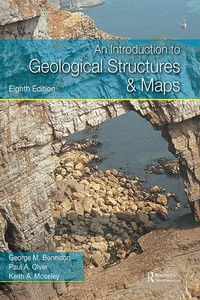
An Introduction to Geological Structures and Maps
8th Edition
Published on 26. November 2013
184 pages
978-1-4441-4960-9 (ISBN)
Description

An Introduction to Geological Structures and Maps is a concise and accessible textbook providing simple structural terminology and map problems which introduce geological structures. It is a perfect introduction to mapping for students of geology, engineering geology and civil engineering.
Each topic is explained and illustrated by figures, and exercises follow on successive maps. If students are unable to complete an exercise, they can read on to obtain more specific instructions on how theory may be used to solve the problem. An appendix at the end of the book provides the solutions.
This new, eighth edition contains simplified introductory matter to make the subject as easy to grasp as possible. Colour photographs illustrating geological structures bring the subject to life and a new map from the British Geological Survey illustrates a real area. There is more on outcrop patterns, which will help students to think in 3D, and on structures and the relationship of topography to geological structure. Cliff sections have been added to reinforce the concept of apparent dip. The section on planetary geology has been more closely tied to igneous geology to aid understanding of the connection between the two. Finally, a new map on economic geology has been added for the benefit of engineering students.
A geological glossary helps students to understand and memorise key terms and a new, colourful, text design enlivens the appearance of this popular book.
Each topic is explained and illustrated by figures, and exercises follow on successive maps. If students are unable to complete an exercise, they can read on to obtain more specific instructions on how theory may be used to solve the problem. An appendix at the end of the book provides the solutions.
This new, eighth edition contains simplified introductory matter to make the subject as easy to grasp as possible. Colour photographs illustrating geological structures bring the subject to life and a new map from the British Geological Survey illustrates a real area. There is more on outcrop patterns, which will help students to think in 3D, and on structures and the relationship of topography to geological structure. Cliff sections have been added to reinforce the concept of apparent dip. The section on planetary geology has been more closely tied to igneous geology to aid understanding of the connection between the two. Finally, a new map on economic geology has been added for the benefit of engineering students.
A geological glossary helps students to understand and memorise key terms and a new, colourful, text design enlivens the appearance of this popular book.
Reviews / Votes
An Introduction to Geological Structures and Maps 'has been a friend to me as an undergraduate and also during the 32 years I have been teaching geology to Civil Engineering undergraduates. I have seen how it has changed over the years. None of these revisions have been as significant and as exciting as those in this 8th edition. The new chapter on strata is an excellent addition as is the new enhanced chapter on igneous and impact features. The most striking feature however, is the inclusion of colour photographs of geological features and structures. These really bring the book alive. The new map problems and exercises are excellent. It is great to see a colour extract of a published BGS map being included. I recommend this book to both students and teachers'.Dr. Marcus C. Matthews, Senior Lecturer in Geotechnical Engineering, Faculty of Engineering and Physical Sciences, University of Surrey, UK
'An Introduction to Geological Structure and Maps has been a prescribed textbook in our department for more than two decades and many a student has started their geological career as an undergraduate student working through "Bennison maps". The new eighth edition proves to be a major improvement on previous editions, with the addition of a more theoretical background on certain geological structures and concepts, backed up by some excellent diagrams and photo illustrations.... The section on igneous and impact features has been expanded quite a lot, [and] I find the additional pictures and background information very helpful. Chapter 12 on economic problems will be very helpful, too....This textbook will be a very valuable resource and teaching tool to undergraduate students and will remain a compulsory prescribed textbook in our department for many years to come'.
Gideon Brunsdon, Geology Lecturer, Nelson Mandela Metropolitan University, South Africa
An Introduction to Geological Structures and Maps is a testament to its ability to remain relevant to students.... concise and accessible....I welcome this "old friend" in its revitalized form'.
ESTA
' book that... will give you a thorough understanding of geological maps and enable you to "read" a geology map and visualise the subsurface structure for yourself.'
Open University Geological Studies Journal 32:1-2
More details
Edition
8th edition
Language
English
Place of publication
London
United Kingdom
Publishing group
Taylor & Francis Ltd
Target group
College/higher education
Edition type
Revised edition
Illustrations
30
File size
64,16 MB
ISBN-13
978-1-4441-4960-9 (9781444149609)
Copyright in bibliographic data and cover images is held by Nielsen Book Services Limited or by the publishers or by their respective licensors: all rights reserved.
Schweitzer Classification
Other editions
Additional editions
George M. Bennison | Paul A. Olver | Keith A. Moseley
An Introduction to Geological Structures and Maps
Book
11/2022
8th Edition
Routledge
€193.12
Shipment within 10-20 days
George M. Bennison | Paul A. Olver | Keith A. Moseley
An Introduction to Geological Structures and Maps
Book
03/2022
8th Edition
Routledge
€76.93
Shipment within 10-20 days
George M. Bennison
An Introduction to Geological Structures and Maps
Book
09/2017
8th Edition
Routledge
€252.55
Withdrawn from sale
George M. Bennison | Paul A. Olver | Keith A. Moseley
An Introduction to Geological Structures and Maps
Book
03/2011
8th Edition
Routledge
€69.51
Article exhausted; check different version
Persons
Dr George M. Bennison, Chartered Geologist, formerly Senior Lecturer in Geology, University of Birmingham, UK
Dr Paul A. Olver, Chartered Geologist, formerly Lifelong Learning Development Officer, Herefordshire Council, UK
Dr Keith A. Moseley, Head of Physics and Geology, Monmouth School, UK
Dr Paul A. Olver, Chartered Geologist, formerly Lifelong Learning Development Officer, Herefordshire Council, UK
Dr Keith A. Moseley, Head of Physics and Geology, Monmouth School, UK
Content
List of Plates
Preface to the current edition
Preface to previous editions
Key to maps
Chapter 1 Strata - the ground rules
Chapter 2 Horizontal strata
Contours
Horizontal and vertical strata in the landscape
Geological maps
Chapter 3 Dipping strata
Structure contours (strike lines)
Construction of structure contours
True and apparent dip
Calculation of the thickness of a bed
Width of outcrop
Inliers and outliers
Exercises using geological survey maps
Chapter 4 Three-point problems
Construction of structure contours
Depth in boreholes
Insertion of outcrops
Chapter 5 Unconformities
Overstep
Overlap
Sub-unconformity outcrops
Exercises using geological maps
Chapter 6 Folding
Anticlines and synclines
Asymmetrical folds
Way-up criteria
Similar and concentric folding
Two possible directions of strike
Exercise on published geological survey map
Chapter 7 Map solution without structure contours 1
Chapter 8 Faults
Normal and reversed faults
The effects of faulting on outcrops
Classification of faults
Calculation of the throw of a fault
Faults and economic calculations
Wrench or tear faults
Pre- and post-unconformity faulting
Structural inliers and outliers
Posthumous faulting
Isopachytes
Exercises on published geological survey maps
Chapter 9 Map solution without structure contours 2
Chapter 10 More folds and faulted folds
Plunging folds
Calculation of the amount of plunge
The effects of faulting on fold structures
Displacement of folds by strike-slip (wrench) faults
Calculation of strike-slip displacement
Faults parallel to the limbs of a fold
Sub-surface structures
Posthumous folding
Polyphase folding
Bed isopachytes
Exercises on geological survey maps
Chapter 11 Igneous and impact features
Pyroclastic rocks
Concordant intrusions
Disordant intrusions
Impact features
Exercise on geological survey map
Impact features
Chapter 12 Economic problems
Chapter 13 Complex structures
Nappes
Thrust faults
Axial plane cleavage
Description of a geological map
The geological history of Map 45
Exercise on geological survey map
Appendix
Glossary
Index
Preface to the current edition
Preface to previous editions
Key to maps
Chapter 1 Strata - the ground rules
Chapter 2 Horizontal strata
Contours
Horizontal and vertical strata in the landscape
Geological maps
Chapter 3 Dipping strata
Structure contours (strike lines)
Construction of structure contours
True and apparent dip
Calculation of the thickness of a bed
Width of outcrop
Inliers and outliers
Exercises using geological survey maps
Chapter 4 Three-point problems
Construction of structure contours
Depth in boreholes
Insertion of outcrops
Chapter 5 Unconformities
Overstep
Overlap
Sub-unconformity outcrops
Exercises using geological maps
Chapter 6 Folding
Anticlines and synclines
Asymmetrical folds
Way-up criteria
Similar and concentric folding
Two possible directions of strike
Exercise on published geological survey map
Chapter 7 Map solution without structure contours 1
Chapter 8 Faults
Normal and reversed faults
The effects of faulting on outcrops
Classification of faults
Calculation of the throw of a fault
Faults and economic calculations
Wrench or tear faults
Pre- and post-unconformity faulting
Structural inliers and outliers
Posthumous faulting
Isopachytes
Exercises on published geological survey maps
Chapter 9 Map solution without structure contours 2
Chapter 10 More folds and faulted folds
Plunging folds
Calculation of the amount of plunge
The effects of faulting on fold structures
Displacement of folds by strike-slip (wrench) faults
Calculation of strike-slip displacement
Faults parallel to the limbs of a fold
Sub-surface structures
Posthumous folding
Polyphase folding
Bed isopachytes
Exercises on geological survey maps
Chapter 11 Igneous and impact features
Pyroclastic rocks
Concordant intrusions
Disordant intrusions
Impact features
Exercise on geological survey map
Impact features
Chapter 12 Economic problems
Chapter 13 Complex structures
Nappes
Thrust faults
Axial plane cleavage
Description of a geological map
The geological history of Map 45
Exercise on geological survey map
Appendix
Glossary
Index
