

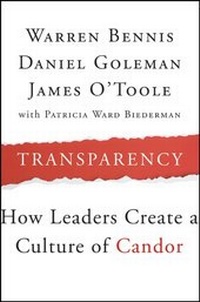
Transparency
How Leaders Create a Culture of Candor
Published on 23. December 2010
144 pages
978-1-118-03957-1 (ISBN)
Description

In Transparency, the authors-a powerhouse trio in thefield of leadership-look at what conspires against "a cultureof candor" in organizations to create disastrous results, andsuggest ways that leaders can achieve healthy and honest openness.They explore the lightning-rod concept of"transparency"-which has fast become the buzzword not only inbusiness and corporate settings but in government and the socialsector as well.
Together Bennis, Goleman, and O'Toole explore why thecontainment of truth is the dearest held value of far too manyorganizations and suggest practical ways that organizations, theirleaders, their members, and their boards can achieve openness.After years of dedicating themselves to research and theory, atfirst separately, and now jointly, these three leadership giantsreveal the multifaceted importance of candor and show what promotestransparency and what hinders it. They describe how leaders oftenstymie the flow of information and the structural impediments thatkeep information from getting where it needs to go. This vitalresource is written for any organization-business,government, and nonprofit-that must achieve a culture ofcandor, truth, and transparency.
Reviews / Votes
"...would not be out of place in the executive reading room." (Edge, October 2008)More details
Other editions
Additional editions
Book
02/2014
1st Edition
Jossey-Bass
€24.00
Shipment within 15-20 days
Book
06/2008
1st Edition
Jossey-Bass
€20.90
Article exhausted; check different version
Persons
Warren Bennis is Distinguished Professor of Business Administration and founding chairman of The Leadership Institute at the University of Southern California. He also serves as chairman of the Advisory Board of the Center for Public Leadership at Harvard University's John F. Kennedy School of Government. He is the author or coauthor of numerous books, including Judgment and On Becoming a Leader.
Daniel Goleman authored the best-selling books Emotional Intelligence and Primal Leadership. He is codirector of the Consortium for Research on Emotional Intelligence in Organizations, based at Rutgers University.
James O'Toole is the Daniels Distinguished Professor of Business Ethics at the University of Denver's Daniels College of Business. He is the author of seventeen books, including The Executive's Compass, Creating the Good Life, and Leading Change.
Content
Preface vii
Warren Bennis
1 Creating a culture of candor 1
Warren Bennis, Daniel Goleman, and Patricia Ward Biederman
2 Speaking truth to power 45
James O'Toole
3 The new transparency 93
Warren Bennis
Notes 123
The authors 129
1 CREATING A CULTURE OF CANDOR Warren Bennis, Daniel Goleman, and Patricia Ward Biederman
In the spring of 2007 something unprecedented happened in the southern Chinese city of Xiamen. In a nation notorious for keeping citizens in the dark, word got out that a petrochemical plant was to be built near the center of the lovely port city. The factory would have produced toxic paraxylene, and residents who learned of the plans were understandably alarmed. A decade ago, concerned Chinese citizens could have done little to stop the plant's construction. But this is a new age, not just in China but throughout the world. Via e-mail, blogs, and text messages, word of the plan spread and a protest was organized against it. As the Wall Street Journal reported, hundreds, perhaps thousands of protesters gathered at Xiamen's city hall to oppose the plant.1 Chinese officials refused to acknowledge the protest and shut down Web sites that opposed the plant. But using today's ubiquitous communication technology protestors were able to circumvent the official silence. Participants took photos of the protest with their cell phones and posted them on the Web. Much to the chagrin of Chinese officials, some photos were transmitted straight to sympathetic media. The result was a victory of electronics-driven light over official darkness. City officials have postponed construction of the plant until a new study of its environmental impact is completed. Today the word transparency pops up in stories about everything from corporate governance to the activities of the U.S. Justice Department. In the mouths of those in power, its meaning tends to be fuzzy, although, as New York Times essayist John Schwartz writes, when officials say they are being transparent, "what they really mean is 'not lying' and 'not hiding what we're really doing.' But that doesn't sound as nice or vague, does it?"2 The vagueness is understandable, however. As we all know, claiming to be transparent is not the same as actually being transparent. Even as many heads of corporations and even of states boast about their commitment to transparency, the containment of truth continues to be a dearly held value of many organizations. Sadly, you can say you believe in transparency without practicing it or even aspiring to it. While opacity is far less of a problem in the United States than in some other nations, it continues to characterize many, if not most, American organizations. And lack of transparency is usually no accident. It is often systematically built into the very structure of an organization. In the following pages, we look at the forces that conspire against an organizational culture of candor and transparency, and the often disastrous results when those qualities are lacking. We also show that the effort to withhold information from the public has become an all-but-impossible task because of profound changes in the global culture. Most important of these is the emergence of electronic technology that facilitates sunlight, and the rise, over the last decade, of the blogosphere-a development that has made transparency all but inevitable. In today's gotcha culture, no men's room tryst is sure to remain secret, no racial slur goes unrecorded, no corporate wrongdoing can be safely entombed forever in a company's locked file cabinets. A decade ago, secrets often remained buried until a professional journalist could be persuaded to reveal them. Today anyone with a cell phone and access to a computer has the power to bring down a billion-dollar corporation or even a government.
When we speak of transparency and creating a culture of candor, we are really talking about the free flow of information within an organization and between the organization and its many stakeholders, including the public. For any institution, the flow of information is akin to a central nervous system: the organization's effectiveness depends on it. An organization's capacity to compete, solve problems, innovate, meet challenges, and achieve goals-its intelligence, if you will-varies to the degree that information flow remains healthy. That is particularly true when the information in question consists of crucial but hard-to-take facts, the information that leaders may bristle at hearing-and that subordinates too often, and understandably, play down, disguise, or ignore. For information to flow freely within an institution, followers must feel free to speak openly, and leaders must welcome such openness. No matter the official line, true transparency is rare. Many organizations pay lip service to values of openness and candor, even writing their commitment into mission statements. Too often these are hollow, if not Orwellian, documents that fail to describe the organization's real mission and inspire frustration, even cynicism, in followers all too aware of a very different organizational reality. When we talk about information flow, we are not talking about some mysterious process. It simply means that critical information gets to the right person at the right time and for the right reason. Although the successful flow of information is not automatic and often requires the leader's commitment, if not intervention, it happens every day in organizational life, often in the most mundane ways. For instance, a few years ago, General Electric became alarmed about a precipitous drop in appliance sales. At meetings on the matter, the conversation soon narrowed to how the problem could be solved by improving marketing: should GE focus on pricing? On advertising? On some other change in marketing strategies? Then someone from the company's financial services arm, GE Capital, spoke up. He put up a PowerPoint presentation showing that consumer debt had reached near-saturation levels. The problem wasn't that GE was failing to market its appliances successfully. The likelier problem was that customers were too strapped to buy the big-ticket items that GE sold. That single crucial bit of information swiftly shifted the conversation from marketing to financing, as the company began seeking ways to help customers pay for appliances. The right information had found its way to the right people at the right time. Just as the free flow of information can maximize the likelihood of success, damming its flow can have tragic consequences. An instructive example is the decision of Guidant executives to continue selling their Contak Renewal defibrillators even after they learned that the implanted heart regulators were prone to electrical failures implicated in the deaths of at least seven patients. Because company officials remain silent on the matter, we can only speculate on why the firm decided not to recall the devices until 2005, three years after insiders learned of the flaw. Perhaps the health-sciences firm was blinded by its then-anticipated acquisition by Johnson & Johnson (it has since been acquired by Boston Scientific). Perhaps its corporate judgment was clouded by its Yale-Harvard-like competition with Medtronic, the leading manufacturer of implantable defibrillators. Whatever Guidant's reasoning, the result was not only needless deaths but a catastrophic trust problem with its primary customers-not heart patients but the physicians who prescribe the lucrative life-saving devices. According to the New York Times, Guidant's share of the defibrillator market dropped from 35 percent to about 24 percent after the recall, apparently because of the disgust many physicians felt at the company's decision to conceal an embarrassing truth on which patients' lives literally depended. As one angry physician wrote to the firm: "I am not critical of Guidant's device problems-these devices are so complex, issues are expected. I will not, however, work with a company that put profit and image in front of good patient care and honesty in device manufacturing."3
It almost goes without saying that complete transparency is not possible-nor is it even desirable, in many instances. Just as national security concerns may justify limiting access to certain information to a small number of carefully vetted individuals, an organization may have a legitimate interest in holding close and guarding from competitors information about innovations, original processes, secret recipes, or corporate strategies. Such secrets are reasonable. However, secretiveness is often simply reflexive. And secretive organizations are vulnerable to exposure by both the mainstream media and their growing legions of amateur competitors. But even when lack of candor is likely to be harmful, many organizations continue to choose it over openness, as Guidant appears to have done. Because the term transparency, like courage and patriotism, has the exalted ring of eternal truth, it is easy to forget that transparency is a choice. Writer Graeme Wood gives a vivid illustration of this in his analysis in the Atlantic of how differently recent U.S. administrations have treated sensitive information. 4 Arguing that the administration of President George W. Bush is unprecedented in its insistence on secrecy, Wood says the current trend began in 1982 with Ronald Reagan, whose philosophy was, in effect, "When in doubt, classify." By 1985, 15 million documents had been classified, far more than had been shrouded under President Carter. President Bill Clinton, who favored declassification, ushered in a new era, saying, in effect, "When in doubt, let it out."...
In the spring of 2007 something unprecedented happened in the southern Chinese city of Xiamen. In a nation notorious for keeping citizens in the dark, word got out that a petrochemical plant was to be built near the center of the lovely port city. The factory would have produced toxic paraxylene, and residents who learned of the plans were understandably alarmed. A decade ago, concerned Chinese citizens could have done little to stop the plant's construction. But this is a new age, not just in China but throughout the world. Via e-mail, blogs, and text messages, word of the plan spread and a protest was organized against it. As the Wall Street Journal reported, hundreds, perhaps thousands of protesters gathered at Xiamen's city hall to oppose the plant.1 Chinese officials refused to acknowledge the protest and shut down Web sites that opposed the plant. But using today's ubiquitous communication technology protestors were able to circumvent the official silence. Participants took photos of the protest with their cell phones and posted them on the Web. Much to the chagrin of Chinese officials, some photos were transmitted straight to sympathetic media. The result was a victory of electronics-driven light over official darkness. City officials have postponed construction of the plant until a new study of its environmental impact is completed. Today the word transparency pops up in stories about everything from corporate governance to the activities of the U.S. Justice Department. In the mouths of those in power, its meaning tends to be fuzzy, although, as New York Times essayist John Schwartz writes, when officials say they are being transparent, "what they really mean is 'not lying' and 'not hiding what we're really doing.' But that doesn't sound as nice or vague, does it?"2 The vagueness is understandable, however. As we all know, claiming to be transparent is not the same as actually being transparent. Even as many heads of corporations and even of states boast about their commitment to transparency, the containment of truth continues to be a dearly held value of many organizations. Sadly, you can say you believe in transparency without practicing it or even aspiring to it. While opacity is far less of a problem in the United States than in some other nations, it continues to characterize many, if not most, American organizations. And lack of transparency is usually no accident. It is often systematically built into the very structure of an organization. In the following pages, we look at the forces that conspire against an organizational culture of candor and transparency, and the often disastrous results when those qualities are lacking. We also show that the effort to withhold information from the public has become an all-but-impossible task because of profound changes in the global culture. Most important of these is the emergence of electronic technology that facilitates sunlight, and the rise, over the last decade, of the blogosphere-a development that has made transparency all but inevitable. In today's gotcha culture, no men's room tryst is sure to remain secret, no racial slur goes unrecorded, no corporate wrongdoing can be safely entombed forever in a company's locked file cabinets. A decade ago, secrets often remained buried until a professional journalist could be persuaded to reveal them. Today anyone with a cell phone and access to a computer has the power to bring down a billion-dollar corporation or even a government.
WHAT IS A CULTURE OF CANDOR?
When we speak of transparency and creating a culture of candor, we are really talking about the free flow of information within an organization and between the organization and its many stakeholders, including the public. For any institution, the flow of information is akin to a central nervous system: the organization's effectiveness depends on it. An organization's capacity to compete, solve problems, innovate, meet challenges, and achieve goals-its intelligence, if you will-varies to the degree that information flow remains healthy. That is particularly true when the information in question consists of crucial but hard-to-take facts, the information that leaders may bristle at hearing-and that subordinates too often, and understandably, play down, disguise, or ignore. For information to flow freely within an institution, followers must feel free to speak openly, and leaders must welcome such openness. No matter the official line, true transparency is rare. Many organizations pay lip service to values of openness and candor, even writing their commitment into mission statements. Too often these are hollow, if not Orwellian, documents that fail to describe the organization's real mission and inspire frustration, even cynicism, in followers all too aware of a very different organizational reality. When we talk about information flow, we are not talking about some mysterious process. It simply means that critical information gets to the right person at the right time and for the right reason. Although the successful flow of information is not automatic and often requires the leader's commitment, if not intervention, it happens every day in organizational life, often in the most mundane ways. For instance, a few years ago, General Electric became alarmed about a precipitous drop in appliance sales. At meetings on the matter, the conversation soon narrowed to how the problem could be solved by improving marketing: should GE focus on pricing? On advertising? On some other change in marketing strategies? Then someone from the company's financial services arm, GE Capital, spoke up. He put up a PowerPoint presentation showing that consumer debt had reached near-saturation levels. The problem wasn't that GE was failing to market its appliances successfully. The likelier problem was that customers were too strapped to buy the big-ticket items that GE sold. That single crucial bit of information swiftly shifted the conversation from marketing to financing, as the company began seeking ways to help customers pay for appliances. The right information had found its way to the right people at the right time. Just as the free flow of information can maximize the likelihood of success, damming its flow can have tragic consequences. An instructive example is the decision of Guidant executives to continue selling their Contak Renewal defibrillators even after they learned that the implanted heart regulators were prone to electrical failures implicated in the deaths of at least seven patients. Because company officials remain silent on the matter, we can only speculate on why the firm decided not to recall the devices until 2005, three years after insiders learned of the flaw. Perhaps the health-sciences firm was blinded by its then-anticipated acquisition by Johnson & Johnson (it has since been acquired by Boston Scientific). Perhaps its corporate judgment was clouded by its Yale-Harvard-like competition with Medtronic, the leading manufacturer of implantable defibrillators. Whatever Guidant's reasoning, the result was not only needless deaths but a catastrophic trust problem with its primary customers-not heart patients but the physicians who prescribe the lucrative life-saving devices. According to the New York Times, Guidant's share of the defibrillator market dropped from 35 percent to about 24 percent after the recall, apparently because of the disgust many physicians felt at the company's decision to conceal an embarrassing truth on which patients' lives literally depended. As one angry physician wrote to the firm: "I am not critical of Guidant's device problems-these devices are so complex, issues are expected. I will not, however, work with a company that put profit and image in front of good patient care and honesty in device manufacturing."3
CHOOSING TRANSPARENCY
It almost goes without saying that complete transparency is not possible-nor is it even desirable, in many instances. Just as national security concerns may justify limiting access to certain information to a small number of carefully vetted individuals, an organization may have a legitimate interest in holding close and guarding from competitors information about innovations, original processes, secret recipes, or corporate strategies. Such secrets are reasonable. However, secretiveness is often simply reflexive. And secretive organizations are vulnerable to exposure by both the mainstream media and their growing legions of amateur competitors. But even when lack of candor is likely to be harmful, many organizations continue to choose it over openness, as Guidant appears to have done. Because the term transparency, like courage and patriotism, has the exalted ring of eternal truth, it is easy to forget that transparency is a choice. Writer Graeme Wood gives a vivid illustration of this in his analysis in the Atlantic of how differently recent U.S. administrations have treated sensitive information. 4 Arguing that the administration of President George W. Bush is unprecedented in its insistence on secrecy, Wood says the current trend began in 1982 with Ronald Reagan, whose philosophy was, in effect, "When in doubt, classify." By 1985, 15 million documents had been classified, far more than had been shrouded under President Carter. President Bill Clinton, who favored declassification, ushered in a new era, saying, in effect, "When in doubt, let it out."...
