

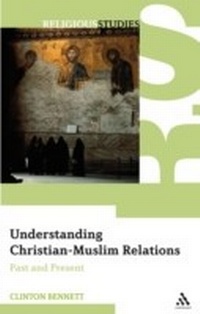
Understanding Christian-Muslim Relations
Past and Present
1st Edition
Published on 10. April 2008
272 pages
978-1-4411-8030-8 (ISBN)
Description

For centuries Christians and Muslims have engaged with each other in manifold ways, peaceful and otherwise, be it in scholarly study, or in war and colonization.
Today, Christians represent an influential body of opinion that largely perceives Islam, post 9/11, as a threat. Yet Muslims represent approximately one third of the world's population. Improved understanding between Christians and Muslims is therefore crucial and a prerequisite for universal peace and justice. This book aims to investigate Islam's place in the world, Muslim aspirations vis-a-vis non-Muslims and the realities of how Muslims are perceived and how they perceive others. Each chapter analyses accessible texts from central thinkers and commentators, broadly split into two camps: confrontational or conciliatory. Christian-Muslim relations are set in the wider context of civilizational, geo-political and economic interaction between the Muslim world and the historically Christian West.
Today, Christians represent an influential body of opinion that largely perceives Islam, post 9/11, as a threat. Yet Muslims represent approximately one third of the world's population. Improved understanding between Christians and Muslims is therefore crucial and a prerequisite for universal peace and justice. This book aims to investigate Islam's place in the world, Muslim aspirations vis-a-vis non-Muslims and the realities of how Muslims are perceived and how they perceive others. Each chapter analyses accessible texts from central thinkers and commentators, broadly split into two camps: confrontational or conciliatory. Christian-Muslim relations are set in the wider context of civilizational, geo-political and economic interaction between the Muslim world and the historically Christian West.
Reviews / Votes
Dr Clinton Bennett's Understanding Christian-Muslim Relations is a scholarly contribution to an important issue in our times. Dr Bennett tells us the story of Christian-Muslim relations with a view to improve our understanding of this area, and analyses the issues involved - past and present. This study is useful for anyone interested in the wider concerns of conciliation and dialogue in relations between Muslims and Christians. mention in Bookseller Buyers Guide, 1 January 2008 This book will undoubtedly repay careful reading and would make a most useful foundation text for a course in the history of Christian-Muslim relations. * Islam and Christian-Mulslim Relations, Vol. 20, April 2009 * Bennett has written a book that is detailed, informative, balanced and touches on both the politically correct and incorrect. There is a wide variety of people who will find this a helpful book. I commend it to everyone wanting to learn more about both Christianity and Islam. I also want to commend it to everyone wanting a deeper understanding of the relationship and developing dialogue between the two. * Theological Book Review, Vol. 21, 2009 * Key conclusions are that early arguments set much of the agenda up to modern times, and that the key issues concern the nature of Jesus and Muhammad, the reliability of the scriptures, the reality of the Crucifixion, and the unity of God. Bennett concludes by articulating his own support for conciliation. Summing up: Recommended. Lower-level undergraduates and above; general readers. * CHOICE, October 2008 *More details
Edition
1. Auflage
Language
English
Place of publication
New York
United States
ISBN-13
978-1-4411-8030-8 (9781441180308)
Copyright in bibliographic data and cover images is held by Nielsen Book Services Limited or by the publishers or by their respective licensors: all rights reserved.
Schweitzer Classification
Other editions
Additional editions
Book
04/2008
Continuum International Publishing Group Ltd.
€56.40
Shipment within 15-20 days
Book
04/2008
Continuum International Publishing Group Ltd.
€222.20
Shipment within 15-20 days
Person
Clinton Bennett teaches Religious Studies at the State University of New York at New Paltz,
USA.
USA.
Content
Introduction: Confrontation versus Conciliation, Debate versus Dialogue
1. The Bible: An Agenda for Dialogue or for Diatribe?
2. The Qur'an and Christianity: Affection or Hostility
3. Christian Polemic towards Islam: Classical Contributions
4. Christian Conciliatory Approaches to Islam
5. The Traditional Muslim Confrontational Approach to Christianity
6. Muslim Conciliatory Approaches to Christianity
7. Contemporary Christian and Muslim Polemic
8. Contemporary Christian and Muslim Conciliatory Contributions
Conclusion
1. The Bible: An Agenda for Dialogue or for Diatribe?
2. The Qur'an and Christianity: Affection or Hostility
3. Christian Polemic towards Islam: Classical Contributions
4. Christian Conciliatory Approaches to Islam
5. The Traditional Muslim Confrontational Approach to Christianity
6. Muslim Conciliatory Approaches to Christianity
7. Contemporary Christian and Muslim Polemic
8. Contemporary Christian and Muslim Conciliatory Contributions
Conclusion
