

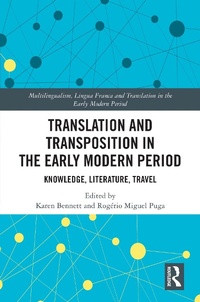
Translation and Transposition in the Early Modern Period
Knowledge, Literature, Travel
1st Edition
Published on 12. December 2023
264 pages
978-1-003-83131-0 (ISBN)
Description

This volume makes an important contribution to the understanding of translation theory and practice in the Early Modern period, focusing on the translation of knowledge, literature and travel writing, and examining discussions about the role of women and office of interpreter.
Over the course of the Early Modern period, there was a dramatic shift in the way that translation was conceptualised, a change that would have repercussions far beyond the world of letters. At the beginning of the period, translation was largely indistinguishable from other textual operations such as exegesis, glossing, paraphrase, commentary, or compilation, and theorists did not yet think in terms of the binaries that would come to characterise modern translation theory. Just how and when this shift occurred in actual translation practice is one of the topics explored in this volume through a series of case studies offering snapshots of translational activity in different times and places. Overall, the picture that emerges is of a translational practice that is still very flexible, as source texts are creatively appropriated for new purposes, whether pragmatic, pedagogical, or diversional, across a range of genres, from science and philosophy to literature, travel writing and language teaching.
This book will be of value to those interested in Early Modern history, linguistics, and translation studies.
Over the course of the Early Modern period, there was a dramatic shift in the way that translation was conceptualised, a change that would have repercussions far beyond the world of letters. At the beginning of the period, translation was largely indistinguishable from other textual operations such as exegesis, glossing, paraphrase, commentary, or compilation, and theorists did not yet think in terms of the binaries that would come to characterise modern translation theory. Just how and when this shift occurred in actual translation practice is one of the topics explored in this volume through a series of case studies offering snapshots of translational activity in different times and places. Overall, the picture that emerges is of a translational practice that is still very flexible, as source texts are creatively appropriated for new purposes, whether pragmatic, pedagogical, or diversional, across a range of genres, from science and philosophy to literature, travel writing and language teaching.
This book will be of value to those interested in Early Modern history, linguistics, and translation studies.
More details
Series
Edition
1. Auflage
Language
English
Place of publication
London
United Kingdom
Publishing group
Taylor & Francis Ebooks
Target group
College/higher education
Professional and scholarly
Illustrations
7 Tables, black and white; 3 Line drawings, black and white; 18 Halftones, black and white; 21 Illustrations, black and white
ISBN-13
978-1-003-83131-0 (9781003831310)
Copyright in bibliographic data and cover images is held by Nielsen Book Services Limited or by the publishers or by their respective licensors: all rights reserved.
Schweitzer Classification
Other editions
Additional editions
Karen Bennett | Rogerio Miguel Puga
Translation and Transposition in the Early Modern Period
Knowledge, Literature, Travel
Book
05/2025
1st Edition
Routledge
€67.90
Shipment within 15-20 days
Karen Bennett | Rogerio Miguel Puga
Translation and Transposition in the Early Modern Period
Knowledge, Literature, Travel
Book
12/2023
1st Edition
Routledge
€206.60
Shipment within 15-20 days
Persons
Karen Bennett is Associate Professor in Translation at Nova University, Lisbon, and researcher with the Centre for English, Translation and Anglo-Portuguese Studies (CETAPS), where she coordinates the Translationality strand. She is general editor of the journal Translation Matters.
Rogerio Miguel Puga is Associate Professor in English Studies at Nova University, Lisbon, and researcher with the Centre for English, Translation and Anglo-Portuguese Studies (CETAPS). He is also Research Fellow at CHAM (Centre for Humanities), Nova University, Lisbon. He is co-editor of the Anglo-Iberian Studies series (Peter Lang).
Rogerio Miguel Puga is Associate Professor in English Studies at Nova University, Lisbon, and researcher with the Centre for English, Translation and Anglo-Portuguese Studies (CETAPS). He is also Research Fellow at CHAM (Centre for Humanities), Nova University, Lisbon. He is co-editor of the Anglo-Iberian Studies series (Peter Lang).
Content
Introduction:
The Slow Transition: Reconfiguring Translation in the Early Modern Period
Karen Bennett
Introduction:
The Slow Transition: Reconfiguring Translation in the Early Modern Period
Karen Bennett
PART I. GENERAL REFLECTIONS
1. Translation as Transposition in Early Modern Europe
Peter Burke
2. Connected Identities: Representing Women in Seventeenth-century English Translation and Print
Marie-Alice Belle and Marie-France Guenette
PART II. TRANSLATING KNOWLEDGE
3. Translation, Humanism and Politics in Early Modern Germany: Xenophon's Hiero Translated by Adam Werner von Themar
Karl Gerhard Hempel
4. The Translational Practice of a Low German Surgeon
Chiara Benati
5. Mary Delany's British Flora (1769): Female Agency in the Translation of Science
Tiago Cardoso
6. Tibb-i Cedid (New Medicine) as a New Era in the Ottoman Medicine: Medical Texts Translated in the Eighteenth-century Ottoman Empire
Semih Sariguel
PART
III. LITERARY TRANSFIGURATIONS
7. Translation as Migration: Traveling Literary Classics into and from Arabic
Ferial Ghazoul
8. "Too Learned and Poetical for our Audience": Translation, (self-)canonisation and Satire in Jonson's Bartholomew Fair
Rui Carvalho Homem
9. "A Fantasticall Rapsody of Dialogisme": John Eliot and the Translational Grotesque
Joseph Hankinson
PART
IV. TRAVEL AND TRANSLATION
10. Indirect Translation and Discursive Identity in John Florio's Two Navigations
Donatella Montini
11. Samuel Purchas Translates China via Iberia: Fernao Mendes Pinto's Peregrinacao (1614) in Hakluytus Posthumus or Purchas his Pilgrimes (1625)
Rogerio Miguel Puga
12. Bolseiros, Lancados, Linguas, Jurubacas and Other Interpreters of Portuguese in Macau and Africa in the Early Modern Period
John Milton
The Slow Transition: Reconfiguring Translation in the Early Modern Period
Karen Bennett
Introduction:
The Slow Transition: Reconfiguring Translation in the Early Modern Period
Karen Bennett
PART I. GENERAL REFLECTIONS
1. Translation as Transposition in Early Modern Europe
Peter Burke
2. Connected Identities: Representing Women in Seventeenth-century English Translation and Print
Marie-Alice Belle and Marie-France Guenette
PART II. TRANSLATING KNOWLEDGE
3. Translation, Humanism and Politics in Early Modern Germany: Xenophon's Hiero Translated by Adam Werner von Themar
Karl Gerhard Hempel
4. The Translational Practice of a Low German Surgeon
Chiara Benati
5. Mary Delany's British Flora (1769): Female Agency in the Translation of Science
Tiago Cardoso
6. Tibb-i Cedid (New Medicine) as a New Era in the Ottoman Medicine: Medical Texts Translated in the Eighteenth-century Ottoman Empire
Semih Sariguel
PART
III. LITERARY TRANSFIGURATIONS
7. Translation as Migration: Traveling Literary Classics into and from Arabic
Ferial Ghazoul
8. "Too Learned and Poetical for our Audience": Translation, (self-)canonisation and Satire in Jonson's Bartholomew Fair
Rui Carvalho Homem
9. "A Fantasticall Rapsody of Dialogisme": John Eliot and the Translational Grotesque
Joseph Hankinson
PART
IV. TRAVEL AND TRANSLATION
10. Indirect Translation and Discursive Identity in John Florio's Two Navigations
Donatella Montini
11. Samuel Purchas Translates China via Iberia: Fernao Mendes Pinto's Peregrinacao (1614) in Hakluytus Posthumus or Purchas his Pilgrimes (1625)
Rogerio Miguel Puga
12. Bolseiros, Lancados, Linguas, Jurubacas and Other Interpreters of Portuguese in Macau and Africa in the Early Modern Period
John Milton
