

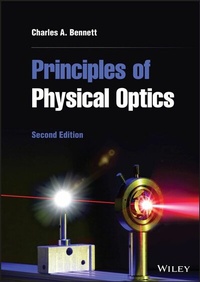
Principles of Physical Optics
Description

In the newly revised Second Edition of Principles of Physical Optics, eminent researcher Dr. Charles A. Bennet delivers an intuitive and practical text designed for a one-semester, introductory course in optics. The book helps readers build a firm foundation in physical optics and gain valuable, practical experience with a range of mathematical applications, including matrix methods, Fourier analysis, and complex algebra.
This latest edition is thoroughly updated and offers 20% more worked examples and 50% more homework problems than the First Edition.
Only knowledge of standard introductory sequences in calculus and calculus-based physics is assumed, with the included mathematics limited to what is necessary to adequately address the subject matter. The book provides additional materials on optical imaging and nonlinear optics and dispersion for use in an accelerated course. It also offers:
* A thorough introduction to the physics of waves, including the one-dimensional wave equation and transverse traveling waves on a string
* Comprehensive explorations of electromagnetic waves and photons, including introductory material on electromagnetism and electromagnetic wave equations
* Practical discussions of reflection and refraction, including Maxwell's equations at an interface and the Fresnel equations
* In-depth examinations of geometric optics, as well as superposition, interference, and diffraction
Perfect for advanced undergraduate students of physics, chemistry, and materials science, Principles of Physical Optics also belongs on the bookshelves of engineering students seeking a one-stop introduction to physical optics.
More details
Other editions
Additional editions
Person
Charles A. Bennett, PhD, is Emeritus Professor of Physics at the University of North Carolina at Asheville and former Director of the UNCA Center for Teaching and Learning. Since 1983, he has collaborated with Oak Ridge National Laboratory. His research is focused on quantum optics, physical optics, and laser applications in environmental and fusion energy problems.
Content
Preface xiii
Acknowledgments xv
1 The Physics of Waves 1
1.1 Introduction 1
1.2 One-Dimensional Wave Equation 1
1.3 General Solutions to the 1D Wave Equation 3
1.4 Harmonic Traveling Waves 5
1.5 The Principle of Superposition 7
1.5.1 Periodic Traveling Waves 7
1.5.2 Linear Independence 7
1.6 Complex Numbers and the Complex Representation 8
1.6.1 Complex Algebra 9
1.6.2 The Complex Representation of Harmonic Waves 11
1.7 The Three-Dimensional Wave Equation 12
1.7.1 Spherical Coordinates 13
1.7.2 Three-Dimensional Plane Waves 13
1.7.3 Spherical Waves 15
Problems 16
2 Electromagnetic Waves and Photons 23
2.1 Introduction 23
2.2 Electromagnetism 23
2.3 Electromagnetic Wave Equations 29
2.3.1 Transverse Electromagnetic Waves 31
2.3.2 Energy Flow and the Poynting Vector 33
2.3.3 Irradiance 34
2.4 Photons 37
2.4.1 Single-Photon Interference 41
2.5 The Electromagnetic Spectrum 42
Problems 43
3 Reflection and Refraction 51
3.1 Introduction 51
3.2 Overview of Reflection and Refraction 51
3.2.1 Fermat's Principle of Least Time 55
3.3 Maxwell's Equations at an Interface 57
3.3.1 Boundary Conditions 57
3.3.2 Electromagnetic Waves at an Interface 58
3.4 The Fresnel Equations 60
3.4.1 Incident Wave Polarized Normal to the Plane of Incidence 61
3.4.2 Incident Wave Polarized Parallel to the Plane of Incidence 63
3.5 Interpretation of the Fresnel Equations 65
3.5.1 Normal Incidence 66
3.5.2 Brewster's Angle 66
3.5.3 Total Internal Reflection 68
3.5.4 Plots of the Fresnel Equations vs. Incident Angle 71
3.5.5 Phase Changes on Reflection 72
3.5.5.1 Summary 75
3.6 Reflectivity and Transmissivity 75
3.6.1 Plots of Reflectivity and Transmissivity vs. Incident Angle 78
3.6.2 The Evanescent Wave 79
3.7 Scattering 81
3.7.1 Atmospheric Scattering 82
3.7.2 Rainbows 82
3.7.3 Parhelia 85
3.8 Optical Materials 86
3.9 Dispersion 86
3.9.1 Dispersion in Dielectric Media 86
3.9.1.1 Nonconducting Gases 92
3.9.2 Dispersion in Conducting Media 94
3.9.2.1 Reflection from Conductors 97
Problems 100
4 Geometric Optics I 107
4.1 Introduction 107
4.2 Reflection and Refraction at Aspheric Surfaces 107
4.3 Reflection and Refraction at a Spherical Surface 112
4.3.1 The Paraxial Approximation 112
4.3.2 Spherical Reflecting Surfaces 113
4.3.2.1 Sign Conventions for Reflecting Surfaces 114
4.3.3 Spherical Refracting Surfaces 115
4.3.4 Sign Conventions and Ray Diagrams 117
4.4 Lens Combinations 121
4.4.1 Thin Lenses in Close Combination 122
4.5 Optical Instruments 123
4.5.1 The Camera 123
4.5.2 The Eye 124
4.5.3 The Magnifying Glass 125
4.5.4 The Compound Microscope 126
4.5.5 The Telescope 127
4.5.6 The Exit Pupil 128
4.6 Optical Fibers 129
Problems 133
5 Geometric Optics II 139
5.1 Introduction 139
5.2 Aberrations 139
5.2.1 Chromatic Aberration 139
5.2.2 Spherical Aberration 143
5.2.3 Astigmatism and Coma 143
5.2.4 Field Curvature 143
5.2.5 Diffraction 144
5.3 Principal Points and Effective Focal Lengths in Paraxial Optics 144
5.4 Thick Paraxial Lenses 148
5.4.1 Principal Points and Effective Focal Lengths of Thick Paraxial Lenses 149
5.5 Introduction to Matrix Methods in Paraxial Geometrical Optics 153
5.5.1 The Translation Matrix 153
5.5.2 The Refraction Matrix 155
5.5.3 The Reflection Matrix 156
5.5.4 The Ray Transfer Matrix 157
5.5.5 Location of Principal Points and Effective Focal Lengths for an Optical System 161
5.6 Radiometry 165
5.6.1 Extended Sources 166
5.6.1.1 Spectral Distributions 168
5.6.1.2 Conservation of Radiance 168
5.6.2 Radiometry of Blackbody Sources 169
5.6.3 Rayleigh-Jeans Theory and the Ultraviolet Catastrophe 170
5.6.4 Planck's Quantum Theory of Blackbody Radiation 173
Problems 176
6 Polarization 185
6.1 Introduction 185
6.2 Linear Polarization 185
6.2.1 Linear Polarizers 186
6.2.2 Linear Polarizer Design 188
6.3 Birefringence 191
6.4 Circular and Elliptical Polarization 194
6.4.1 Wave Plates and Circular Polarizers 196
6.5 Jones Vectors and Matrices 199
6.5.1 Jones Matrices 201
6.5.2 Birefringent Colors 204
Problems 207
7 Superposition and Interference 213
7.1 Introduction 213
7.2 Superposition of Harmonic Waves 213
7.3 Interference Between Two Monochromatic Electromagnetic Waves 214
7.3.1 Linear Power Detection 215
7.3.2 Interference Between Beams with the Same Frequency 216
7.3.2.1 Young's Double-Slit Experiment 216
7.3.3 Thin-Film Interference 219
7.3.4 Quasi-Monochromatic Sources 222
7.3.5 Fringe Geometry 222
7.3.5.1 Lloyd's Mirror 223
7.3.5.2 Newton's Rings 223
7.3.6 Interference Between Beams with Different Frequencies 224
7.3.6.1 Coherent Detection 226
7.4 Fourier Analysis 229
7.4.1 Fourier Transforms 229
7.4.2 Position Space, k-Space Domain 230
7.4.3 Frequency-Time Domain 234
7.5 Properties of Fourier Transforms 234
7.5.1 Symmetry Properties 234
7.5.2 Linearity 235
7.5.3 Transform of a Transform 236
7.6 Wavepackets 236
7.7 Group and Phase Velocity 241
7.8 Interferometry 243
7.8.1 Energy Conservation and Complementary Fringe Patterns 248
7.9 Single-Photon Interference 250
7.10 Multiple-Beam Interference 251
7.10.1 The Scanning Fabry-Perot Interferometer 254
7.11 Interference in Multilayer Films 257
7.11.1 Antireflection Films 261
7.11.2 High-Reflectance Films 263
7.11.2.1 Fabry-Perot Interference Filters 264
7.12 Coherence 265
7.12.1 Temporal Coherence 265
7.12.2 Spatial Coherence 266
7.12.3 Michelson's Stellar Interferometer 269
7.12.4 Irradiance Interferometry 270
7.12.5 Telescope Arrays 271
Problems 272
8 Diffraction 281
8.1 Introduction 281
8.2 Huygens' Principle 282
8.2.1 Babinet's Principle 284
8.3 Fraunhofer Diffraction 284
8.3.1 Single Slit 285
8.3.2 Rectangular Aperture 290
8.3.3 Circular Aperture 291
8.3.4 Optical Resolution 294
8.3.5 More on Stellar Interferometry 295
8.3.6 Double Slit 295
8.3.7 N Slits: The Diffraction Grating 296
8.3.8 The Diffraction Grating 298
8.3.8.1 Chromatic Resolving Power 302
8.3.9 Fraunhofer Diffraction as a Fourier Transform 304
8.3.10 Apodization 306
8.3.10.1 Apertures with Circular Symmetry 307
8.4 Fresnel Diffraction 309
8.4.1 Fresnel Zones 310
8.4.1.1 Circular Apertures 313
8.4.1.2 Circular Obstacles 313
8.4.1.3 Fresnel Zone Plate 316
8.4.2 Holography 320
8.4.3 Numerical Analysis of Fresnel Diffraction with Circular Symmetry 321
8.4.4 Fresnel Diffraction from Apertures with Cartesian Symmetry 323
8.4.4.1 Semi-Infinite Straightedge 326
8.4.4.2 Single Slit 327
8.4.4.3 Rectangular Aperture 329
8.5 Introduction to Quantum Electrodynamics 330
8.5.1 Feynman's Interpretation 333
Problems 334
9 Lasers 343
9.1 Introduction 343
9.2 Energy Levels in Atoms, Molecules, and Solids 343
9.2.1 Atomic Energy Levels 343
9.2.2 Molecular Energy Levels 346
9.2.3 Solid-State Energy Bands 348
9.2.4 Semiconductor Devices 352
9.3 Stimulated Emission and Light Amplification 354
9.4 Laser Systems 357
9.4.1 Atomic Gas Lasers 358
9.4.1.1 Helium-Neon Laser 359
9.4.2 Molecular Gas Lasers 360
9.4.2.1 Carbon Dioxide Laser 360
9.4.3 Solid-State Lasers 362
9.4.3.1 Diode Lasers 363
9.4.4 Other Laser Systems 364
9.5 Longitudinal Cavity Modes 365
9.6 Frequency Stability 366
9.7 Introduction to Gaussian Beams 367
9.7.1 Overview of Gaussian Beam Properties 367
9.8 Gaussian Beam Properties 369
9.8.1 Approximate Solutions to the Wave Equation 370
9.8.2 Paraxial Spherical Gaussian Beams 372
9.8.3 Gaussian Beam Focusing 373
9.8.4 Matrix Methods and the ABCD Law 376
9.9 Laser Cavities 377
9.9.1 Laser Cavity with Equal Mirror Curvatures 377
9.9.2 Laser Cavity with Unequal Mirror Curvatures 379
9.9.3 Stable Resonators 381
9.9.4 Traveling Wave Resonators 385
9.9.5 Unstable Resonators 385
9.9.6 Transverse Cavity Modes 386
9.10 Electro-optics and Nonlinear Optics 387
9.10.1 The Electro-optic Effect 388
9.10.1.1 Pockels Cells 388
9.10.1.2 Kerr Cells 390
9.10.2 Optical Activity 390
9.10.2.1 Faraday Rotation 392
9.10.3 Acousto-optic Effect 393
9.10.4 Nonlinear Optics 397
9.10.4.1 Harmonic Generation 398
9.10.4.2 Phase Conjugation Reflection by Degenerate Four-Wave Mixing 402
9.10.5 Frequency Mixing 404
Problems 405
10 Optical Imaging 419
10.1 Introduction 419
10.2 Abbe Theory of Image Formation 419
10.2.1 Phase Contrast Microscope 424
10.3 The Point Spread Function 425
10.3.1 Coherent vs. Incoherent Images 426
10.3.2 Speckle 430
10.4 Resolving Power of Optical Instruments 431
10.5 Image Recording 432
10.5.1 Photographic Film 433
10.5.2 Digital Detector Arrays 434
10.6 Contrast Transfer Function 436
10.7 Spatial Filtering 437
10.8 Adaptive Optics 441
Problems 443
Appendix A Chapter 1 Appendix: Transverse Traveling Waves on a String 449
Appendix B Chapter 2 Appendix: Electromagnetic Wave Equations 451
B. 1 Maxwell's Equations in Differential Form and Wave Equations for ¿E and ¿B 451
B. 2 Method 1: Cartesian Coordinates 451
B.2. 1 Wave Equations for ¿E and ¿B 455
B. 3 Method 2: Vector Calculus 456
B.3. 1 Wave Equations for ¿E and ¿B 457
Appendix C Chapter 5 Appendix: Calculation of the Jeans Number 459
Appendix D Chapter 7 Appendix: Fourier Series 461
D.1 Real Fourier Series 461
D.2 Complex Fourier Series 467
D.3 Nonperiodic Functions and Fourier Transforms 468
Problems 470
Appendix E Solutions to Selected Problems 473
Bibliography 553
Index 555
1
The Physics of Waves
The solution of the difficulty is that the two mental pictures which experiment lead us to form - the one of the particles, the other of the waves - are both incomplete and have only the validity of analogies which are accurate only in limiting cases.
Heisenberg
1.1 Introduction
The properties of waves are central to the study of optics. As we will see, light (or more properly, electromagnetic radiation) has both particle and wave properties. These complementary aspects are a result of quantum mechanics, and prior to the early 1900s, there were two schools of thought. Newton postulated that light consists of particles, while contemporaries Huygens and Hooke promoted a wave theory of light. The matter seemed settled with Young's important double-slit experiment offering clear experimental evidence that light is a wave. Maxwell's sweeping theory of electromagnetism finally provided a deep and complete description of electromagnetic waves that we consider in detail in Chapter 2. Although current theories of optics include both wave and particle descriptions, the wave picture still forms the bedrock of most optical technology. In this chapter, we will outline some general properties that apply to traveling waves of all types.
1.2 One-Dimensional Wave Equation
Mechanical waves travel within elastic media whose material properties provide restoring forces that result in oscillation. When a guitar string is plucked, it is displaced away from its equilibrium position, and the mechanical energy of this disturbance subsequently propagates along the string as traveling waves. In this case, the waves are transverse, meaning that the displacement of the medium (the string) is perpendicular to the direction of energy travel. Acoustic waves in a gas are longitudinal, meaning that the gas molecules are displaced back and forth along the direction of energy flow as regions of high and low pressure are created along the wave.
As we shall see in Chapter 2, electromagnetic waves are transverse but differ from mechanical waves in that they do not require an elastic medium. Rather, they propagate as disturbances in the electromagnetic field. Mechanical waves and electromagnetic waves are both examples of classical waves, which can be described with classical physics.1
Consider a mechanical wave, and let describe a disturbance of the medium away from its equilibrium condition. For a transverse wave along a horizontal string, represents a vertical displacement along the -axis. For a longitudinal acoustic wave traveling horizontally through air, might represent deviations away from ambient pressure along the -axis. In any case, we refer to as the wavefunction. Since depends only on the single spatial coordinate , it is a one-dimensional wavefunction.
All classical mechanical waves can be described by the differential wave equation
(1.1)where is the wave speed and is the wavefunction. To demonstrate that a given function describes a classical wave, it is necessary only to show that this function satisfies Equation 1.1. Conversely, any physical system that can be shown to be described by Equation 1.1 must necessarily involve classical traveling waves.
Equation 1.1 is an example of a class of mathematical equations known as differential equations. When taking a partial derivative with respect to a given parameter, the remaining parameters are treated as constants.
1.3 General Solutions to the 1D Wave Equation
Consider a plot of vs. . Data for such a plot could be provided by an array of measuring devices, such as an array of pressure sensors arranged linearly to record the pressure amplitude of a passing acoustic wave. A plot of vs. at a particular time represents a snap shot of the wave as it passes by an array of measuring devices.
There are many possible shapes for this amplitude. Perhaps a sinusoidal function comes to mind, with distinct periodic crests and troughs. However, such waves are not the most general solution to Equation 1.1, as you can determine by comparing the sound of your voice as you hum or sing a specific musical note (if you can!) with the sound that your hands make when you clap them together. We will refer to the sound of a clap as a pulse.
We will show below that the most general solutions to Equation 1.1 may be expressed as follows:
(1.2) (1.3)where the functions and represent any function that has finite second derivatives and the parameters , , and all occur explicitly within the function as or .
As an example, consider the function
(1.4)where is a constant. Equation 1.4 represents a peaked function whose maximum is located at points given by . A plot of this wavefunctions at two different times is shown in Figure 1.1.
To show that Equation 1.4 represents a traveling wave, we could simply check to see if it solves the differential wave equation. It is more elegant, however, to show this for any differentiable functions given by Equations 1.2 and 1.3. Begin with the function , and define a new variable given by . Differentiate using the chain rule:
In this case, , so the derivative of with respect to is just 1. Thus,
and
(1.5)The time derivative of is given by
Figure 1.1 The traveling pulse of Equation 1.4, shown at two different times .
and
(1.6)Substitute the results of Equations 1.5 and 1.6 into the differential wave equation:
Thus Equation 1.1 is satisfied by . In a similar way, you may show that also solves Equation 1.1 (see Problem 1.7). Thus and both solve the differential wave equation and therefore represent traveling waves.
In summary, we have shown that functions of and with finite second derivatives and with explicit occurrences of and that can be grouped as or are solutions to the differential wave equation and thus represent traveling waves. In particular, the function of Equation 1.4 fits this requirement and is therefore a traveling wave. Of course, you can also demonstrate this by substituting Equation 1.4 directly into Equation 1.1 (see Example 1.2).
We now show that the function represents a forward-traveling wave. Consider values of and determined by . In Equation 1.4, choosing the value zero for this constant locates the peak of the pulse. As time proceeds, the specific value of that satisfies this equation changes according to
or
Thus, propagates in the positive direction with velocity and is therefore a forward-traveling wave. In a similar way, you can show that represents a backward-traveling wave (see Problem 1.8).
1.4 Harmonic Traveling Waves
According to the results of Section 1.3, any function described by Equation 1.2 or 1.3 represents a traveling wave. In particular, harmonic functions (i.e. sines and cosines) with the appropriate arguments solve the differential wave equation. Thus, the following function represents a traveling wave:
(1.7)where is the wave amplitude and is defined below.
Harmonic functions are periodic with a period of radians:
The given in Equation 1.7 is periodic in both space and time coordinates. The term represents the spatial period:
The parameter is also called the wavelength. It has SI units of meters.
Let represent the temporal period, i.e. the time required for one cycle. The SI unit of is seconds (s), but it is convenient to use s/cycle as a reminder of what represents. Since Equation 1.7 is periodic in , we have
represents the temporal period provided that
(1.8)or
(1.9)Thus, a periodic classical wave travels one wavelength in one temporal period . It is customary to define the wave frequency as
(1.10)The units of are cycles/s (SI unit: ), often referred to as Hertz (Hz). In terms of frequency, Equation 1.9 becomes
(1.11)A plot of vs. is shown in Figure 1.2(a). Figure 1.2(b) shows a plot of vs. . A plot such as this could be obtained from data provided by a measuring device located at a particular value of .
It is customary to define the propagation constant as follows:
(1.12)This quantity is also sometimes referred to as the wavenumber. Since converts meters to radians, the units are rad/m (SI unit: ). We may rewrite Equation 1.7 as
Similarly, we can define the angular frequency:
(1.13)Figure 1.2 Plots of a harmonic wavefunction. (a) A plot of vs. position . (b) A plot...
