

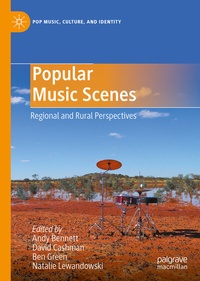
Popular Music Scenes
Description

Part 1 will focus on the spatial aspects of regional popular music scenes and how place and locality inform the perceptions and discourses of those involved in such scenes.
Part 2 focuses on the technologies and forms of distribution whereby regional and rural popular music scenes exist and, in many cases co-exist in forms of trans-local connection with other scenes.
Part 3 considers the importance of collective memory in the way that regional and rural popular music scenes are constructed in both the past and the present.
Part 4 examines themes of industry and policy, in relation to culture and music, as these impact on the nature and identity of rural and regional popular music scenes.
More details
Other editions
Additional editions
Persons
David Cashman is an Adjunct Associate Professor of Contemporary Music at Southern Cross University. He writes on regional music scenes, live popular music, and music and tourism.
Ben Green is a Postdoctoral Research Fellow of the Griffith Centre for Social and Cultural Research at Griffith University in Queensland, Australia. He is the author of
Peak Music Experiences: A New Perspective on Popular Music, Identity and Scenes.
Natalie Lewandowski is an Adjunct of the Creative Arts Institute at Griffith University in Queensland, Australia. Her experience working across government, the arts, academia and commercial industries has resulted in publications and engagement with film sound, music sustainability, music and wellbeing.
