

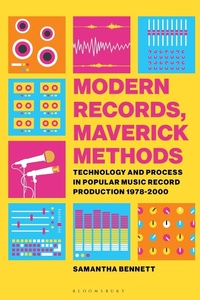
Modern Records, Maverick Methods
Technology and Process in Popular Music Record Production 1978-2000
1st Edition
Published on 27. December 2018
256 pages
978-1-5013-4412-1 (ISBN)
Description

From the Fairlight CMI through MIDI to the digital audio workstations at the turn of the millennium, Modern Records, Maverick Methods examines a critical period in commercial popular music record production: the transformative digital age from the late 1970s until 2000.
Drawing on a discography of more than 300 recordings across pop, rock, hip hop, dance and alternative musics from artists such as the Beastie Boys, Madonna, U2 and Fatboy Slim, and extensive and exclusive ethnographic work with many world-renowned recordists, Modern Records presents a fresh and insightful new perspective on one of the most significant eras in commercial music record production.
The book traces the development of significant music technologies through the 1980s and 1990s, revealing how changing attitudes and innovative techniques of recording personnel reimagined recording processes and, finally, exemplifies the impact of these technologies and techniques via six comprehensive tech-processual analyses. This meticulously researched and timely book reveals the complexity of recordists' responses to a technological landscape in flux.
Drawing on a discography of more than 300 recordings across pop, rock, hip hop, dance and alternative musics from artists such as the Beastie Boys, Madonna, U2 and Fatboy Slim, and extensive and exclusive ethnographic work with many world-renowned recordists, Modern Records presents a fresh and insightful new perspective on one of the most significant eras in commercial music record production.
The book traces the development of significant music technologies through the 1980s and 1990s, revealing how changing attitudes and innovative techniques of recording personnel reimagined recording processes and, finally, exemplifies the impact of these technologies and techniques via six comprehensive tech-processual analyses. This meticulously researched and timely book reveals the complexity of recordists' responses to a technological landscape in flux.
Reviews / Votes
Bennett provides loads of details and analysis in her diverse linkage of process, technology, and the people whose maverick methods sought to combine and overlay analogue and digital technologies ... A valuable book for musicians, fans, and scholars. It is an interesting read for others as well. * Leonardo Reviews * In this deeply researched study of commercial popular music production in the 1980s and '90s, Samantha Bennett turns the digital vs. analog debate on its head, revealing the hybrid "maverick methods" recordists developed as they blended technologies and practices from both analog and digital domains in a rapidly changing studio environment. Rich in technical detail and musical analysis, the book nevertheless underscores the human element of record-making as recordists' choices and attitudes influenced the sound of the "modern records" they produced. * Susan Schmidt Horning, Associate Professor of History, St. John's University, USA, and author of Chasing Sound: Technology, Culture, and the Art of Studio Recording from Edison to the LP (2013). * In Modern Records, Maverick Methods, Sam Bennett not only provides a hugely detailed study of the linking technologies and methods that characterise the two decades between the 'golden age' of rock recording in the 1960s/70s and the current world of the DAW, she also provides a fascinating analysis of the tortured and complex process through which attitudes to recording technologies both developed and changed. This is an important and welcome addition to the literature. * Simon Zagorski-Thomas, Professor of Music, London College of Music, UK, and author of The Musicology of Record Production (2014) * Modern Records begins with a simple question: "How are recordings made and why do they sound the way they do?" The answers to that question take Bennett deep into the processes of recording and are as fascinating and diverse, profound and fun as the music itself. Process, technology, sound and music are at the heart of this study and the strength of Bennett's approach is how she links them together - an illuminating read for musicians, fans and scholars alike. * Paul Theberge, Canada Research Professor in Music and Interdisciplinary Studies, Carleton University, Canada, and co-editor of Living Stereo: Histories and Cultures of Multichannel Sound (Bloomsbury, 2015) *More details
Edition
1. Auflage
Language
English
Place of publication
New York
United States
Publishing group
Bloomsbury Publishing PLC (Digital)
ISBN-13
978-1-5013-4412-1 (9781501344121)
Copyright in bibliographic data and cover images is held by Nielsen Book Services Limited or by the publishers or by their respective licensors: all rights reserved.
Schweitzer Classification
Other editions
Additional editions
Samantha Bennett
Modern Records, Maverick Methods
Technology and Process in Popular Music Record Production 1978-2000
Book
12/2018
Bloomsbury Academic USA
€54.65
Shipment within 15-20 days
Person
Samantha Bennett is Associate Professor of Music at the Australian National University. She is the author of Siouxsie and the Banshees' Peepshow (2018), part of Bloomsbury's 33 1/3 series, and co-editor of Critical Approaches to the Production of Music and Sound (2018) and Popular Music, Stars and Stardom (2018). Her journal articles are published in Popular Music, Popular Music and Society, The Journal of Popular Music Studies and IASPM@journal.
Content
List of Tables and Diagrams
Acknowledgements
1. Introduction
2. Constructing Records: Sound Recording and Production Technology in the Early 1980s
3. The Sound of Technology: Machines and Formats that Transformed Mid-late 1980s Popular Music
4. Technological Hybridity: Conflations of Analogue, Digital, the Cutting Edge and the Vintage in the 1990s
5. Maverick Methods: Tech-Processual Unorthodoxies in Contemporary Record Production
6. Sound Recordists in Flux: The Diversification of the Recording and Production Role
7. Sound Minds: Mapping Recordists' Attitudes
8. Analyzing Technology and Process in Popular Music Recordings: A Tech-Processual Methodology
9. Conclusion
Records Cited
Bibliography
Filmography
Acknowledgements
1. Introduction
2. Constructing Records: Sound Recording and Production Technology in the Early 1980s
3. The Sound of Technology: Machines and Formats that Transformed Mid-late 1980s Popular Music
4. Technological Hybridity: Conflations of Analogue, Digital, the Cutting Edge and the Vintage in the 1990s
5. Maverick Methods: Tech-Processual Unorthodoxies in Contemporary Record Production
6. Sound Recordists in Flux: The Diversification of the Recording and Production Role
7. Sound Minds: Mapping Recordists' Attitudes
8. Analyzing Technology and Process in Popular Music Recordings: A Tech-Processual Methodology
9. Conclusion
Records Cited
Bibliography
Filmography
