

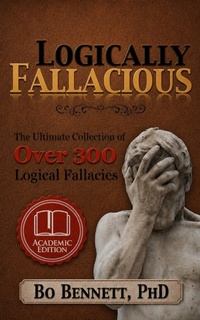
Logically Fallacious
The Ultimate Collection of Over 300 Logical Fallacies (Academic Edition)
Published on 19. February 2012
481 pages
978-1-4566-0737-1 (ISBN)
Description

This book is a crash course in effective reasoning, meant to catapult you into a world where you start to see things how they really are, not how you think they are. The focus of this book is on logical fallacies, which loosely defined, are simply errors in reasoning. With the reading of each page, you can make significant improvements in the way you reason and make decisions. Logically Fallacious is one of the most comprehensive collections of logical fallacies with all original examples and easy to understand descriptions, perfect for educators, debaters, or anyone who wants to improve his or her reasoning skills. "Expose an irrational belief, keep a person rational for a day. Expose irrational thinking, keep a person rational for a lifetime." - Bo Bennett
More details
Other editions
Additional editions
Bo Bennett
Logically Fallacious
The Ultimate Collection of Over 300 Logical Fallacies (Academic Edition)
Book
02/2012
Ebookit.com
€27.50
Article not available for order
Person
Bo holds a PhD in social psychology, a master's degree in general psychology, and a bachelor's degree in marketing.
Content
- Intro
- Contents
- Preface
- Introduction
- Reasoning
- Arguments
- Beliefs
- What is a Logical Fallacy, Exactly?
- An Error in Reasoning
- Formal and Informal Fallacies
- The Difference Between Logical Fallacies and Cognitive Biases
- Factual Errors are Not Logical Fallacies
- Logical Fallacies Can Be Committed by the Arguer or Audience
- Logical Fallacies are Deceptive
- Logical Fallacies are Common and Worthy of Identifying by Name
- Dr. Bo's Three Criteria for a Logical Fallacy
- On Reason and Rationality
- Being a Smart-Ass
- When All You Have is a Hammer, Everything Looks Like a Nail.
- Methodology
- Format and Style of this Book
- Accent Fallacy
- Accident Fallacy
- Ad Fidentia
- Ad Hoc Rescue
- Ad Hominem (Abusive)
- Ad Hominem (Circumstantial)
- Ad Hominem (Guilt by Association)
- Ad Hominem (Tu quoque)
- Affirmative Conclusion from a Negative Premise
- Affirming a Disjunct
- Affirming the Consequent
- Alleged Certainty
- Alphabet Soup
- Alternative Advance
- Amazing Familiarity
- Ambiguity Fallacy
- Anonymous Authority
- Anthropomorphism
- Appeal to Accomplishment
- Appeal to Anger
- Appeal to Authority
- Appeal to Celebrity
- Appeal to Closure
- Appeal to Coincidence
- Appeal to Common Belief
- Appeal to Common Folk
- Appeal to Common Sense
- Appeal to Complexity
- Appeal to Consequences
- Appeal to Definition
- Appeal to Desperation
- Appeal to Emotion
- Appeal to Equality
- Appeal to Extremes
- Appeal to Faith
- Appeal to False Authority
- Appeal to Fear
- Appeal to Flattery
- Appeal to Force
- Appeal to Heaven
- Appeal to Intuition
- Appeal to Loyalty
- Appeal to Nature
- Appeal to Normality
- Appeal to Novelty
- Appeal to Pity
- Appeal to Popularity
- Appeal to Possibility
- Appeal to Ridicule
- Appeal to Self-evident Truth
- Appeal to Spite
- Appeal to Stupidity
- Appeal to the Law
- Appeal to the Moon
- Appeal to Tradition
- Appeal to Trust
- Argument by Emotive Language
- Argument by Fast Talking
- Argument by Gibberish
- Argument by Personal Charm
- Argument by Pigheadedness
- Argument by Repetition
- Argument by Selective Reading
- Argument from Age
- Argument from Fallacy
- Argument from Hearsay
- Argument from Ignorance
- Argument from Incredulity
- Argument from Silence
- Argument of the Beard
- Argument to Moderation
- Argument to the Purse
- Avoiding the Issue
- Base Rate Fallacy
- Begging the Question
- Biased Sample Fallacy
- Blind Authority Fallacy
- Broken Window Fallacy
- Bulverism
- Causal Reductionism
- Cherry Picking
- Circular Definition
- Circular Reasoning
- Commutation of Conditionals
- Complex Question Fallacy
- Conflicting Conditions
- Confusing an Explanation with an Excuse
- Confusing Currently Unexplained with Unexplainable
- Conjunction Fallacy
- Conspiracy Theory
- Contextomy
- Deceptive Sharing
- Definist Fallacy
- Denying a Conjunct
- Denying the Antecedent
- Denying the Correlative
- Disjunction Fallacy
- Distinction Without a Difference
- Double Standard
- Ecological Fallacy
- Etymological Fallacy
- Equivocation
- Exclusive Premises
- Existential Fallacy
- Extended Analogy
- Fact-to-Fiction Fallacy
- Failure to Elucidate
- Fake Precision
- Fallacy of (the) Undistributed Middle
- Fallacy of Composition
- Fallacy of Division
- Fallacy of Every and All
- Fallacy of Four Terms
- Fallacy of Opposition
- False Attribution
- False Conversion
- False Dilemma
- False Effect
- False Equivalence
- Fantasy Projection
- Far-Fetched Hypothesis
- Faulty Comparison
- Gadarene Swine Fallacy
- Galileo Fallacy
- Gambler's Fallacy
- Genetic Fallacy
- Gish Gallop
- Hasty Generalization
- Having Your Cake
- Hedging
- Historian's Fallacy
- Homunculus Fallacy
- Hot Hand Fallacy
- Hypnotic Bait and Switch
- Hypothesis Contrary to Fact
- Identity Fallacy
- If-By-Whiskey
- Illicit Contraposition
- Illicit Major
- Illicit Minor
- Illicit Substitution of Identicals
- Imposter Fallacy
- Incomplete Comparison
- Inconsistency
- Inflation of Conflict
- Insignificant Cause
- Jumping to Conclusions
- Just Because Fallacy
- Just In Case Fallacy
- Kettle Logic
- Least Plausible Hypothesis
- Limited Depth
- Limited Scope
- Logic Chopping
- Ludic Fallacy
- Lying with Statistics
- Magical Thinking
- McNamara Fallacy
- Meaningless Question
- Misleading Vividness
- Missing Data Fallacy
- Modal (Scope) Fallacy
- Moralistic Fallacy
- Moving the Goalposts
- Multiple Comparisons Fallacy
- Naturalistic Fallacy
- Negating Antecedent and Consequent
- Negative Conclusion from Affirmative Premises
- Nirvana Fallacy
- No True Scotsman
- Non Sequitur
- Notable Effort
- Nutpicking Fallacy
- Overextended Outrage
- Oversimplified Cause Fallacy
- Overwhelming Exception
- Package-Deal Fallacy
- Poisoning the Well
- Political Correctness Fallacy
- Post-Designation
- Post Hoc
- Pragmatic Fallacy
- Prejudicial Language
- Proof by Intimidation
- Proof Surrogate
- Proving Non-Existence
- Psychogenetic Fallacy
- Quantifier-Shift Fallacy
- Quantum Physics Fallacy
- Questionable Cause
- Rationalization
- Red Herring
- Reductio ad Hitlerum
- Regression Fallacy
- Reification
- Relative Privation
- Retrogressive Causation
- Righteousness Fallacy
- Rights To Ought Fallacy
- Scapegoating
- Self-righteousness Fallacy
- Selective Attention
- Self-Sealing Argument
- Shifting of the Burden of Proof
- Shoehorning
- Slippery Slope
- Special Pleading
- Spiritual Fallacy
- Spin Doctoring
- Spotlight Fallacy
- Statement of Conversion
- Stereotyping (the fallacy)
- Stolen Concept Fallacy
- Strawman Fallacy
- Style Over Substance
- Subjectivist Fallacy
- Subverted Support
- Sunk-Cost Fallacy
- Suppressed Correlative
- Survivorship Fallacy
- Texas Sharpshooter Fallacy
- Tokenism
- Traitorous Critic Fallacy
- Two Wrongs Make a Right
- Type-Token Fallacy
- Unfalsifiability
- Unreasonable Inclusion Fallacy
- Unwarranted Contrast
- Use-Mention Error
- Weak Analogy
- Willed Ignorance
- Wishful Thinking
- Pseudo-Logical Fallacies
- Cognitive Biases, Effects, and Heuristics
- The Reductios: Techniques for Exposing Fallacious Reasoning
- Types of Lies
- Top 25 Most Common Fallacies
- Practice Identifying Fallacies
- Practice Situation #1
- Practice Situation #2
- Practice Situation #3
- Practice Situation #4
- Practice Situation #5
- Practice Situation #6
- Practice Situation #7
- Practice Situation #8
- Practice Situation #9
- Practice Situation #10
- Practice Situation #11
- Practice Situation #12
- Questions and Answers
- What is the best way to defend against an ad hominem?
- Is not the belief in the existence of a supernatural being (God) a logical fallacy?
- How can we stop an infinite regression by constantly asking "why" or "how do you know that"?
- How do I know if I am simply rehearsing my prejudices?
- Is there such thing as a sexist fallacy?
- Can "fallacious detecting mode" hamper creativity?
- If fallacious reasoning were to spark an idea, leading to another idea or part of the solution to the big picture, would it be wrong?
- Can it be absolutely true that there are no absolute truths?
- Is including the line "just food for thought" a legitimate way of making a bad argument? For example, "Just food for thought, if foods were meant to be genetically modified, they'd appear that way in nature."
- There are some famous people who have mocked God and resulted in their untimely death. To give just one example, the designer of the Titanic said, "Not even God can sink this ship." Of course, we all know what happened to the Titanic. My question is, would this be considered a coincidence or is the fact that the ship sank proof that God exists?
- Is it fallacious reasoning to reject a source as evidence for an argument because of a dislike or distrust of the source, without looking at the validity of the source?
- I know that using the phrase "experts say that," is the anonymous authority fallacy. I was wondering, when using someone's statement as evidence for a claim, is there any standard to determine who is a legitimate expert?
- What is the main difference between the appeal to popularity and the appeal to common belief?"
- What do you think about this argument against the riots? The riots are causing many buildings to be destroyed. Destruction is bad. Therefore, the riots are bad.
- If one claims that something shouldn't be debated because of the negative consequences of debating the issue, is this the "appeal to consequences" fallacy?
- If you do not trust doctors' advice regarding the Coronavirus, then you should not trust them on any other medical issue as you need to be consistent. Is this a fallacious argument?
- True or fallacious? When you single out one race and say 'that' race matters, you ARE implicitly saying other races don't matter as much.
- Why isn't there a "Fake News" fallacy for calling news you don't like, "fake?"
- Does "What is the greatest contributor of carbon dioxide affecting climate change?" beg the question?
- Many people think if you're old enough to fight for your country you should be old enough to drink. Is this a weak analogy?
- Is it a fallacy when pro-life/pro-choice advocates say that if you are pro-life, then you clearly don't care about women's rights or if you are pro-choice, then you clearly don't care about the unborn?
- Is saying "You are either with us or against us" a fallacy?
- Is there a fallacy in the statement: "I don't trust any 3rd party fact checker and simply by saying the 'least biased' you prove they are biased."
- Any fallacies in the argument, "Any science that doesn't agree with our narrative ain't science?"
- Would it be hasty generalization to call the protests in 2020 "riots?" Especially, when statistics came out that the majority of protests were peaceful?
- About the Author
- Footnotes
