

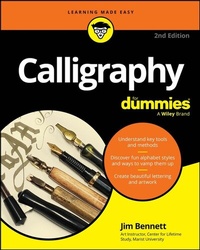
Calligraphy For Dummies
Description

A fun introduction to the art of calligraphy-plus how-tos and practice exercises
Calligraphy For Dummies, 2nd Edition is an approachable place to start for anyone interested in lettering with flair. This book provides helpful tips and tricks for learning this expressive artform, including choosing your pen and paper, taking care of your materials, understanding foundational concepts, and putting your own spin on classic alphabet styles. Once you've gotten the basics down, this book also helps spark interesting project ideas, including ways you can elevate letters, invitations, posters, and beyond. With plenty of practice opportunities and guidance, this easy-to-use resource will have you dotting your i's and crossing your t's-the fancy way.
Inside:
- Learn classic calligraphy lettering and techniques, as well as digital calligraphy
- Discover the world of ink, pens, and paper, and choose the best materials for your project
- Add your own artistic touch to alphabet styles
- Add beautiful lettering to your other art and craft projects
Pick up an exciting new hobby or brush up, with Calligraphy For Dummies, 2nd Edition.
More details
Other editions
Additional editions
Person
Jim Bennett is an accomplished calligrapher and former portrait artist with over forty years' experience as an award-winning teacher. He is the author of the first edition of Calligraphy For Dummies and the creator of the website, mathsquad.com, which uses art projects to teach students middle school math.
Content
Introduction 1
Part 1: Getting Started with Calligraphy 7
Chapter 1: You Can Do Calligraphy! 9
Chapter 2: Assembling Your Calligrapher's Toolbox 15
Chapter 3: Putting Pen to Paper: Modern Tools for a Timeless Art 25
Part 2: Taking a Beginner's Path to Calligraphic Artistry 43
Chapter 4: Getting Acquainted with EZScript 45
Chapter 5: Lettering EZScript with a Calligraphy Pen 55
Chapter 6: Refining Your Calligraphy 63
Chapter 7: Creating Expressive Quotations: Elevating Your Skills 71
Part 3: Exploring the Traditional Alphabets 79
Chapter 8: Classical Roman Letters: The Pillars of Written Language 81
Chapter 9: Uncial: The Irish Charm of Celtic Glyphs 97
Chapter 10: Manuscript: The Elegant Hand of the Scribes 109
Chapter 11: Blackletter: The Majesty of Medieval Script 125
Chapter 12: Italic: The Renaissance of Elegance 145
Chapter 13: Copperplate: The Art of Flourished Perfection 167
Chapter 14: Versals: Elegantly Outlined and Decorated Letters 203
Part 4: Expanding Your Repertoire Beyond the Basics 213
Chapter 15: Adding Variations, Borders, Flourishes, and Other Embellishments 215
Chapter 16: Broadening Your Artistic Horizons: Signatures, Quotations, and More 225
Chapter 17: Crafting Elegant Certificates 241
Chapter 18: Designing Eye-Catching Posters or Signs 251
Chapter 19: Creating Calligraphic Computer Fonts 261
Part 5: The Part of Tens 269
Chapter 20: Ten Ways to Use Your Calligraphy for Weddings 271
Chapter 21: Ten Fun Alphabets 277
Chapter 22: Ten Tips for Turning Your Calligraphy into Income 285
Index 291
Introduction
Welcome to the 2nd edition of Calligraphy For Dummies. You can use this book as your guide to mastering the art of calligraphy. Whether you're completely new to calligraphy or have some prior experience, this book can help you grasp the basics and explore the endless possibilities that calligraphy offers.
Starting with a beginner's alphabet, EZScript, I guide you through the fundamentals of calligraphy with step-by-step instructions and practical tips. You'll learn different styles, master essential techniques, and gain the skills to create beautiful, professional-quality calligraphy.
Many believe calligraphy requires innate talent, but I've seen determination triumph time and again. One of my students, despite a severe nervous disorder, steadied his pen with both hands and achieved professional-level work. Success in calligraphy isn't about talent - it's about persistence.
If you can write, you can do calligraphy. This book provides the knowledge and inspiration to help you succeed with calligraphy, whether as a relaxing hobby, a serious pursuit, or even a source of income.
About This Book
This book is both a guide and a workbook, combining two courses in one: Calligraphy I and II. Calligraphy I introduces calligraphy - tools, basic methods, and a beginner's alphabet. Then you'll meet seven traditional alphabets to build your lettering skills. Calligraphy II offers creative projects, from designing a unique signature to crafting elegant wedding calligraphy.
But calligraphy isn't learned by reading - you have to practice. This book is filled with illustrations, examples, and exercises to guide you step by step. You set your own pace, progressing as quickly or slowly as you like.
Practice by studying, tracing, and copying the letters provided - almost as if I were right there helping you. Don't write in this book! Photocopy the practice pages so that you can use them again and again.
With time and effort, you'll see your progress unfold before your eyes.
Conventions Used in This Book
I use some conventions throughout this book to make your practice as easy as possible and to make sure that you don't wonder whether you missed something along the way. These conventions make everything consistent and simple to understand:
- Getting what you need: At the beginning of chapters that require you to have certain materials or already know certain skills, I have a "Got What You Need?" section that lists what you need for that chapter.
- Practice, practice, practice: The chapters contain some short practice exercises to get you started, but for more practice, you have full page practice exercises available in the online Practice Pack and Cheat Sheet (
www.dummies.com). Having full-page practice exercises available online means that you can easily print as many copies as you want. - Following guidelines: There are several types of practice guidelines that that enable you to keep your letters uniform in proportion:
Black lines separate sections of writing.
Rectangles show where to draw the body of the letters.
Dashed lines indicate the slant.
- Using the three-step method: The practice exercises in this book use a special three-step method: study, trace, and copy. Study the example letters printed in black that show the direction and sequence of strokes. Trace over the letters printed in gray. And in the blank spaces of these practice areas, copy the letters.
Foolish Assumptions
I try to avoid technical jargon in this book. Whenever I have a choice between a specialized calligraphy term that only calligraphers use and a word that everyone understands, I opt to use the more commonplace word. For example, I use the terms capital letters and lowercase letters throughout this book, instead of calling the letters majuscules and minuscules. (If you pursue calligraphy in greater depth, you can pick up all the specialized terminology.)
I wrote this book for anyone curious about calligraphy - whether you're a complete beginner, an admirer eager to learn, a practiced hand looking to refine your skills, or an experienced calligrapher seeking to improve and sell your work.
No matter which category fits you best, I believe that you'll find plenty in this book to explore.
How This Book Is Organized
Like all other For Dummies books, this one is divided into parts, so you can easily find where to start or revisit. Each section covers a different aspect of calligraphy, letting you explore at your own pace - whether you're a beginner or refining your skills. The book is organized into five parts, each focusing on key calligraphy topics.
Part 1: Getting Started with Calligraphy
Part 1 introduces calligraphy - its benefits, how to get started, and the special practice method used in this book. It covers essential tools like pens, ink, and paper, along with basic steps for using and caring for your materials - especially the calligraphy fountain pen, an ideal choice for beginners.
Part 2: Taking a Beginner's Path to Calligraphic Artistry
Part 2 introduces EZScript, a beginner-friendly calligraphy style designed to make learning easy and affordable. If you're new to calligraphy, EZScript helps you get comfortable with techniques and tools while avoiding common pitfalls.
Inspired by print, Italic, copperplate, and cursive, EZScript feels familiar no matter your background. After teaching calligraphy for over 50 years, I created it to remove obstacles that often frustrate beginners, making the learning process smoother and more enjoyable.
In this part I also offer guidance on improving and developing your skills as you progress.
Part 3: Exploring the Traditional Alphabets
Part 3 introduces alphabets that expand your repertoire and build a strong foundation for your calligraphy journey. Each style has unique characteristics and conveys distinct emotions, helping you refine your craft and continue growing:
- Roman (Chapter 8): Classical, solid, and strong
- Uncial (Chapter 9): Artistic and expressive
- Manuscript (Chapter 10): Prioritizes readability and clarity
- Blackletter (Chapter 11): Conveys an ancient and formal aesthetic
- Italic (Chapter 12): Fluid, versatile, and highly legible
- Copperplate (Chapter 13): Embodies elegance with graceful flourishes
- Versals (Chapter 14): Adds decorative flair and visual impact to lettering
Mastering these seven alphabets equips you with the building blocks to explore and adapt virtually any lettering style.
Part 4: Expanding Your Repertoire Beyond the Basics
Part 4 explores exciting calligraphy projects to try once you're confident in your lettering skills. Start with an eye-catching signature or a beautifully lettered quote, then move on to posters, signs, certificates, plaques, and decorative borders.
If you work in other art forms, you'll find ideas on blending calligraphy with different mediums. You'll also learn how to create custom calligraphic computer fonts and use digital tools for composition and layout.
Part 5: The Part of Tens
Part 5 offers valuable tips, starting with ten creative ways to use calligraphy for weddings - whether yours or someone else's. You'll also find ten fun alphabets that mimic styles like Chinese and Greek, helping you expand your skills. The final chapter covers a topic many find exciting: how to turn calligraphy into a source of income.
Icons Used in This Book
I include some icons in this book to flag important information. Keep an eye out for these icons while you read:
Want to know how do something better, easier, or faster? Just look for info attached to this icon.
Although the list of things that you have to remember - stroke sequence, what angle to hold your hand, and so on - may seem endless, this icon points out some really important info that you just can't miss.
With this icon, I highlight potential pitfalls - whether it's something that can spoil a calligraphy project or damage a favorite pen.
When you see this icon, go to the online Practice Pack and Cheat Sheet for this book (www.dummies.com) to find more practice related to that section.
Where to Go from Here
This book isn't a textbook - it's an adventure. Flip through the pages, scan the Table of Contents, and explore whatever catches your eye. There's no set path, so take your time and follow your curiosity.
If you're new to calligraphy, start at the beginning and work through every chapter and practice exercise in Parts 1 and 2. Don't skip anything, and if you struggle, spend extra time practicing before moving forward. By the end, you'll be ready to explore on your own.
If you already have calligraphy experience, feel free to jump between sections. But don't miss the skill-refinement parts - especially Chapter...
