

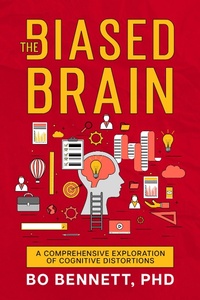
The Biased Brain
A Comprehensive Exploration of Cognitive Distortions
Published on 18. July 2023
464 pages
978-1-4566-4117-7 (ISBN)
Description

Unravel the Secrets of Your Mind: A Journey into Cognitive Biases
Step into the intriguing world of cognitive biases with this comprehensive guide that promises to transform the way you perceive yourself and others. Packed with fascinating insights, this book unveils the subtle but powerful ways our minds shape our understanding of reality.
In The Biased Brain, you will delve deep into the heart of human cognition and discover hundreds of cognitive biases that influence our decisions. Written by an expert in the field, this book is a powerful tool that will enable you to navigate your life with enhanced understanding and control.
Nearly 500 pages packed with well-researched, engaging content that will draw you into the labyrinth of the human mind. You will explore concepts that will make you question your assumptions and provoke you to think critically about your thought processes. This book doesn't just offer theoretical knowledge; it also provides practical solutions to identify and overcome your biases.
It doesn't matter whether you're a student of psychology, a curious observer of human behavior, or someone who's simply looking to better understand their own mind-this book has something for everyone. In fact, it might just be the most insightful book you will read this year.
Are you ready to challenge your perceptions and unveil the biases hiding in plain sight? This book is your map to understanding the complex landscape of human cognition. So, why wait? Start your journey now and transform the way you see yourself and the world.
Grab your copy of The Biased Brain today and embark on an enlightening journey into the human mind.
Step into the intriguing world of cognitive biases with this comprehensive guide that promises to transform the way you perceive yourself and others. Packed with fascinating insights, this book unveils the subtle but powerful ways our minds shape our understanding of reality.
In The Biased Brain, you will delve deep into the heart of human cognition and discover hundreds of cognitive biases that influence our decisions. Written by an expert in the field, this book is a powerful tool that will enable you to navigate your life with enhanced understanding and control.
Nearly 500 pages packed with well-researched, engaging content that will draw you into the labyrinth of the human mind. You will explore concepts that will make you question your assumptions and provoke you to think critically about your thought processes. This book doesn't just offer theoretical knowledge; it also provides practical solutions to identify and overcome your biases.
It doesn't matter whether you're a student of psychology, a curious observer of human behavior, or someone who's simply looking to better understand their own mind-this book has something for everyone. In fact, it might just be the most insightful book you will read this year.
Are you ready to challenge your perceptions and unveil the biases hiding in plain sight? This book is your map to understanding the complex landscape of human cognition. So, why wait? Start your journey now and transform the way you see yourself and the world.
Grab your copy of The Biased Brain today and embark on an enlightening journey into the human mind.
More details
Content
- Intro
- Introduction
- Actor-Observer Bias
- Ambiguity Aversion
- Ambiguity Effect
- Anchoring Bias
- Anthropic Bias
- Appeal to Novelty
- Argument from Repetition (Argument Ad Nauseam)
- Association Fallacy
- Association-Transfer Bias
- Attentional Bias
- Attentional Blink
- Authority Bias
- Automation Bias
- Availability Cascade
- Availability Heuristic
- Backfire Effect
- Backward Induction
- Backward Reasoning
- Bandwagon Effect
- Base Rate Neglect
- Belief Bias
- Belief Perseverance
- Ben Franklin Effect
- Bias Blind Spot
- Boomerang Effect
- Bystander Effect
- Cheerleader Effect
- Choice-Supportive Bias
- Chameleon Effect
- Clustering Illusion
- Cobra Effect
- Confirmation Bias
- Conjunction Fallacy
- Conservatism Bias
- Construal Level Theory
- Contrast Effect
- Control Bias
- Courtesy Bias
- Curse of Knowledge
- Decoy Effect
- Default Effect
- Denomination Effect
- Disconfirmation Bias
- Disjunction Fallacy
- Disregard of Regression Toward the Mean
- Divergence Bias
- Door-In-The-Face Technique
- Dunning-Kruger Effect
- Duration Neglect
- Effort Justification
- Egocentric Bias
- Endowment Effect
- Epistemic Closure
- Experimenter's Bias (Expectation Bias)
- Extension Neglect
- Extrinsic Incentives Bias
- False Consensus Effect
- False Dichotomy
- False Fame Effect
- False Memory
- Fading Affect Bias
- Fear of Missing Out (FOMO)
- Focusing Effect
- Foot-In-The-Door Technique
- Forer Effect (Barnum Effect)
- Framing Effect
- Frequency Illusion
- Functional Fixedness
- Fundamental Attribution Error
- Gambler's Fallacy
- Generation Bias
- Google Effect
- Group Attribution Error
- Groupthink
- Hard-Easy Effect
- Halo Effect
- Hawthorne Effect
- Herd Instinct
- Hindsight Bias
- Hoarding
- Horns Effect
- Hot-Hand Fallacy
- Hot-Cold Empathy Gap
- Hyperbolic Discounting
- Illusion of Asymmetric Insight
- Illusion of Attention
- Illusion of Control
- Illusion of External Agency
- Illusion of Explanatory Depth
- Illusion of Knowledge
- Illusion of Skill
- Illusion of Superiority
- Illusion of Transparency
- Illusion of Truth Effect
- Illusory of Understanding
- Illusory Pattern Perception
- Impact Bias
- Impostor Syndrome
- Inattentional Blindness
- Inductive Bias
- Information Bias
- Insensitivity to Sample Size
- Introspection Illusion
- In-group Bias
- Irrelevant Alternatives Fallacy
- Irrational Escalation
- Just-Noticeable Difference (JND)
- Just-World Hypothesis
- Law of the Instrument
- Law of Triviality
- Less-is-Better Effect
- Likability Bias
- Licensing Effect
- Loss Aversion
- Mere Exposure Effect
- Memory Bias
- Misattribution of Arousal
- Misinformation Effect
- Money Illusion
- Mood-Congruent Judgment
- Mood-Congruent Memory Bias
- Moral Credential Effect
- Moral Luck
- Myside Bias
- Naive Realism
- Narrative Fallacy
- Negativity Bias
- Neglect of Duration
- Neglect of Probability
- Normalcy Bias
- Not Invented Here (NIH) Syndrome
- Observer Expectancy Effect
- Observational Selection Bias
- Omission Bias
- Optimism Bias
- Outcome Bias
- Outgroup Homogeneity Bias
- Overconfidence Bias
- Overestimation Bias
- Overprecision
- Overreaction Bias
- Overtrust
- Pareidolia
- Peak-End Rule
- Perceptual Bias
- Picture Superiority Effect
- Planning Fallacy
- Positivity Effect
- Post Hoc Ergo Propter Hoc Fallacy
- Post-Purchase Rationalization
- Pratfall Effect
- Primacy Effect
- Priming
- Pro-Innovation Bias
- Projection Bias
- Proportionality Bias
- Prototype Heuristic
- Pseudocertainty Effect
- Pseudo-opinion
- Psychological Reactance
- Pygmalion Effect
- Reactive Devaluation
- Recency Effect
- Reification (Concretism, Hypostatization, or the Fallacy of Misplaced Concreteness)
- Rejection of Instruction
- Reminiscence Bump
- Representativeness Heuristic
- Restraint Bias
- Rhyme as Reason Effect
- Risk Compensation or Peltzman Effect
- Rosy Retrospection
- Satisficing
- Scarcity Principle
- Scope Insensitivity
- Selective Exposure
- Self-Consistency Bias
- Self-Enhancement Bias
- Self-Handicapping Bias
- Self-Perception Bias
- Self-Relevance Effect
- Self-Reference Effect
- Semmelweis Reflex
- Shared Information Bias
- Simulation Heuristic
- Sleeper Effect
- Social Attribution Bias
- Social Comparison Bias
- Social Desirability Bias
- Social Loafing
- Stereotype Boost and Stereotype Lift
- Stereotype Threat
- Stereotyping
- Status Quo Bias
- Streetlight Effect
- Subadditivity Effect
- Subjective Validation
- Survivorship Bias
- Sunk Cost Fallacy
- System Justification
- Telescoping Bias
- Temporal Discounting
- The Texas Sharpshooter Fallacy
- Third Person Effect
- Thought Suppression
- Time-saving Bias
- Trait Negativity Bias
- Trivial-Pursuit Effect
- Triviality Bias
- Ultimate Attribution Error
- Uncertainty Bias
- Unit Bias
- Von Restorff Effect
- Wishful Thinking
- WYSIATI (What You See Is All There Is)
- Zeigarnik Effect
- Zero Price Effect
- Zero-Sum Bias
- Zero Risk Bias
- Conclusion
- About the Author
