

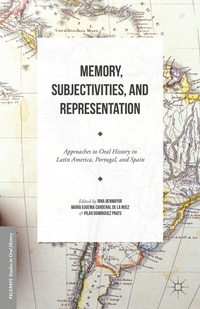
Memory, Subjectivities, and Representation
Description

This collection presents diverse scholarly approaches to oral narratives in the Spanish and Portuguese-speaking worlds. Eleven essays, originally written in Spanish, Portuguese, and English, coalesce around major themes that have long concerned oral historians and social scientists: collective memories of conflictive national pasts, subjectivity in re/framing social identities, and visual and performative re/presentations of identity and public memory.
Reviews / Votes
"The topics treated throughout the volume are laudably diverse and very timely, sometimes offering innovative approaches to the material . . The volume could be valuable for researchers working with oral testimony about precarious and illegalized working conditions in Spain and other contexts of migration, and to early career researchers interested in learning about oral history in Spanish and Portuguese-speaking countries." (Hendrikje Grunow, Oral History Forum d'histoire orale, Vol. 37, 2017)More details
Other editions
Additional editions
Persons
Rina Benmayor is Professor Emerita at California State University Monterey Bay, USA and former President of the International Oral History Association (2004-06), and the Oral History Association (2010-11). She writes on community oral history, testimonio, and digital storytelling.
María Eugenia Cardenal de la Nuez is Assistant Professor at the University of Las Palmas de Gran Canaria. Her main area of research is youth transitions, foregrounding the Biographic Narrative Interpretive Method, and interpretive analysis to biography in Sociology.
Pilar Domínguez Prats is Assistant Professor at the University of Las Palmas de Gran Canaria; and former President of the International Oral History Association (2008-10). She has written oral history essays on the Spanish Civil War and the transition to democracy.
Content
1. 'I Was Just One More Among Many:" A Mosaic of Ex-combatant Voices from the Portuguese Colonial War ; Ângela Campos
2. Voices of Spanish Socialist Trade Unionism During the End of the Franco Regime and the Transition to Democracy; Pilar Domínguez Prats
3. 'Gendered' Memories: Women's Narratives from the Southern Cone; Cristina Scheibe Wolff, Joana Maria Pedro, and Janine Gomes da Silva
4. The Healing Effect of Discourses: Body, Emotions and Gender Subjectivity in Basque Nationalism; Miren Llona
5. Lola's Story: The Struggle to Build a Professional Identity with No Good Jobs in Sight; María Eugenia Cardenal de la Nuez
6. 'Getting Ahead:' The American Dream in the California Agricultural Fields; Magdalena Villarreal
7. Migration, Sex Work, and Stigma: An Analysis in Biographical Code; Ángeles Arjona Garrido, Juan Carlos Checa Olmos, Estefanía Acién González, and FranciscoMajuelos Martínez
8. Oral Accounts and Visual Inscriptions: Narratives Under Heavily Tattooed Skin; Vitor Sérgio Ferreira
9. The Black Movement and Race Relations in Brazil: Building New Knowledge Through Online Oral History Materials; Verena Alberti and Amilcar Araujo Pereira
10. Images and Words: Photography and the 1968 Student Movement in Mexico; Alberto del Castillo Troncoso
11."A Living Museum of Small, Forgotten and Unwanted Memories:' Performing Oral Histories of the Portuguese Dictatorship and Revolution; Joana Craveiro
