

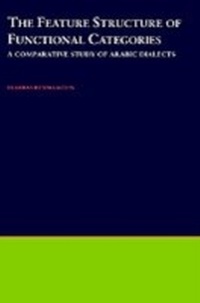
The Feature Structure of Functional Categories
A Comparative Study of Arabic Dialects
1st Edition
Published in December 2000
193 pages
978-0-19-535314-3 (ISBN)
Description

Focusing on the relation between functional categories and lexical and phrasal categories in Arabic dialects, Benmamoun proposes that universally functional categories are specified for categorial features which determine their relation with lexical categories. Language variation is attributed to differences with respect to the categorial feature specifications of functional categories and how they interact with lexical categories. The book brings new insights to issues related to the syntax of functional categories, the relation between syntax and the morpho-phonological component, and comparative syntax.
More details
Language
English
Place of publication
Oxford
United Kingdom
File size
8,00 MB
ISBN-13
978-0-19-535314-3 (9780195353143)
Copyright in bibliographic data and cover images is held by Nielsen Book Services Limited or by the publishers or by their respective licensors: all rights reserved.
Schweitzer Classification
Other editions
Additional editions
Elabbas Benmamoun
The Feature Structure of Functional Categories
A Comparative Study of Arabic Dialects
Book
04/2000
Oxford University Press Inc
€100.10
Shipment within 15-20 days
Elabbas Benmamoun
The Feature Structure of Functional Categories
A Comparative Study of Arabic Dialects
Book
03/2000
Oxford University Press Inc
€125.20
Shipment within 15-20 days
Content
- Intro
- Contents
- 1. Comparative Arabic Syntax
- 1.1 Main Empirical Generalizations
- 1.1.1 The Syntax of Tense in Arabic
- 1.1.2 The Syntax of Sentential Negation in Arabic
- 1.1.3 Agreement Asymmetries
- 1.2 Theoretical Assumptions and Implications
- 1.2.1 The Syntax of Functional Categories
- 1.2.2 Theoretical Implications
- Part I: The Feature Structure of Tense
- 2. The Tense Systems of Egyptian Arabic, Moroccan Arabic, and Standard Arabic
- 2.1 Verb Morphology in Standard Arabic, Moroccan Arabic, and Egyptian Arabic
- 2.2 The Typology of Tense in Arabic
- 2.3 The Syntactic Status of the Imperfective
- 2.4 The Present Tense
- 2.5 The Future Tense
- 2.6 Imperatives
- 2.7 Conclusion
- 3. The Categorial Features of Tense
- 3.1 Typology of the Categorial Features of Tense
- 3.2 The Feature Structure of the Arabic Tense System
- 3.3 A Theory of the Categorial Features of Tense
- 3.4 Conclusion
- 4. Checking the Categorial Features of Tense
- 4.1 Verb Movement and Negation
- 4.2 Independent Negatives
- 4.3 Idiomatic Expressions and Word Order Asymmetries
- 4.4 The Morphological Distribution of the Person Prefix
- 4.5 Word Order Alternations
- 4.6 Position of the Subject in Verbless Negative Sentences
- 4.7 Conclusion
- Part II: The Feature Structure of Negation
- 5. Sentential Negation in the Modern Arabic Dialects
- 5.1 Representation of Sentential Negation
- 5.2 The Feature Structure of Negation
- 5.3 Merger between Negation and Non-Verbal Predicates: Syntax or PF?
- 5.4 Conclusion
- 6. Negation in Standard Arabic
- 6.1 laa, lam, and Ian
- 6.2 Complementary Distribution, Feature Checking and Morphological Blocking
- 6.3 The Negative laysa
- 6.4 maa
- 6.5 Conclusion
- 7. Negation and Imperatives
- 7.1 The Syntactic Distribution of the Imperative
- 7.2 Positive Imperatives vs. Negative Imperatives
- 7.3 Previous Accounts of the Difference between Negative Imperatives and Positive Imperatives
- 7.4 Analysis of the Difference between Positive and Negative Imperatives
- 7.5 Conclusion
- Part III: Agreement Asymmetries
- 8. Subject Verb Agreement Asymmetries
- 8.1 Agreement Paradigms
- 8.2 Previous Accounts
- 8.3 Distribution of Number Agreement
- 8.4 Analysis of the Distribution of Number Agreement
- 8.5 Agreement in Moroccan Arabic
- 8.6 Agreement and Interpretation
- 8.7 Agreement Between Demonstratives and Nouns
- 8.8 Conclusion
- 9. Agreement Asymmetries in DPs
- 9.1 The Construct State
- 9.2 Merger of the Members of the Construct State
- 9.3 Members of the Construct State Merge Post-Syntactically
- 9.4 Merger vs. Percolation
- 9.5 Conclusion
- Notes
- Bibliography
- Index
- A
- B
- C
- D
- E
- F
- G
- H
- I
- J
- K
- L
- M
- N
- O
- P
- Q
- R
- S
- T
- V
- W
- Y
- Z
