

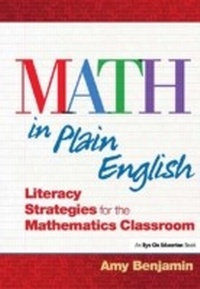
Math In Plain English
Literacy Strategies for the Mathematics Classroom
1st Edition
Published on 2. October 2013
144 pages
978-1-317-92675-7 (ISBN)
Description

Do word problems and math vocabulary confuse students in your mathematics classes? Do simple keywords like "value" and "portion" seem to mislead them?
Many words that students already know can have a different meaning in mathematics. To grasp that difference, students need to connect English literacy skills to math. Successful students speak, read, write, and listen to each other so they can understand, retain, and apply mathematics concepts.
This book explains how to use 10 classroom-ready literacy strategies in concert with your mathematics instruction. You'll learn how to develop students who are able to explain to themselves - and communicate to others - what problems mean and how to attack them.
Embedding these strategies in your instruction will help your students gain the literacy skills required to achieve the eight Common Core State Standards for Mathematics. You'll discover the best answer to their question, "When am I ever going to use this?"
The 10 Strategies:
1. Teaching mathematical words explicitly
2. Teaching academic words implicitly
3. Reinforcing reading comprehension skills that apply to mathematics
4. Teaching mathematics with metaphor and gesture
5. Unlocking the meaning of word problems
6. Teaching note-taking skills for mathematics
7. Using language-based formative assessment in mathematics
8. Connecting memorization to meaning in mathematics
9. Incorporating writing-to-learn activities in mathematics
10. Preparing students for algebraic thinking
Many words that students already know can have a different meaning in mathematics. To grasp that difference, students need to connect English literacy skills to math. Successful students speak, read, write, and listen to each other so they can understand, retain, and apply mathematics concepts.
This book explains how to use 10 classroom-ready literacy strategies in concert with your mathematics instruction. You'll learn how to develop students who are able to explain to themselves - and communicate to others - what problems mean and how to attack them.
Embedding these strategies in your instruction will help your students gain the literacy skills required to achieve the eight Common Core State Standards for Mathematics. You'll discover the best answer to their question, "When am I ever going to use this?"
The 10 Strategies:
1. Teaching mathematical words explicitly
2. Teaching academic words implicitly
3. Reinforcing reading comprehension skills that apply to mathematics
4. Teaching mathematics with metaphor and gesture
5. Unlocking the meaning of word problems
6. Teaching note-taking skills for mathematics
7. Using language-based formative assessment in mathematics
8. Connecting memorization to meaning in mathematics
9. Incorporating writing-to-learn activities in mathematics
10. Preparing students for algebraic thinking
More details
Language
English
Place of publication
London
United Kingdom
Publishing group
Taylor & Francis Ltd
Target group
Professional and scholarly
File size
2,08 MB
ISBN-13
978-1-317-92675-7 (9781317926757)
Copyright in bibliographic data and cover images is held by Nielsen Book Services Limited or by the publishers or by their respective licensors: all rights reserved.
Schweitzer Classification
Other editions
Additional editions
Book
10/2015
1st Edition
Routledge
€171.12
Shipment within 10-20 days
Book
06/2011
1st Edition
Eye On Education, Inc
€40.00
Shipment within 3-4 weeks
Person
Amy Benjamin is a literacy consultant who works with educators across the United States and Canada. Her work is informed by more than thirty years of teaching experience at the middle and high school levels. She has been recognized for excellence in teaching by the New York State English Council, the State Education Department of New York, Tufts University, and Union College.As a member of the professional development team for the National Council of Teachers of English (NCTE), and president of its Assembly for the Teaching of English Grammar, Amy has had a major impact in transforming the paradigm of grammar instruction from fill-in-the-blank worksheets to the kind of active, authentic, discovery-based models presented in this book. This is Amy's eleventh book for Eye on Education.,
Joan Berger has developed unique approaches for teaching writing and grammar during her four decades working with high-school and middle-school students. A Golden Apple finalist, Joan has written articles for various National Council of Teachers of English journals, as well as NCTE's teacher sourcebook Professional Communities at Work: Grammar. Now a consultant who works with schools and school districts, Joan also speaks frequently at NCTE conferences about writing and grammar. At her workshops, Joan gives teachers fun, easy-to-use strategies that inspire their students to write effectively.
Joan Berger has developed unique approaches for teaching writing and grammar during her four decades working with high-school and middle-school students. A Golden Apple finalist, Joan has written articles for various National Council of Teachers of English journals, as well as NCTE's teacher sourcebook Professional Communities at Work: Grammar. Now a consultant who works with schools and school districts, Joan also speaks frequently at NCTE conferences about writing and grammar. At her workshops, Joan gives teachers fun, easy-to-use strategies that inspire their students to write effectively.
Content
Strategy 1 Teaching Mathematical Words Explicitly; Strategy 2 Teaching Academic Words Implicitly; Strategy 3 Reinforcing Reading Comprehension Skills that Apply to Mathematics; Strategy 4 Teaching Mathematics with Metaphor and Gesture; Strategy 5 Unlocking the Meaning of Word Problems; Strategy 6 Teaching Note-Taking Skills for Mathematics; Strategy 7 Using Language-Based Formative Assessment in Mathematics; Strategy 8 Connecting Memorization to Meaning in Mathematics; Strategy 9 Incorporating Writing-to-Learn Activities in Mathematics; Strategy 10 Preparing Students for Algebraic Thinking;
