

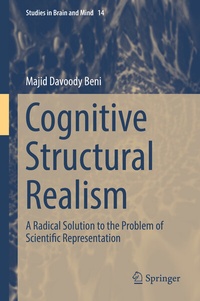
Cognitive Structural Realism
A Radical Solution to the Problem of Scientific Representation
1st Edition
Published on 29. January 2019
XI, 188 pages
978-3-030-05114-3 (ISBN)
Description

In this book, the author develops a new form of structural realism and deals with the problem of representation. The work combines two distinguished developments of the Semantic View of Theories, namely Structural Realism (SR), a flourishing theory from contemporary philosophy of science, and Ronald Giere and colleagues' Cognitive Models of Science approach (CMSA).
Readers will see how replacing the model-theoretic structures that are at issue in SR with connectionist networks and activations patterns (which are the formal tools of computational neuroscience) helps us to deal with the problem of representation. The author suggests that cognitive structures are not only the precise formal tools for regimenting the structure of scientific theories but also the tools that the biological brain uses to capture the essential features (i.e., structures) of its environment. Therefore, replacing model-theoretic structures with cognitive structures allows us to account for the theories-reality relationship on the basis of the most reliable theories of neurology. This is how a new form of SR, called Cognitive Structural Realism (CSR) is introduced through this book, which articulates and defends CSR, and shows how two diverging branches of SVT can be reconciled.
This ground-breaking work will particularly appeal to people who work in the philosophy of science, philosophy of mind and cognitive sciences.
Readers will see how replacing the model-theoretic structures that are at issue in SR with connectionist networks and activations patterns (which are the formal tools of computational neuroscience) helps us to deal with the problem of representation. The author suggests that cognitive structures are not only the precise formal tools for regimenting the structure of scientific theories but also the tools that the biological brain uses to capture the essential features (i.e., structures) of its environment. Therefore, replacing model-theoretic structures with cognitive structures allows us to account for the theories-reality relationship on the basis of the most reliable theories of neurology. This is how a new form of SR, called Cognitive Structural Realism (CSR) is introduced through this book, which articulates and defends CSR, and shows how two diverging branches of SVT can be reconciled.
This ground-breaking work will particularly appeal to people who work in the philosophy of science, philosophy of mind and cognitive sciences.
More details
Series
Language
English
Place of publication
Cham
Switzerland
Publishing group
Springer International Publishing
Target group
Professional and scholarly
Product notice
Reflowable
Illustrations
XI, 188 p. 1 illus.
File size
2,30 MB
ISBN-13
978-3-030-05114-3 (9783030051143)
DOI
10.1007/978-3-030-05114-3
Schweitzer Classification
Other editions
Additional editions
Majid Davoody Beni
Cognitive Structural Realism
A Radical Solution to the Problem of Scientific Representation
Book
02/2019
Springer
€53.49
Shipment within 7-9 days
Person
Majid D. Beni obtained his PhD. at Tehran, Iranian Institute of Philosophy. He wrote greater part of his dissertation when he was visiting the School of Life Science, at ASU, where he worked on the history of philosophy of science under the supervision of Rick Creath. For the past few years he taught courses on the philosophy of science, philosophy of cognitive science, and mathematical logic. Through his career he attempted drawing connection between his work on Structural Realism and the philosophy of science on the one hand and recent developments in computational neuroscience and empirical and theoretical psychology on the other hand. He has developed Epistemic Informational Structural Realism and Structural Realist theory of Self in his previous publications.
Content
Chapter 1. Introduction.- Chapter 2. The Parting of the Ways.- Chapter 3. The Grounding Problem: Why Worry?.- Chapter 4. Churchland's Extension of Cognitive Models of Science.- Chapter 5. The Brain's Predictive Processing.- Chapter 6. An Ecological Solution to the Grounding Problem.- Chapter 7. Cognitive Structural Realism.- Chapter 8. Conclusion: Meeting of the Ways.
