

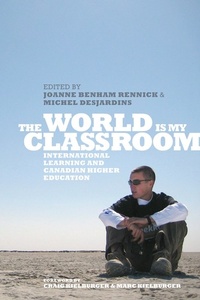
The World Is My Classroom
International Learning and Canadian Higher Education
1st Edition
Published on 4. December 2013
272 pages
978-1-4426-6907-9 (ISBN)
Description

International education and learn-abroad programs have received heightened interest in the knowledge economy, and universities are keen to create successful programs for students. The World Is My Classroom presents diverse perspectives on these experiential learning programs and ways of globalizing Canadian classrooms. Examining themes such as global education, global citizenship, and service learning, it sheds light on current debates that are of concern for faculty members, administrators, international partners, and students alike.
The World Is My Classroom is the first book to examine pedagogical questions about the internationalization and globalization of higher education from an explicitly Canadian perspective. It features original reflections from students on their experiences in learn-abroad programs, as well a foreword by Craig and Marc Kielburger, founders of Free the Children and Me to We, on the benefits of international learning experiences. Universities considering developing, enhancing, and refining their learning abroad programs, as well as students considering these programs and experiences, will find this an insightful and useful book.
The World Is My Classroom is the first book to examine pedagogical questions about the internationalization and globalization of higher education from an explicitly Canadian perspective. It features original reflections from students on their experiences in learn-abroad programs, as well a foreword by Craig and Marc Kielburger, founders of Free the Children and Me to We, on the benefits of international learning experiences. Universities considering developing, enhancing, and refining their learning abroad programs, as well as students considering these programs and experiences, will find this an insightful and useful book.
Reviews / Votes
'The book is a fascinating representative read for those concerned with problematic overwhelming trends in IESL thinking and practices today.'- Vanessa Andreotti (Canadian Journal of Developmental Studies vol 37:01:2016)
More details
Language
English
Place of publication
Toronto
Canada
Target group
College/higher education
Professional and scholarly
Edition type
Digital original
Illustrations
2 figures
2 figures
File size
1,60 MB
ISBN-13
978-1-4426-6907-9 (9781442669079)
Copyright in bibliographic data and cover images is held by Nielsen Book Services Limited or by the publishers or by their respective licensors: all rights reserved.
Schweitzer Classification
Other editions
Additional editions
Joanne Benham Rennick | Michel Desjardins
The World Is My Classroom
International Learning and Canadian Higher Education
Book
10/2013
University of Toronto Press
€39.50
Shipment within 10-20 days
Persons
Joanne Benham Rennick is an assistant professor in the Department of Contemporary Studies at Wilfrid Laurier University.
Michel Desjardins is a professor in the Department of Religion and Culture at Wilfrid Laurier University.
Michel Desjardins is a professor in the Department of Religion and Culture at Wilfrid Laurier University.
Content
Foreword
Marc and Craig Kielburger (Free the Children)
Acknowledgments
Tables and Figures
Part I: Introduction
1. Towards a Pedagogy of Good Global Citizenship
Joanne Benham Rennick (Wilfrid Laurier University, Contemporary Studies) and Michel Desjardins (Wilfrid Laurier University, Religion and Culture)
Student Intermezzo: What draws students to go abroad?
Jessica DeBrouwer (University of Waterloo): Planting little seeds
Part II: Historical and Pedagogical Contexts
2 Canadian Values, Good Global Citizenship, and Service Learning in Canada: A Socio-Historical Analysis
Joanne Benham Rennick (Wilfrid Laurier, Contemporary Studies)
3. An Experiential Pedagogical Model for Developing Better Global Citizens
Nancy Johnston (Simon Fraser University, Director of Co-op Education), Maureen Drysdale (University of Waterloo, Psychology) and Caitlin Chiupka (Suffolk University, Psychology)
4. Culture Shock, Cognitive Dissonance, or Cognitive Negotiation? Terms Matter in International Service Learning Programs
Cathleen DiFruscio (University of Waterloo), with Joanne Benham Rennick (Wilfrid Laurier University, Contemporary Studies)
Student Intermezzi: What happens when students are abroad?
Clara Yoon (Balsillie School of International Affairs, Global Governance): What it means to be human
Stephany Lau (Wilfrid Laurier University, Global Studies): A shared humanity
Part III: The Good in Global Citizenship
5. Re-thinking the "Good" in Good Global Citizenship: The Ethics of Cosmopolitan Pluralism
Sara Matthews (Wilfrid Laurier, Global Studies)
6. Students as Culturally Intelligent Change Agents: Global Citizenship and the Workplace
Norah McRae (University of Victoria, Co-operative Education Program and Career Services)
Student Intermezzi: Repercussions for students when they come home
Cathleen DiFruscio (University of Waterloo): All in
Lynn Matisz (Wilfrid Laurier University, Global Studies): Staying involved
Part IV: Case Studies
7. Educating Future Teachers through the Lens of an Equity and Diversity Course
Jackie Eldridge (University of Toronto, Ontario Institute for Studies in Education) and John Smith (University of Toronto, Concurrent Teacher Education Program and Internship Coordinator)
8. More than the Money: Creating Opportunities for Students to Consider their Responsibility for Global Citizenshipwithin their Local Internship Experiences
Tracey Bowen (University of Toronto Mississauga, Institute of Communication, Culture and Information Technology)
9. Relating Across Difference: A Case Study in Transformative Learning
David Peacock (University of Queensland, Education)
10. International Internships: Creating Conditions for Critical Dialogue
Nadya Ladouceur (University of New Brunswick, Experiential Education)
Student Intermezzi: Transformative learning
Nevena Savija (University of Waterloo): My experience, somebody's life
Conor Brennan (University of Waterloo): Separating the wants from the needs
Part V: Conclusion
11. Practicalities and Pedagogies: Implementing International Learning Opportunities for Students
Michel Desjardins (Wilfrid Laurier University, Religion and Culture)
Contributors
Index
Marc and Craig Kielburger (Free the Children)
Acknowledgments
Tables and Figures
Part I: Introduction
1. Towards a Pedagogy of Good Global Citizenship
Joanne Benham Rennick (Wilfrid Laurier University, Contemporary Studies) and Michel Desjardins (Wilfrid Laurier University, Religion and Culture)
Student Intermezzo: What draws students to go abroad?
Jessica DeBrouwer (University of Waterloo): Planting little seeds
Part II: Historical and Pedagogical Contexts
2 Canadian Values, Good Global Citizenship, and Service Learning in Canada: A Socio-Historical Analysis
Joanne Benham Rennick (Wilfrid Laurier, Contemporary Studies)
3. An Experiential Pedagogical Model for Developing Better Global Citizens
Nancy Johnston (Simon Fraser University, Director of Co-op Education), Maureen Drysdale (University of Waterloo, Psychology) and Caitlin Chiupka (Suffolk University, Psychology)
4. Culture Shock, Cognitive Dissonance, or Cognitive Negotiation? Terms Matter in International Service Learning Programs
Cathleen DiFruscio (University of Waterloo), with Joanne Benham Rennick (Wilfrid Laurier University, Contemporary Studies)
Student Intermezzi: What happens when students are abroad?
Clara Yoon (Balsillie School of International Affairs, Global Governance): What it means to be human
Stephany Lau (Wilfrid Laurier University, Global Studies): A shared humanity
Part III: The Good in Global Citizenship
5. Re-thinking the "Good" in Good Global Citizenship: The Ethics of Cosmopolitan Pluralism
Sara Matthews (Wilfrid Laurier, Global Studies)
6. Students as Culturally Intelligent Change Agents: Global Citizenship and the Workplace
Norah McRae (University of Victoria, Co-operative Education Program and Career Services)
Student Intermezzi: Repercussions for students when they come home
Cathleen DiFruscio (University of Waterloo): All in
Lynn Matisz (Wilfrid Laurier University, Global Studies): Staying involved
Part IV: Case Studies
7. Educating Future Teachers through the Lens of an Equity and Diversity Course
Jackie Eldridge (University of Toronto, Ontario Institute for Studies in Education) and John Smith (University of Toronto, Concurrent Teacher Education Program and Internship Coordinator)
8. More than the Money: Creating Opportunities for Students to Consider their Responsibility for Global Citizenshipwithin their Local Internship Experiences
Tracey Bowen (University of Toronto Mississauga, Institute of Communication, Culture and Information Technology)
9. Relating Across Difference: A Case Study in Transformative Learning
David Peacock (University of Queensland, Education)
10. International Internships: Creating Conditions for Critical Dialogue
Nadya Ladouceur (University of New Brunswick, Experiential Education)
Student Intermezzi: Transformative learning
Nevena Savija (University of Waterloo): My experience, somebody's life
Conor Brennan (University of Waterloo): Separating the wants from the needs
Part V: Conclusion
11. Practicalities and Pedagogies: Implementing International Learning Opportunities for Students
Michel Desjardins (Wilfrid Laurier University, Religion and Culture)
Contributors
Index
