

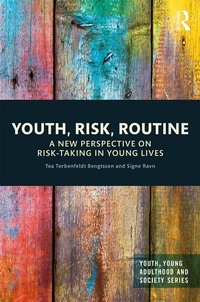
Youth, Risk, Routine
A New Perspective on Risk-Taking in Young Lives
1st Edition
Published on 3. October 2018
154 pages
978-1-315-44075-0 (ISBN)
Description

Young people's lives continue to be the topic of public scrutiny and recurring 'moral panics'. Smoking cannabis, speeding, and engaging in street-level fights are depicted as activities based on 'poor choices' or simple hedonism, putting young people's futures at risk. Based on comprehensive, qualitative research with young people in Denmark, this book illustrates how such individualised accounts miss out on the inherently social character of risk-taking activities.
Youth, Risk, Routine introduces a new approach to risk-taking activities as being an integral and routinised part of young people's everyday life. By applying social theories of practice, this insightful volume presents a framework for understanding the routinised dimensions of young people's engagement in risk-taking and how this is embedded in, intertwined with, and held in place by other everyday practices. Indeed, through extensive empirical analyses of the rich material at hand, the authors explore how routinisation, coordination, embodiment, and social context are central aspects for understanding how, why, and when young people engage in risk-taking practices.
Youth, Risk, Routine will be of interest to students and scholars in sociology, criminology, and social work as well as wider social science audiences, particularly those interested in exploring the empirical potential of social theories of practice.
Youth, Risk, Routine introduces a new approach to risk-taking activities as being an integral and routinised part of young people's everyday life. By applying social theories of practice, this insightful volume presents a framework for understanding the routinised dimensions of young people's engagement in risk-taking and how this is embedded in, intertwined with, and held in place by other everyday practices. Indeed, through extensive empirical analyses of the rich material at hand, the authors explore how routinisation, coordination, embodiment, and social context are central aspects for understanding how, why, and when young people engage in risk-taking practices.
Youth, Risk, Routine will be of interest to students and scholars in sociology, criminology, and social work as well as wider social science audiences, particularly those interested in exploring the empirical potential of social theories of practice.
Reviews / Votes
This is an important, thoughtful, and original new research monograph about young people and risk. It deserves a wide audience amongst researchers, lecturers, and students; not only is it useful and accessible, it is ambitious and innovative. The authors have combined their own, separate research studies to provide a compelling, expansive, and coherent new approach to understanding young people's risk-taking practices.Young people are often said to be at risk, or to pose risks to others. Risk is an influential concept in youth research, theory, and policy but it is also complicated, contested, and multi-faceted and used in quite different ways. Bengtsson and Ravn lead us away from individualised, positivistic, normative, choice-heavy, moral-panic infused understandings of risk to a theory that prioritises young people's shared understandings and their routinized, embodied, socially-contextualised everyday practices. Practices of risk in respect of alcohol and drug use, speeding in motor vehicles, offending, youth culture, violence, partying, and so on are explored through detailed, qualitative vignettes and case studies from the authors' own research. Bengtsson and Ravn quite rightly locate these insights into the everyday risk practices of young people within a wider analysis of changing patterns of youth transition to adulthood and, in turn, how these relate to changes in the welfare state, society, and economy.
Rob MacDonald, Visiting Professor, Danish Centre for Youth Research, University of Aalborg; Adjunct Research Professor, Department of Sociology, Monash University
This is an excellent book that not only takes our understanding of 'risk' to new levels but also shows why it should remain central to how we analyses the lives of young people today. A must read for those working in the field of youth sociology'.
Alan France, Professor, University of Auckland
This is an insightful book about risk-taking practices amongst young people in Denmark. Bengtsson and Ravn take a fresh look at theories of risk while also drawing on youth sociology to analyse their own empirical data on young people's risk-taking practices. I will strongly recommend this book for both practitioners and researchers dealing with young people today.
Katrine Fangen, Professor, University of Oslo
More details
Series
Edition
1. Auflage
Language
English
Place of publication
London
United Kingdom
Publishing group
Taylor & Francis Ltd
Target group
College/higher education
File size
17,88 MB
ISBN-13
978-1-315-44075-0 (9781315440750)
Copyright in bibliographic data and cover images is held by Nielsen Book Services Limited or by the publishers or by their respective licensors: all rights reserved.
Schweitzer Classification
Other editions
Additional editions
Tea Torbenfeldt Bengtsson | Signe Ravn
Youth, Risk, Routine
A New Perspective on Risk-Taking in Young Lives
Book
03/2021
1st Edition
Routledge
€64.70
Shipment within 15-20 days
Tea Torbenfeldt Bengtsson | Signe Ravn
Youth, Risk, Routine
A New Perspective on Risk-Taking in Young Lives
Book
09/2018
1st Edition
Routledge
€215.41
Shipment within 10-20 days
Persons
Tea Torbenfeldt Bengtsson is a senior researcher at VIVE - The Danish Center for Social Science Research, Denmark.
Signe Ravn is a lecturer in sociology in the School of Social and Political Sciences at the University of Melbourne, Australia.
Signe Ravn is a lecturer in sociology in the School of Social and Political Sciences at the University of Melbourne, Australia.
Content
Chapter 1. Introduction: why study youth and risk?
Chapter 2. Setting the scene: growing up in Denmark
Chapter 3. Looking back: 'risk' in the sociology of youth
Chapter 4. Looking ahead: towards a new framework for analysing youth risk-taking as practice
Chapter 5. Being young: risk-taking practices and youth culture
Chapter 6. Coordinating practices: risk-taking and everyday life
Chapter 7. Embodying risk-taking: risk, embodiment, and gender
Chapter 8. Contextualising risk: risk-taking, youth transitions, and processes of social marginalisation
Chapter 9. Conclusion: routines of risk in young lives
Appendix: The two empirical studies
Chapter 2. Setting the scene: growing up in Denmark
Chapter 3. Looking back: 'risk' in the sociology of youth
Chapter 4. Looking ahead: towards a new framework for analysing youth risk-taking as practice
Chapter 5. Being young: risk-taking practices and youth culture
Chapter 6. Coordinating practices: risk-taking and everyday life
Chapter 7. Embodying risk-taking: risk, embodiment, and gender
Chapter 8. Contextualising risk: risk-taking, youth transitions, and processes of social marginalisation
Chapter 9. Conclusion: routines of risk in young lives
Appendix: The two empirical studies
