

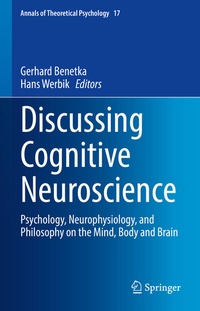
Discussing Cognitive Neuroscience
Description

The sciences philosophy, psychology and neuroscience share the basis that all refer to the human being. Therefore, an interdisciplinary collaboration would be desirable. The exchange of criticism is an essential requirement for interdisciplinary collaboration. Criticism must be heard and - if possible - considered. Indeed, criticism can be valid or unwarranted. However, whether criticism is unwarranted can only emerge from discussion and conversation. In the discussion of cognitive neuroscience, some criticism can easily be considered (such as the mereological fallacy that represents that talking about the person is substituted with talking bout the brain). Another issue for an interdisciplinary discussion of cognitive neuroscience is the interpretation of the readiness potential including re-considering Benjamin Libet's classic experiments. Additionally, a critical discussion on cognitive neuroscience must address ethical questions, such as the possibility of the abuse of neuroscientific insight.
More details
Other editions
Additional editions
Persons
Born 1962 in Vienna, studies of psychology, history and sociology at University of Vienna; Master's degree ( Mag.phil. ) 1989, PhD ( Dr.phil. ) 1994; authorisation to teach ( venia docendi ) for the subject of psychology 1998; visiting professorships in Vienna, Innsbruck, Graz, Klagenfurt and in the Principality of Liechtenstein; since 2007 full professor at Sigmund Freud University; since 2015 Dean of the Faculty of Psychology and chair of the academic senate.
Hans Werbik
Born 1941 in Hollabrunn (Lower Austria), studies of psychology and musicology at University of Vienna; PhD ( Dr.phil. ) 1963; 1963-1965 psychologist at the Institute of Empirical Social Research in Vienna; 1965-1969 research assistant at the Institute of Psychology at the University of Tübingen; authorisation to teach ( venia docendi ) for the subject of psychology 1969; 1970-1973 professor, since 1973 full professor at the Institute ofPsychology at University of Erlangen-Nuremberg; since 2006 emeritus professor; since 2015 university lecturer at Sigmund Freud University.
Content
Chapter 1. Critique of neuropsychology - A polemic.- Chapter 2. Living body (Leib) or physical dataset? Antonio Damsio's and Thomas Fuchs's holistic conception of the human being as opposite standpoint to reductionist models.- Chapter 3. The person and the brain.- Chapter 4. The neuropsychological discourse in philosophical critique - Bennett/Hacker and the consequences.- Chapter 5. Persistent biologism and the misuse of neuropsychology - an activity-theoretical contribution.- Chapter 6. Measuring free will with the readiness potential? New data on an old misunderstanding.- Chapter 7. The brain as protagonist - Without the brain all is nothing.- Chapter 8. Is it possible to simulate "thought"?
