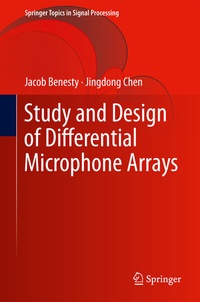
Study and Design of Differential Microphone Arrays
Description

Microphone arrays have attracted a lot of interest over the last few decades since they have the potential to solve many important problems such as noise reduction/speech enhancement, source separation, dereverberation, spatial sound recording, and source localization/tracking, to name a few. However, the design and implementation of microphone arrays with beamforming algorithms is not a trivial task when it comes to processing broadband signals such as speech. Indeed, in most sensor arrangements, the beamformer output tends to have a frequency-dependent response. One exception, perhaps, is the family of differential microphone arrays (DMAs) who have the promise to form frequency-independent responses. Moreover, they have the potential to attain high directional gains with small and compact apertures. As a result, this type of microphone arrays has drawn much research and development attention recently. This book is intended to provide a systematic study of DMAs from a signal processing perspective. The primary objective is to develop a rigorous but yet simple theory
for the design, implementation, and performance analysis of DMAs. The theory includes some signal processing techniques for the design of commonly used first-order, second-order, third-order, and also the general N th-order DMAs. For each order, particular examples are given on how to form standard directional patterns such as the dipole, cardioid, supercardioid, hypercardioid, subcardioid, and quadrupole. The study demonstrates the performance of the different order DMAs in terms of beampattern, directivity factor, white noise gain, and gain for point sources. The inherent relationship between differential processing and adaptive beamforming is discussed, which provides a better understanding of DMAs and why they can achieve high directional gain. Finally, we show how to design DMAs that can be robust against white noise amplification.
More details
Other editions
Additional editions