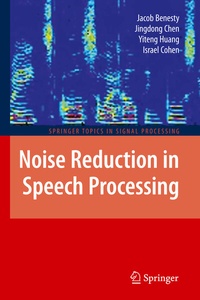
Noise Reduction in Speech Processing
Description

Noise is everywhere and in most applications that are related to audio and speech, such as human-machine interfaces, hands-free communications, voice over IP (VoIP), hearing aids, teleconferencing/telepresence/telecollaboration systems, and so many others, the signal of interest (usually speech) that is picked up by a microphone is generally contaminated by noise. As a result, the microphone signal has to be cleaned up with digital signal processing tools before it is stored, analyzed, transmitted, or played out. This cleaning process is often called noise reduction and this topic has attracted a considerable amount of research and engineering attention for several decades. One of the objectives of this book is to present in a common framework an overview of the state of the art of noise reduction algorithms in the single-channel (one microphone) case. The focus is on the most useful approaches, i.e., filtering techniques (in different domains) and spectral enhancement methods. The other objective of Noise Reduction in Speech Processing is to derive all these well-known techniques in a rigorous way and prove many fundamental and intuitive results often taken for granted. This book is especially written for graduate students and research engineers who work on noise reduction for speech and audio applications and want to understand the subtle mechanisms behind each approach. Many new and interesting concepts are presented in this text that we hope the readers will find useful and inspiring.
Reviews / Votes
From the reviews: "Written for new PhD students . or for senior engineers who want to browse existing technologies before designing noise-reduction systems. . readers can be quickly refreshed on basic concepts of a variety of DSP technologies, ranging from Wiener and Kalman filters to the general adaptive filter. The authors discuss the well-known linear filters . in terms of time domain, but also in frequency, joint time-frequency, and spatial domain. . Overall, this book is more like general DSP books than books specifically written on speech applications." (Shie Qian, International Journal of Acoustics and Vibration, Vol. 14 (4), 2009)More details
Other editions
Additional editions