

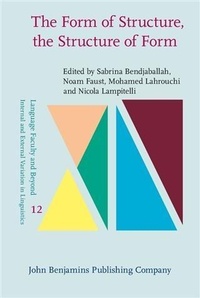
The Form of Structure, the Structure of Form
Essays in honor of Jean Lowenstamm
1st Edition
Published on 17. December 2014
VII, 377 pages
978-90-272-6948-5 (ISBN)
Description

This volume brings together articles by some major figures in various linguistics domains - phonology, morphology and syntax - aiming at explaining the form of linguistic items by exploring the structures that underlie them.
The book is divided in 5 parts: vowels, syllables, templates, syntax-morphology interface and Afro-Asiatic languages. Specific topics are the internal structure of vowels and its relation to harmony; the logic of recurrent vocalic patterns; syllabic prominence; the interaction of syllabic and templatic structure and segmental realization; the innateness of templates and paradigms; the limits of phonology; and various morpho-syntactic implications on phonological form.
The volume renders homage to Jean Lowenstamm's work, by underlining the importance of seeking structural and intermodular insight in the study of linguistic form.
The book is divided in 5 parts: vowels, syllables, templates, syntax-morphology interface and Afro-Asiatic languages. Specific topics are the internal structure of vowels and its relation to harmony; the logic of recurrent vocalic patterns; syllabic prominence; the interaction of syllabic and templatic structure and segmental realization; the innateness of templates and paradigms; the limits of phonology; and various morpho-syntactic implications on phonological form.
The volume renders homage to Jean Lowenstamm's work, by underlining the importance of seeking structural and intermodular insight in the study of linguistic form.
More details
Other editions
Additional editions
Sabrina Bendjaballah | Noam Faust | Mohamed Lahrouchi
The Form of Structure, the Structure of Form
Essays in honor of Jean Lowenstamm
Book
12/2014
John Benjamins Publishing Co
€111.30
Shipment within 10-15 days
Persons
Content
- The Form of Structure, the Structure of Form
- Editorial page
- Title page
- LCC data
- Table of contents
- Introduction
- 1. Jean Lowenstamm, the teacher and the man
- 2. Jean Lowenstamm, the linguist
- 3. The form of structure, the structure of forms
- 3.1 Vowels
- 3.2 Syllables
- 3.3 Templates
- 3.4 The Phonology-Syntax interface
- 3.5 Selected issues in Afro-Asiatic syntax and semantics
- References
- Supervised PhD dissertations
- Part 1. Vowels
- Lowering harmony in Bantu
- 1. Introduction
- 2. A synopsis of Radical cv Phonology
- 3. Licensing
- 4. Lowering harmony in Bantu
- 4.1 Kikuyu
- 4.2 The unique case of Kimatuumbi
- 5. Conclusion
- References
- On vowel harmony and vowel reduction
- 1. Background
- 2. Things that might disturb the comparison
- 3. Morphological and phonological structures
- 3.1 Yukuben3
- 3.2 Mòoré
- 3.3 German
- 4. Vowel assimilation and "harmony"
- 4.1 Yukuben
- 4.2 Mòoré
- 4.3 German I-Umlaut
- 5. Vowel reduction
- 5.1 Yukuben
- 5.2 Mòoré
- 5.3 German
- 6. Similarities and differences
- 6.1 Strengthening of first-syllable vowels
- 6.2 Weakening of the second-syllable vowels
- 7. Discussion
- 7.1 The order of morphemes
- 7.2 Stress
- 7.3 Robustness
- References
- Notes
- Apophony and chiming words in Malay
- 1. Introduction
- 2. Data
- 3. Analysis
- 3.1 Apophony and vowel alternation in Classical Arabic verbs
- 3.2 Apophony and chiming in Malay
- 3.3 Summary
- 4. Conclusion
- References
- Notes
- Understanding what has happened with the ablaut
- 1. Bopp, Grimm and the first steps of comparative grammar
- 2. Bréal's presentation of Bopp's synthesis
- 3. Saussure's Dissertation and later work?
- 4. Baudouin de Courtenay and the "alternants"
- 5. Conclusion
- References
- Notes
- Part 2. Syllables
- On the licensing of glides
- 1. Introduction
- 2. Background
- 2.1 The constituent structure of Classical Arabic
- 2.2 The status of onsets
- 3. The active voice of Form I
- 4. Glide-initial verb roots and the licensing of glides
- 5. On structure preservation
- 6. Conclusion
- References
- Notes
- Coda constraints on tone
- 1. Introduction
- 2. The issues
- 3. Stopped tones in Kuki-Chin
- 3.1 Stopped tones in Hakha Lai
- 3.2 Stopped tones in Kuki-Thaadow
- 3.3 Stopped tones in Falam Lai
- 4. Other cases
- 5. Summary
- References
- Notes
- C/V interactions in strict CV
- 1. Introduction
- 2. The specificity of length
- 2.1 Typology
- 2.2 Positional markedness
- 2.3 Integrity
- 2.4 No compensatory lengthening
- 2.5 Templatic behaviour
- 2.6 CV as melodies
- 3. Additional evidence
- 3.1 "Schwa/zero" alternations
- 3.2 Lax checked vowels
- 3.3 Unreleased stops and the so-called "phonetic detail"
- 4. C/V interactions and 'lateral' phonology
- References
- Notes
- What does the Moroccan Malhun meter compute, and how?
- 1. Introduction
- 2. An overview of the malhun tradition
- 3. A brief sketch of the MA syllabification system
- 4. The malhun's metical patterns generator
- 4.1 General
- 4.2 Characterization of a malhun metrical pattern
- 4.3 Alphabet and syntax of the malhun-MPs generator
- 4.4 Malhun poetic idiom's metrical wheel
- 4.5 Metrical embedding, complementarity and line's length
- 5. Lineation and rhyming
- Summary
- References
- Notes
- Part 3. Templates
- Regularities in irregular Chaha verbs
- 1. The problem
- 2. Monoconsonantal verbs
- 2.1 Alternations of the Perfective
- 2.2 Alternations of the Imperative
- 2.3 Alternations of the Imperfective
- 2.4 Independence and assimilation: W?y?-m 'he descended' and n?y?-m 'he slept'
- 2.5 Quadrisyllabic shortening
- 3. Biconsonantal verbs
- 3.1 Alveolar versus alveopalatal alternation
- 3.2 [r] versus [y] alternation
- 4. Conclusion
- References
- Notes
- Overlapping morphologies in Arabic hypocoristics
- 1. Introduction
- 2. Hypocoristic suffixes sounding like possessive suffixes
- 2.1 First person singular possessive suffix -i/-ti in Kuwaiti Arabic
- 2.2 Third person singular masculine possessive suffix -u
- 3. Other suffixed hypocoristics
- 3.1 Hypocoristics formed by suffixing -aat in Levantine Arabic
- 3.2 Hypocoristics formed by suffixing -iin in Kuwaiti Arabic
- 3.3 Hypocoristics formed by suffixing -aan in Kuwaiti Arabic
- 3.4 Hypocoristics formed by suffixing -uun in Kuwaiti Arabic
- 4. KA hypocoristics based on analogy with existing words or PNs
- 5. Conclusion
- References
- Notes
- Staying away from the weak left edge
- 1. Introduction
- 2. Strength and strengthening
- 2.1 Segmental strength and positional strength
- 2.2 Strength and strengthening
- 3. The beginning of the hypocoristic
- 3.1 Deriving hypocoristics
- 3.2 The left edge
- 4. Gradient mis-anchoring in Hebrew hypocoristics
- 4.1 The left-edge parameter in Hebrew hypocoristics
- 4.2 Mis-anchoring and the strength hierarchy
- 5. Limitations on strengthening
- References
- Notes
- The Modern Hebrew template tQuLa in light of Jean Lowenstamm's work
- 1. Introduction
- 2. The CV template of tQuLa is tripartite
- 3. Analyticity, the no-straddling government effect and the peculiarity of tQuLa
- 4. Phonology as the manifestation of morpho-syntactic structure
- 5. Conclusion
- References
- Notes
- Templates and representations in phonology
- 1. Introduction
- 2. What is a template in acquisition and what is it good for
- 3. Templates and templatic behaviors in the acquisition of French
- 3.1 Spreading, reduplication and autosegmental representations
- 3.2 aCV patterns and morphological constraints on the early template
- 4. Conclusion: Why phonological representations are useful
- References
- Notes
- On templates
- 0. Preface
- 1. Introduction: Can words be anything?
- 2. Is shape templaticity a general property of natural languages? A comparison of French, Mohawk and Semitic.
- 3. Gothic verb inflection
- 4. Conclusion: What are templates?
- References
- Notes
- Part 4. The Phonology-Syntax interface
- The Ins and Outs of phonology
- 1. Introduction
- 2. The Outs: What is not phonology
- 2.1 Contrast
- 2.2 Articulation
- 2.3 Diachrony
- 2.4 Morphological Alternations
- 2.5 Segments
- 3. The Ins: What is phonology
- References
- Notes
- Phase cycles, f-cycles, and phonological (In)activity
- 1. Introduction
- 2. Phase cycles and (In)activity
- 3. Phonological behavior of inactive material
- 4. Towards a revised PIP
- 5. Phase cycles and f-cycles
- 6. Conclusions
- References
- Notes
- Sepp vs Paradigms
- 1. Introduction
- 2. Initial facts
- 3. Morpho-phonological asymmetries
- 4. Semantic asymmetries
- 5. Conclusion
- References
- Notes
- On Plurals, noun phrase and num(ber) in Moroccan Arabic and Djibouti Somali
- 1. Number in Moroccan Arabic nouns
- 2. Emphasis spread
- 3. Number in Somali
- 4. -yáal plurals in DJ
- 5. Conclusions
- References
- Notes
- The initial CV
- 1. Introduction
- 2. Diacritic sleepers vs. phonologically meaningful objects
- 3. The initial CV parameterized: Languages may or may not have it
- 3.1 Stable cross-linguistic effects disqualify diacritics
- 3.2 Three for the price of one
- 4. Predictions made by the parameterisation of the initial CV
- 5. The initial CV is not recorded in the lexical entry of its host
- 5.1 The initial CV must not be a sleeper
- 5.2 (Non-) privativity: an echo of SPE
- 5.3 The initial CV is online-created information
- 6. The initial and other CVs
- 6.1 Carriers of morpho-syntactic information reduce to syllabic space
- 6.2 CV units that have been found to carry morpho-syntactic information
- References
- Notes
- Part 5. Selected Issues in Afro-Asiatic (Morpho-)Syntax and Semantics
- Causatives, anticausatives and lexicalization
- 1. Introduction
- 2. Lexicalization
- 3. Causatives
- 4. Anticausatives
- 5. Anticausativization, reflexivization and internal causation
- 6. "Walk"
- 7. Conclusions
- References
- Notes
- A note on labeling, Berber states and VSO order
- 1. The Construct State in Berber
- 2. Labeling
- 3. The construct state is the shape of a noun merged with K.
- 4. Conclusion
- References
- Notes
- The interpretation of Construct-State morphology
- References
- Notes
- Index
