

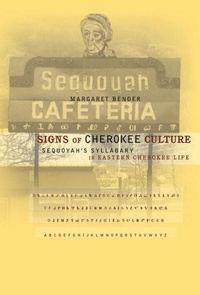
Signs of Cherokee Culture
Sequoyah's Syllabary in Eastern Cherokee Life
Published on 3. April 2003
208 pages
978-0-8078-6005-2 (ISBN)
Description

Based on extensive fieldwork in the community of the Eastern Band of Cherokee Indians in western North Carolina, this book uses a semiotic approach to investigate the historic and contemporary role of the Sequoyan syllabary — the written system for representing the sounds of the Cherokee language — in Eastern Cherokee life.
The Cherokee syllabary was invented in the 1820s by the respected Cherokee Sequoyah. The syllabary quickly replaced alternative writing systems for Cherokee and was reportedly in widespread use by the mid-nineteenth century. After that, literacy in Cherokee declined, except in specialized religious contexts. But as Bender shows, recent interest in cultural revitalization among the Cherokees has increased the use of the syllabary in education, publications, and even signage.
Bender also explores the role played by the syllabary within the ever more important context of tourism. (The Eastern Cherokee Band hosts millions of visitors each year in the Great Smoky Mountains.) English is the predominant language used in the Cherokee community, but Bender shows how the syllabary is used in special and subtle ways that help to shape a shared cultural and linguistic identity among the Cherokees. Signs of Cherokee Culture thus makes an important contribution to the ethnographic literature on culturally specific literacies.
The Cherokee syllabary was invented in the 1820s by the respected Cherokee Sequoyah. The syllabary quickly replaced alternative writing systems for Cherokee and was reportedly in widespread use by the mid-nineteenth century. After that, literacy in Cherokee declined, except in specialized religious contexts. But as Bender shows, recent interest in cultural revitalization among the Cherokees has increased the use of the syllabary in education, publications, and even signage.
Bender also explores the role played by the syllabary within the ever more important context of tourism. (The Eastern Cherokee Band hosts millions of visitors each year in the Great Smoky Mountains.) English is the predominant language used in the Cherokee community, but Bender shows how the syllabary is used in special and subtle ways that help to shape a shared cultural and linguistic identity among the Cherokees. Signs of Cherokee Culture thus makes an important contribution to the ethnographic literature on culturally specific literacies.
More details
Other editions
Additional editions

Book
06/2002
The University of North Carolina Press
€46.80
Shipment within 15-20 days
Person
Margaret Bender teaches linguistic and cultural anthropology at Wake Forest University in Winston-Salem, North Carolina.
Content
- Intro
- Preface
- Note on Orthography
- Introduction
- Notes
- 1. Pride and Ambivalence
- Notes
- 2. Reading, Writing, and the Reproduction of Cultural Categories
- Notes
- 3. Talking Leaves, Silent Leaves
- Notes
- 4. Reading the Signs
- Notes
- 5. What Else You Gonna Go After?
- Notes
- Conclusion
- Notes
- Notes
- References
- Index
