

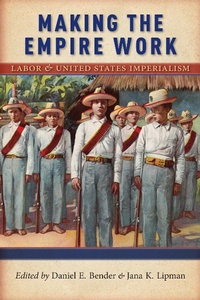
Making the Empire Work
Description

This collection challenges historians to consider the labor that formed, worked, confronted, and rendered the U.S. empire visible. The U.S. empire is a project of global labor mobilization, coercive management, military presence, and forced cultural encounter. Together, the essays in this volume recognize the United States as a global imperial player whose systems of labor mobilization and migration stretched from Central America to West Africa to the United States itself.
Workers are also the key actors in this volume. Their stories are multi-vocal, as workers sometimes defied the U.S. empire's rhetoric of civilization, peace, and stability and at other times navigated its networks or benefited from its profits. Their experiences reveal the gulf between the American 'denial of empire' and the lived practice of management, resource exploitation, and military exigency. When historians place labor and working people at the center, empire appears as a central dynamic of U.S. history.
Reviews / Votes
"Bender and Lipman have assembled a collection of short studies that conflate labor studies, imperial analyses, and diplomatic history to produce a challenging, insightful means of viewing such histories simultaneously. [] The innovative subjects and rigorous scholarship in this highly readable volume are accessible to general readers and scholars alike." (Choice) "This book makes an important contribution to our understanding of the history of American imperialism, much of it from the bottom up." (American Historical Review) "Making the Empire Work is a game changer. This spectacular volume will transform the way U.S. historians conceive, write and teach about empire. Workers were everywhere in the U.S. empire: building and serving it, shaped by and suffering from it. The work collected here gives new meaning to William Appleman Williams trenchant call for us to consider 'empire as a way of life.'" - Nan Enstad,University of Wisconsin, MadisonMore details
Other editions
Additional editions
Persons
Jana K. Lipman is Associate Professor in History at Tulane University. She is the author of Guantanamo: A Working-Class History between Empire and Revolution.
Content
Contents
1. The Wages of Empire: Capitalism, Expansionism, and Working-Class Formation 35
2. Revolutionary Currents: Interracial Solidarities, Imperial Japan, and the U.S. Empire 59
3. The Secret Soldiers' Union: Labor and Soldier Politics in the Philippine Scout Mutiny of 1924 85
4. The Photos That We Don't Get to See: Sovereignties, Archives, and the 1928 Massacre of Banana Workers in Colombia 104
5. Sexual Labor and the U.S. Military Empire: Comparative Analysis of Europe and East Asia 137
6. Making Aloha: Lei and the Cultural Labor of Hospitality 161
7. The Advantages of Empire: Chinese Servants and Conflicts over Settler Domesticity in the "White Pacific,” 1870-1900 185
8. Empire and the Moving Body: Fermin Tobera, Military California, and Rural Space 208
9. Slavery's Stale Soil: Indentured Labor, Guestworkers, and the End of Empire 227
10. The Colonization of Antislavery and the Americanization of Empires: The Labor of Autonomy and the Labor of Subordination in Togo and the United States 267
11. Progressive Empire: Race and Tropicality in United Fruit's Central America 289
