

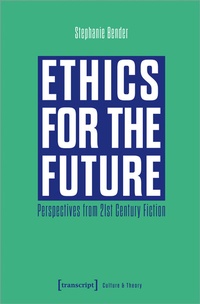
Ethics for the Future
Perspectives from 21st Century Fiction
1st Edition
Published on 2. June 2023
318 pages
978-3-8394-6820-3 (ISBN)
Description

Which of the possible futures might be a good future, and how do we know? Stephanie Bender looks at contemporary films and novels to address major ethical challenges of the future: the ecological catastrophe, digitalisation and biotechnology. She proposes that fiction and its modes of aesthetic simulation and emotional engagement offer a different way of knowing and judging possible futures. From a critical posthumanist angle, she discusses works ranging from Don DeLillo's Zero K (2017) and Margaret Atwood's MaddAddam Trilogy (2003-2013) to Kim Stanley Robinson's New York 2140 as well as Avatar (2009), and Blade Runner 2049 (2017) among many others.
Reviews / Votes
Besprochen in:mediendiskurs, 109 (2024), Lothar MikosMore details
Other editions
Additional editions
Book
06/2023
1st Edition
transcript
€49.00
Available immediately
Person
Stephanie Bender gained her doctorate in English literary and cultural studies, and teaches courses at Albert-Ludwigs-Universität Freiburg. She turns theory into practice on the fields of Community Supported Agriculture as the degrowth future of sustainable food production.
Content
- Cover
- Contents
- Acknowledgements
- Introduction
- Challenging Times
- Ethics for the Future: From Humanism to Posthumanism
- Ethical Criticism in the 21st Century
- Aesthetics for the Future: Popular Future Fictions
- The Chapters
- 2 Ethics for the Future through Fiction
- A Difficult Heritage: Humanism and Beyond
- New Ethics for a New Age: Hans Jonas
- Deconstruction, Ethics, and the Anthropocene: Joanna Zylinska
- Towards Posthumanist Ethics
- Actual Worlds and Possible Futures in Fiction
- Existing Ethical Approaches to Literature
- Ethical Criticism in Film
- Limitations of Existing Approaches
- Future Ethical Criticism: Worlds in the Making
- 3 Future World Ecologies: Kim Stanley Robinson's New York 2140 (2017) and James Cameron's Avatar (2009)
- A Political World-Ecology Approach: Kim Stanley Robinson's NewYork 2140
- New Realist Utopianism
- Ethics through an Aesthetic Unity of Effect
- The Capitalocene: Economy-Ecology
- Political Organisation through Actor Networks
- Back to "Nature" in James Cameron's Avatar
- Effective Affection? Ethical Responses to the Fantastic
- Ecologies without Nature
- The Unobtainium of the Industrial-Military Complex
- Are the Scientists also the Good Guys?
- Can You See What Is Real?
- Conclusion
- 4 Transhumanist Futures: Christopher Nolan's Interstellar (2014) and Wally Pfister's Transcendence (2014)
- Transhumanist Ethics in Christopher Nolan's Interstellar
- Directing Viewers' Emotions
- The End Times of the Earth's World Ecology Managed by Bureaucrats
- Normative Humanity and Border Transgressions
- The Scientific, Science Fiction, and Space
- The Otherworld in Space: A Fusion of Science and Love
- Philosophical Essentialism: Futuristic Technologies and The Humanin Wally Pfister's Transcendence
- More than Black and White: Ambiguous Ethics and Aesthetics
- Will as a Prototypical Representative of Transhumanist Thought
- Technology as a New Form of Secular Spirituality
- A Natural Techno-Spirituality
- The Classical Substantivist View: Revolutionary Independence fromTechnology
- The Resolution? Max as Middle Ground, Love as Reconciling Force
- Conclusion
- 5 Futuristic Digital Neoliberalism: Spike Jonze's Her (2013) and Dave Eggers's The Circle (2013)
- The Self and the Other in Digital Neoliberalism: Relationshipsand Identities in Spike Jonze's Her
- The Aesthetics of Digital Neoliberalism, the Self and the Other
- A Digital Mimicking of Neoliberal Selfhood
- Failed Romance: Meeting the Self instead of the Other
- Selling Love
- A Posthuman(ist) Possibility of an Other(world)
- The Economy of Attention in Dave Eggers's The Circle
- The Aesthetics of Warning
- The Threat of a Digital Economy of Attention
- Digital Capitalism and Transhumanism
- The Individual Level: Computational Psychologies
- The Political Level: Democratic Transhumanism
- The Physical and the Political Economy as Otherworlds
- Conclusion
- 6 Biopolitics of the Future: Kazuo Ishiguro's Never Let Me Go (2006) and Don DeLillo's Zero K (2016)
- The Biopolitics of Health in an Alternative Past: KnowingandNotKnowinginKazuo Ishiguro's Never Let Me Go
- Knowing and Not Knowing
- The Alternative Futuristic History
- The Complicity of the Deprived
- Narrative Worldmaking
- Structures of Recognition
- Making Arts and Creating Illusions: Humanist Art as a Tool forIdeological Worldmaking
- A Futuristic Present: The Power over Life and Death inDonDeLillo'sZero K
- The Present as Future
- The Biopolitics of Death in the Future
- Language and Life
- The Immortality of Art and the Art of Immortality
- The Little Life as Otherworld
- Conclusion
- 7 More than Human?: Threats of AI in Dennis Villeneuve's Blade Runner 2049 (2017) and Alex Garland's ExMachina (2014)
- "To Be Born Is to Have a Soul, I Guess." Reproduction andHuman(e)ness in Dennis Villeneuve's Blade Runner 2049
- The Ethics and Aesthetics of Biopunk Futures
- Reality and Simulation
- The Dominant World: Capitalism and Transhumanism, Again
- Reproducing "the Human"
- Deconstructing "the Human"
- Reflecting the Speculative Spectacle: Alex Garland's ExMachina
- The Speculative Spectacle: Cultural Fear of AI
- ExMachina "through the Looking Glass"
- Transhumanist Hubris: Nathan
- Humanism Failed: Caleb as the Antihero
- Posthuman(ist) Otherness: Ava
- Conclusion
- 8 Posthumanist Futures: Margaret Atwood's MaddAddam Trilogy (2003, 2006, 2013) and Paolo Bacigalupi's The Windup Girl (2009)
- Ethics through Metafiction: Storytelling in Margaret Atwood's MaddAddam Trilogy
- "It matters what stories make worlds, what worlds make stories"
- Postmodernist Aesthetics and Ethics
- Neoliberal Capitalism Unleashed
- The Otherworld of the Gardeners
- The Story of the Apocalypse
- Postapocalyptic Posthumanism
- Non-human Agents and Posthumanist Ethics in Paolo Bacigalupi'sThe Windup Girl
- Biopunk and the Aesthetics of Scale
- A Complex Entanglement of Worlds
- The Bioconservatist Regression to "Niche and Nature"
- The New Expansion of Biocapitalism
- Posthuman and Transhumanist Perspectives
- Posthumanist Ethics
- Conclusion
- 9 Contemporary Imaginaries of the Future
- Ethical Openness versus Closure
- Unmaking Capitalist Futures
- Otherworlds of the Future
- Speculative Realism
- Works Cited
