

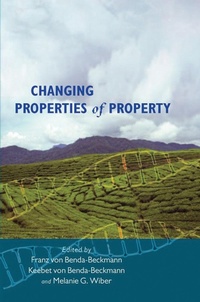
Changing Properties of Property
Description

As an important contribution to debates on property theory and the role of law in creating, disputing, defining and refining property rights, this volume provides new theoretical material on property systems, as well as new empirically grounded case studies of the dynamics of property transformations. The property claimants discussed in these papers represent a diverse range of actors, including post-socialist states and their citizens, those receiving restitution for past property losses in Africa, Southeast Asia and in eastern Europe, collectives, corporate and individual actors. The volume thus provides a comprehensive anthropological analysis not only of property structures and ideologies, but also of property (and its politics) in action.
More details
Other editions
Additional editions
Persons
Franz von Benda-Beckmann is head of the project group "Legal Pluralism" at the Max Planck Institute for Social Anthropology at Halle, Germany. He is professor for law in developing countries at Wageningen University, the Netherlands and honorary professor at the University of Leipzig. His research in Malawi and Indonesia focuses property and inheritance, social security, decentralization and legal anthropological theory.
Content
List of Maps, Figures and Tables
Chapter 1. The Properties of Property
Franz von Benda-Beckmann, Keebet von Benda-Beckmann and Melanie G. Wiber
Chapter 2. Ownership in Stateless Places
Charles Geisler
Chapter 3. The Romance of Privatisation and Its Unheralded Challengers: Case Studies from English, Russian, Soviet and Post-Soviet History
Esther Kingston-Mann
Chapter 4. Beyond Embeddedness: A Challenge Raised by a Comparison of the Struggles Over Land in African and Post-socialist Countries
Pauline E. Peters
Chapter 5. Land as Asset, Land as Liability: Property Politics in Rural Central and Eastern Europe
Thomas Sikor
Chapter 6. Property, Labour Relations and Social Obligations in Russia's Privatised Farm Enterprises
Oane Visser
Chapter 7. Cooperative Property at the Limit
John R. Eidson
Chapter 8. Who Owns the Fisheries? Changing Views of Property and Its Redistribution in Post-colonial Maori Society
Toon van Meijl
Chapter 9. How Communal is Communal and Whose Communal is It? Lessons from Minangkabau
Franz and Keebet von Benda-Beckmann
Chapter 10. Moving Borders and Invisible Boundaries: A Force Field Approach to Property Relations in the Commons of a Mexican
Ejido Monique Nuijten and David Lorenzo
Chapter 11. 'The Tragedy of the Private': Owners, Communities and the State in South Africa's Land Reform Programme
Deborah James
Chapter 12. The Folk Conceptualisation of Property and Forest-related Going Concerns in Madagascar
Frank Muttenzer
Chapter 13. Property Rights, Water and Conflict in the Western U.S.
Edella Schlager
Chapter 14. Appropriating Family Trees: Genealogies in the Age of Genetics
Gísli Pálsson
Chapter 15. Cultural Property, Repatriation and Relative Publics: Which Public? Whose Culture?
Melanie G. Wiber
Notes on Contributors
Index
