

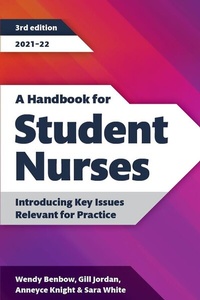
A Handbook for Student Nurses, third edition
Introducing Key Issues Relevant for Practice
3rd Edition
Published on 9. August 2021
228 pages
978-1-908625-94-6 (ISBN)
Description

A Handbook for Student Nurses is widely recommended in institutions across the UK and is essential reading for new students.
The book provides an introduction to the essential background knowledge that pre-registration nursing students need as a foundation for their training. This third edition has been thoroughly revised to reflect the new NMC standards of proficiency for registered nurses and the most recent update of the NMC Code. It also features a completely new chapter on health promotion, and incorporates the very latest developments in nurse education and in the health service.
A Handbook for Student Nurses covers the core of first-year nursing studies:
- Practice supervision and assessment
- Communication
- Legal and professional issues
- Values, ethics and cultural awareness
- Reflection and personal development
- Quality care and evidence-based practice
- Study skills
- Public health and promoting health and wellbeing
"An excellent introductory text for student nurses, written in a clear and illuminative style." Lecturer, Adult Nursing
The book provides an introduction to the essential background knowledge that pre-registration nursing students need as a foundation for their training. This third edition has been thoroughly revised to reflect the new NMC standards of proficiency for registered nurses and the most recent update of the NMC Code. It also features a completely new chapter on health promotion, and incorporates the very latest developments in nurse education and in the health service.
A Handbook for Student Nurses covers the core of first-year nursing studies:
- Practice supervision and assessment
- Communication
- Legal and professional issues
- Values, ethics and cultural awareness
- Reflection and personal development
- Quality care and evidence-based practice
- Study skills
- Public health and promoting health and wellbeing
"An excellent introductory text for student nurses, written in a clear and illuminative style." Lecturer, Adult Nursing
More details
Other editions
Additional editions
Wendy Benbow | Gill Jordan | Anneyce Knight
A Handbook for Student Nurses, third edition
Introducing Key Issues Relevant for Practice
Book
08/2021
3rd Edition
Lantern Publishing Ltd
€42.27
Article exhausted; check for reprint
Persons
Author
Gill Jordan qualified as a registered nurse in 1978. She completed her Orthopaedic Nursing Certificate and moved to New Zealand where she worked in a large orthopaedic teaching hospital, ultimately as a ward sister of a trauma orthopaedic ward. On her return to the UK in 1988, Gill moved into nurse education. Since then, she was involved in a variety of courses and professional development programmes, as both a teacher and programme leader. These included courses leading to professional registration, Return to Practice, Overseas Nurses Programme, conversion courses and various post-registration undergraduate and postgraduate programmes. Most recently Gill was Framework Leader for CPD Programmes at Bournemouth University before retiring in 2019.
The late Anneyce Knight, who died in 2021, had retired earlier that year from her role as Associate Dean for Global Engagement and Senior Lecturer in Adult Nursing at Bournemouth University, where she was also the Programme Leader for the Return to Nursing Practice course. She qualified as a registered nurse in 1982 and worked in orthopaedics and oncology, then trained as a midwife. She continued to practise in a variety of nursing and midwifery clinical settings before moving into Higher Education in 2000. Prior to taking up her role at Bournemouth University in 2015, Anneyce was the Course Lead for the innovative Foundation Degree in Health and Social Care (clinical) for Associate Practitioners, a joint NHS and Southampton Solent University collaboration. Previously she was at the University of Greenwich, where she held a number of positions. She was passionate about the need for compassionate care, thereby enhancing the quality of patient care, particularly at the end of life. Her primary research interests focused on public health and wellbeing, areas in which she has published and presented nationally and internationally.
Sara qualified as a registered nurse in 1986, after which she worked in Acute Trauma and Orthopaedics before moving to Intensive care (ICU) and Coronary care. She worked in a number of ICUs in London and the south of England and gained multiple qualifications (including General Intensive Care Nursing, Principles of Intensive Care (Paediatrics), BSc (Hons) Nursing Studies and Diploma in Health Service Management). Having spent ten years as an ICU Sister she moved into Higher Education where she has been for twenty years. During her time in HE she has facilitated the learning of many thousands of students at both undergraduate level and postgraduate level, whilst at the same time continuing her own education to Doctorate level. She believes that as a nurse educator she should strive to enable students to fuse their learning and integrate education, professional practice and research in order to develop as future nurses and enhance the care they offer patients.
Content
Preface to the third edition; Preface to the second edition; About the authors
1. Nurse education, practice supervision and assessment
1.1 Introduction
1.2 Pre-registration nurse education
1.3 Nurse education today
1.4 Standards of proficiency for registered nurses
1.5 Standards for education
1.6 Practice placements
1.7 Registration
2. Communication
2.1 Introduction
2.2 Communication defined
2.3 The communication process
2.4 Interpersonal skills
2.5 Intercultural communication
2.6 Emotional intelligence
2.7 Non-verbal interaction
2.8 Barriers to effective communication
2.9 Listening skills
2.10 Advocacy and empowerment
2.11 Digital literacy
3. Legal and professional issues
3.1 Professional accountability
3.2 Arenas of professional accountability
3.3 Disclosure and Barring Service (DBS)
3.4 Compassion in Practice
3.5 Delegation
3.6 The Code in more detail
3.7 Consent
3.8 Safeguarding
3.9 Confidentiality
3.10 Record-keeping
3.11 Fitness to Practise
4. Values and healthcare ethics
4.1 Values and rights
4.2 Patients' rights
4.3 Human rights
4.4 Professional considerations
4.5 Respect, privacy and dignity
4.6 Healthcare ethics
5. Cultural awareness
5.1 Introduction
5.2 Culture
5.3 Associated cultural terminology
5.4 Legislation and policy
5.5 Culture in practice
5.6 Religious awareness
6. Quality care
6.1 Defining quality assurance
6.2 A brief history of the organisation of quality assurance in UK healthcare
6.3 National quality assurance
6.4 Local clinical level
6.5 Further aspects of quality assurance
7. Evidence-based practice
7.1 Introduction
7.2 Evidence-based practice in nursing
7.3 Carrying out evidence-based practice
7.4 Clinical effectiveness and evidence-based practice
7.5 Implementing evidence-based practice
8. Professional roles in healthcare
8.1 Introduction to interprofessional practice
8.2 Definitions
8.3 Interprofessional working
8.4 Challenges to interprofessional working
8.5 Changing roles in nursing
8.6 Nursing in the 21st century in the UK
8.7 Careers in nursing
9. Reflection and clinical supervision
9.1 Reflection
9.2 Models of reflection
9.3 Using reflective frameworks
9.4 The benefits of practising reflectively
9.5 Reflective writing - keeping a journal or reflective diary
9.6 Preceptorship
9.7 Maintaining professional knowledge and competence (revalidation)
9.8 Continuing professional development and lifelong learning
9.9 Clinical supervision
9.10 Resilience in nursing
10. Study skills
10.1 Study skills
10.2 Reading
10.3 Taking notes
10.4 Writing essays
10.5 Electronic learning (e-learning)
10.6 Researching online
10.7 Numeracy
11. Public health and promoting health and wellbeing
11.1 Why is public health and promoting health and wellbeing relevant to nursing?
11.2 The context of public health
11.3 Determinants of health and health inequalities
11.4 Local public health
11.5 Health promotion
Index
1. Nurse education, practice supervision and assessment
1.1 Introduction
1.2 Pre-registration nurse education
1.3 Nurse education today
1.4 Standards of proficiency for registered nurses
1.5 Standards for education
1.6 Practice placements
1.7 Registration
2. Communication
2.1 Introduction
2.2 Communication defined
2.3 The communication process
2.4 Interpersonal skills
2.5 Intercultural communication
2.6 Emotional intelligence
2.7 Non-verbal interaction
2.8 Barriers to effective communication
2.9 Listening skills
2.10 Advocacy and empowerment
2.11 Digital literacy
3. Legal and professional issues
3.1 Professional accountability
3.2 Arenas of professional accountability
3.3 Disclosure and Barring Service (DBS)
3.4 Compassion in Practice
3.5 Delegation
3.6 The Code in more detail
3.7 Consent
3.8 Safeguarding
3.9 Confidentiality
3.10 Record-keeping
3.11 Fitness to Practise
4. Values and healthcare ethics
4.1 Values and rights
4.2 Patients' rights
4.3 Human rights
4.4 Professional considerations
4.5 Respect, privacy and dignity
4.6 Healthcare ethics
5. Cultural awareness
5.1 Introduction
5.2 Culture
5.3 Associated cultural terminology
5.4 Legislation and policy
5.5 Culture in practice
5.6 Religious awareness
6. Quality care
6.1 Defining quality assurance
6.2 A brief history of the organisation of quality assurance in UK healthcare
6.3 National quality assurance
6.4 Local clinical level
6.5 Further aspects of quality assurance
7. Evidence-based practice
7.1 Introduction
7.2 Evidence-based practice in nursing
7.3 Carrying out evidence-based practice
7.4 Clinical effectiveness and evidence-based practice
7.5 Implementing evidence-based practice
8. Professional roles in healthcare
8.1 Introduction to interprofessional practice
8.2 Definitions
8.3 Interprofessional working
8.4 Challenges to interprofessional working
8.5 Changing roles in nursing
8.6 Nursing in the 21st century in the UK
8.7 Careers in nursing
9. Reflection and clinical supervision
9.1 Reflection
9.2 Models of reflection
9.3 Using reflective frameworks
9.4 The benefits of practising reflectively
9.5 Reflective writing - keeping a journal or reflective diary
9.6 Preceptorship
9.7 Maintaining professional knowledge and competence (revalidation)
9.8 Continuing professional development and lifelong learning
9.9 Clinical supervision
9.10 Resilience in nursing
10. Study skills
10.1 Study skills
10.2 Reading
10.3 Taking notes
10.4 Writing essays
10.5 Electronic learning (e-learning)
10.6 Researching online
10.7 Numeracy
11. Public health and promoting health and wellbeing
11.1 Why is public health and promoting health and wellbeing relevant to nursing?
11.2 The context of public health
11.3 Determinants of health and health inequalities
11.4 Local public health
11.5 Health promotion
Index
