

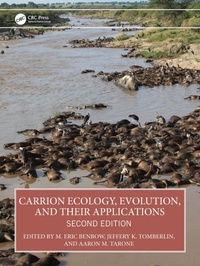
Carrion Ecology, Evolution, and Their Applications
2nd Edition
Published on 17. July 2025
722 pages
978-1-040-33449-2 (ISBN)
Description

The first edition of Carrion Ecology, Evolution, and Their Applications brought together multiple scientific disciplines to shed light on the importance of carrion within the context of ecology and evolutionary biology, and through applications ranging from human mass disasters to habitat/ecosystem conservation. This second edition builds upon this foundation to include a huge amount of new research, consisting of 33 chapters-9 brand new and the remaining 24 substantially updated and expanded. One of the most significant changes for this edition is the coverage of aquatic ecosystems, both freshwater and marine.
The book is now represented by 73 authors from eight countries, incorporating more diverse perspectives and engagement into this multidisciplinary and expanding science. The resulting new edition showcases a broader scope of topics, geographic areas, ecosystems and history of carrion ecology, evolution, and their applications for humanity. It provides the most comprehensive resource on carrion from all ecosystems of the world.
The student, academic, and professional will find this book insightful, providing new insights for the fields of molecular ecology, microbiology, entomology, population biology, community and ecosystem ecology, as well as applications in forensics and human and environmental health.
The book is now represented by 73 authors from eight countries, incorporating more diverse perspectives and engagement into this multidisciplinary and expanding science. The resulting new edition showcases a broader scope of topics, geographic areas, ecosystems and history of carrion ecology, evolution, and their applications for humanity. It provides the most comprehensive resource on carrion from all ecosystems of the world.
The student, academic, and professional will find this book insightful, providing new insights for the fields of molecular ecology, microbiology, entomology, population biology, community and ecosystem ecology, as well as applications in forensics and human and environmental health.
Reviews / Votes
"I can report that there is no comparable standard reference for students and researchers. All the state-of-the-art information regarding carrion ecology can be found very quickly: in my student courses I only need this single book as a reference work for the whole story of carrion ecology. Furthermore, I think this book will pave the way for a more comprehensive understanding of necromass as a whole, independent of its origin, key to the understanding of whole ecosystem functioning."Christian von Hoermann, Conservation and Research, Bavarian Forest National Park, Germany
More details
Edition
2nd edition
Language
English
Place of publication
London
United Kingdom
Publishing group
Taylor & Francis Ltd
Target group
College/higher education
Professional and scholarly
Illustrations
28 Tables, black and white; 34 Line drawings, color; 59 Line drawings, black and white; 90 Halftones, color; 8 Halftones, black and white; 67 Illustrations, color; 124 Illustrations, black and white
File size
27,08 MB
ISBN-13
978-1-040-33449-2 (9781040334492)
Copyright in bibliographic data and cover images is held by Nielsen Book Services Limited or by the publishers or by their respective licensors: all rights reserved.
Schweitzer Classification
Other editions
Additional editions
M. Eric Benbow | Jeffery K. Tomberlin | Aaron M. Tarone
Carrion Ecology, Evolution, and Their Applications
Book
07/2025
2nd Edition
CRC Press
€221.50
Shipment within 10-20 days

Book
05/2025
CRC Press
Unfortunately, price unknown
Available (delivery time upon request)
Persons
M. Eric Benbow is a Professor and Global Scholar at Michigan State University with a joint appointment between the Department of Entomology (College of Agriculture and Natural Resources) and the Department of Osteopathic Medical Specialties (College of Osteopathic Medicine). His research program addresses basic and applied insect and microbial biodiversity and community ecology, with a history of research in West Africa, East Africa, South Africa, South America, and throughout the USA. He is the author or coauthor of over 200 journal articles and technical papers, 30 book chapters, 5 edited books, 3 National Academies of Science, Medicine, and Engineering reports, and has received funding through NIH, NSF, USAID, NIJ, USDA, USGS, USFS, and multiple state and regional agencies. Professor Benbow has served on three National Academy of Science, Engineering, and Medicine appointed committees, and he is a Fellow of the American Academy of Forensic Sciences. He also participated in the semi-finals and finals of the 2019-2024 XPRIZE Rainforest biodiversity competition. The students and postdocs in the Benbow lab ask three general questions through coupled field and laboratory surveys and experiments: (1) Is insect fitness influenced by the community of microbes living in or on them? (2) What are the ecological interactions of insects with their microbiomes and microbial communities associated with habitat or food resources? and (3) How can understanding insect-microbe biodiversity relationships be used to inform natural resources management, human health, and agriculture, including insects as feed and food? The questions are answered within three general areas of inquiry: disease ecology, decomposition ecology, and forensic ecology. This work encompasses research in both aquatic and terrestrial ecosystems. A proponent of One Health science, Professor Benbow has spent over 25 years of collaborative research and teaching in countries with developing economies spanning the globe from Africa, Polynesia, Central America, South America, and Asia, with projects focused on biodiversity, the ecology of disease, forensics, and insects as feed and food. He has been a leader in understanding and predicting ecological and landscape influences on the aquatic mycobacterial pathogen responsible for Buruli ulcer disease endemic to many tropical and subtropical countries. New areas of research involve investigations related to managing insect pest and vector microbiomes and bacterial symbionts. He is passionate about using science, capacity building, and collaborations for improving lives in the most vulnerable regions of the world. The Benbow Lab is always open to new collaborations and hosting visiting scientists from around the world. Outside of academia and science, Benbow enjoys traveling with his family and friends, is an avid downhill skier, and enjoys hiking, cooking, and photography. Over the past few years, he has been involved with mixed martial arts, earning his first-degree black belt along with his youngest daughter. He may also be known for evenings of karaoke, blue steel facial expressions, and "worm" races with the co-editors of this book, at many conferences around the world.
Jeffery K. Tomberlin is a Professor, AgriLife Research Fellow, and Presidential Impact Fellow in the Department of Entomology at Texas A&M University and a Fellow of the Entomological Society of America. He is the principal investigator of the Forensic Laboratory for Investigative Entomological Sciences (F.L.I.E.S.) Facility (https://forensicentomology.tamu.edu) at Texas A&M University, and he is the Director of the National Science Foundation Center for Environmental Sustainability through Insect Farming. Research in the F.L.I.E.S. Facility examines species interactions on ephemeral resources such as vertebrate carrion, decomposing plant material, and animal wastes in order to better understand the mechanisms regulating arthropod behavior as related to arrival, colonization, and succession patterns. The goals of his program are numerous; however, a major focus of his research is on forensic entomology, waste management in confined animal facilities, and concerns with food waste being placed in landfills. His research efforts for the past 27 years have been developing methods for the production of alternate protein sources for use as livestock, poultry, and aquaculture feed from these resources. Predominantly, these efforts have been accomplished through his research with the black soldier fly. Since arriving at Texas A&M University in 2002, 20 PhD and 21 MS students have completed their degrees under his supervision. He has also supervised eight postdoctoral associates. To date, he has edited 8 books and published 28 book chapters and over 260 research articles, which have more than 22,000 citations. Through his efforts, he has been recognized as a Fellow by the Entomological Society of America and the American Academy of Forensic Sciences. Dr. Tomberlin welcomes those who are interested in collaborating or gaining experience in black soldier fly as a sustainable system to produce protein or other areas of his research to visit the F.L.I.E.S. Facility. Dr. Tomberlin has worked with companies throughout the world, including but not limited to Malaysia, China, and Australia. He has also given presentations (e.g., TEDx) on research throughout the world as well (over 35 countries to date).
Aaron M. Tarone is a Professor in the Entomology Department at Texas A&M University, where he teaches forensic entomology and a forensic science capstone course. He served as director of the accredited Forensic and Investigative Sciences major from 2020 to 2024 and is part of the academic leadership for the NSF/NIJ co-funded Center for Advanced Research in Forensic Science. Tarone started his research career studying Drosophila speciation and sexual dimorphism and has taken that perspective with him to research on other decomposers, including carrion flies. He now studies a variety of systems apart from life history traits of flies, including genomics of pest and carrion-feeding ants, transcriptomics of development, genome size variation, statistical and quantitative genetics, microbiomes, xenosurveillance, tick sex determination, intraguild predation, interkingdom communication, thermal biology, and control of myiasis flies with eBeams. Some of these projects have led to publications in Nature, Science, PNAS, Annual Review of Entomology, Trends in Ecology and Evolution, Genome Research, ISMEJ, and Nature Chemical Biology (though his papers are more commonly found in the Journal of Medical Entomology, Journal of Forensic Sciences, BMC Genomics, Ecological Entomology, International Journal of Legal Medicine, and Insect Molecular Biology). These projects have led to funding through the State of Texas, Department of Energy, Department of Justice, Department of Education, and National Science Foundation. Several of his postdoctoral trainees and graduate students (including some contributors to this book) are now professors (Houston Christian University, Utah Valley University, Arizona State University, Virginia Commonwealth University, Indiana University in Indianapolis, Oklahoma State University) or work as scientists in universities (Texas A&M University, Washington University in St. Louis), the US government (Department of Agriculture and Department of Defense), or private industry. In his rare moments of spare time, Tarone enjoys the company of his family, as well as their dogs and horses, at their home in rural Brazos County, Texas. He is a coach for 4-H archery. When the stars align, he even gets to indulge in his hobby of horseback archery. Every once in a while, Tarone also gets to socialize with his co-editors, much less frequently now than when we were young grad students/postdocs-but always with the same spirit of collegiality, generosity, intellectual curiosity, and friendship.
Jeffery K. Tomberlin is a Professor, AgriLife Research Fellow, and Presidential Impact Fellow in the Department of Entomology at Texas A&M University and a Fellow of the Entomological Society of America. He is the principal investigator of the Forensic Laboratory for Investigative Entomological Sciences (F.L.I.E.S.) Facility (https://forensicentomology.tamu.edu) at Texas A&M University, and he is the Director of the National Science Foundation Center for Environmental Sustainability through Insect Farming. Research in the F.L.I.E.S. Facility examines species interactions on ephemeral resources such as vertebrate carrion, decomposing plant material, and animal wastes in order to better understand the mechanisms regulating arthropod behavior as related to arrival, colonization, and succession patterns. The goals of his program are numerous; however, a major focus of his research is on forensic entomology, waste management in confined animal facilities, and concerns with food waste being placed in landfills. His research efforts for the past 27 years have been developing methods for the production of alternate protein sources for use as livestock, poultry, and aquaculture feed from these resources. Predominantly, these efforts have been accomplished through his research with the black soldier fly. Since arriving at Texas A&M University in 2002, 20 PhD and 21 MS students have completed their degrees under his supervision. He has also supervised eight postdoctoral associates. To date, he has edited 8 books and published 28 book chapters and over 260 research articles, which have more than 22,000 citations. Through his efforts, he has been recognized as a Fellow by the Entomological Society of America and the American Academy of Forensic Sciences. Dr. Tomberlin welcomes those who are interested in collaborating or gaining experience in black soldier fly as a sustainable system to produce protein or other areas of his research to visit the F.L.I.E.S. Facility. Dr. Tomberlin has worked with companies throughout the world, including but not limited to Malaysia, China, and Australia. He has also given presentations (e.g., TEDx) on research throughout the world as well (over 35 countries to date).
Aaron M. Tarone is a Professor in the Entomology Department at Texas A&M University, where he teaches forensic entomology and a forensic science capstone course. He served as director of the accredited Forensic and Investigative Sciences major from 2020 to 2024 and is part of the academic leadership for the NSF/NIJ co-funded Center for Advanced Research in Forensic Science. Tarone started his research career studying Drosophila speciation and sexual dimorphism and has taken that perspective with him to research on other decomposers, including carrion flies. He now studies a variety of systems apart from life history traits of flies, including genomics of pest and carrion-feeding ants, transcriptomics of development, genome size variation, statistical and quantitative genetics, microbiomes, xenosurveillance, tick sex determination, intraguild predation, interkingdom communication, thermal biology, and control of myiasis flies with eBeams. Some of these projects have led to publications in Nature, Science, PNAS, Annual Review of Entomology, Trends in Ecology and Evolution, Genome Research, ISMEJ, and Nature Chemical Biology (though his papers are more commonly found in the Journal of Medical Entomology, Journal of Forensic Sciences, BMC Genomics, Ecological Entomology, International Journal of Legal Medicine, and Insect Molecular Biology). These projects have led to funding through the State of Texas, Department of Energy, Department of Justice, Department of Education, and National Science Foundation. Several of his postdoctoral trainees and graduate students (including some contributors to this book) are now professors (Houston Christian University, Utah Valley University, Arizona State University, Virginia Commonwealth University, Indiana University in Indianapolis, Oklahoma State University) or work as scientists in universities (Texas A&M University, Washington University in St. Louis), the US government (Department of Agriculture and Department of Defense), or private industry. In his rare moments of spare time, Tarone enjoys the company of his family, as well as their dogs and horses, at their home in rural Brazos County, Texas. He is a coach for 4-H archery. When the stars align, he even gets to indulge in his hobby of horseback archery. Every once in a while, Tarone also gets to socialize with his co-editors, much less frequently now than when we were young grad students/postdocs-but always with the same spirit of collegiality, generosity, intellectual curiosity, and friendship.
Content
Foreword
About the Editors
List of Contributors
Acknowledgments
Section I Introduction to the Study of Carrion Ecology and Evolution
1 Introduction to Carrion Ecology and Evolution
2 The Carrion Necrobiome
3 Overview of Carrion Biology
4 Design and Analysis of Field Studies in Carrion Ecology
5 Aggregate Carrion Ecology: Mass Mortality Events
6 Role of Carrion Resources in Ecological Theory
Section II Ecological Mechanisms of Carrion Decomposition
7 Processes and Mechanisms of Death and Decomposition of Vertebrate Carrion in Terrestrial Systems
8 Microbial Ecology of Terrestrial Carrion Decomposition via Multi-Omics
9 Terrestrial Carrion Decomposition Bacteriology
10 Arthropod Communities of Terrestrial Vertebrate Carrion
11 Chemical Ecology of Vertebrate Carrion
12 Ecological Role of Vertebrate Scavengers
13 Vertebrate Carrion as a Model for Conducting Behavior Research
14 Modeling Species Interactions within Vertebrate Carrion Food Webs
?15 Carrion Effects on Belowground Communities and Consequences for Soil Processes
16 Community and Landscape Ecology of Carrion
17 The Role of Carrion In Terrestrial Ecosystems
18 Terrestrial Ecology of African Carrion
19 Ecology of Vertebrate and Invertebrate Scavengers of Australian Carrion in Terrestrial Environments
20 Carrion Decomposition in Aquatic Systems: An Introduction
21 Role of Aquatic and Terrestrial Carcasses in Freshwater Ecosystems
Section III Evolutionary Ecology of Carrion
22 Ecological Genetics of Carrion and Dung Decomposers
23 Microbial Genetics and Systematics
24 Population Genetics and Molecular Evolution of Carrion-Associated Arthropods
25 Sociality and the Necrobiome
26 Carrion and Dung Mimicry in Plants
27 Interkingdom Ecological Interactions during Carrion Decomposition
Section IV Applications of Carrion Decomposition
28 Carrion Communities as Indicators in Fisheries, Wildlife Management, and Conservation
29 Composting As a Method of Livestock Carrion Disposal
30 Human Decomposition and Forensics
31 Death, History, and Archeology
?32 From Forensics and Human Health to Animal Feed
33 Future Opportunities in Carrion Ecology and Evolution
Index
About the Editors
List of Contributors
Acknowledgments
Section I Introduction to the Study of Carrion Ecology and Evolution
1 Introduction to Carrion Ecology and Evolution
2 The Carrion Necrobiome
3 Overview of Carrion Biology
4 Design and Analysis of Field Studies in Carrion Ecology
5 Aggregate Carrion Ecology: Mass Mortality Events
6 Role of Carrion Resources in Ecological Theory
Section II Ecological Mechanisms of Carrion Decomposition
7 Processes and Mechanisms of Death and Decomposition of Vertebrate Carrion in Terrestrial Systems
8 Microbial Ecology of Terrestrial Carrion Decomposition via Multi-Omics
9 Terrestrial Carrion Decomposition Bacteriology
10 Arthropod Communities of Terrestrial Vertebrate Carrion
11 Chemical Ecology of Vertebrate Carrion
12 Ecological Role of Vertebrate Scavengers
13 Vertebrate Carrion as a Model for Conducting Behavior Research
14 Modeling Species Interactions within Vertebrate Carrion Food Webs
?15 Carrion Effects on Belowground Communities and Consequences for Soil Processes
16 Community and Landscape Ecology of Carrion
17 The Role of Carrion In Terrestrial Ecosystems
18 Terrestrial Ecology of African Carrion
19 Ecology of Vertebrate and Invertebrate Scavengers of Australian Carrion in Terrestrial Environments
20 Carrion Decomposition in Aquatic Systems: An Introduction
21 Role of Aquatic and Terrestrial Carcasses in Freshwater Ecosystems
Section III Evolutionary Ecology of Carrion
22 Ecological Genetics of Carrion and Dung Decomposers
23 Microbial Genetics and Systematics
24 Population Genetics and Molecular Evolution of Carrion-Associated Arthropods
25 Sociality and the Necrobiome
26 Carrion and Dung Mimicry in Plants
27 Interkingdom Ecological Interactions during Carrion Decomposition
Section IV Applications of Carrion Decomposition
28 Carrion Communities as Indicators in Fisheries, Wildlife Management, and Conservation
29 Composting As a Method of Livestock Carrion Disposal
30 Human Decomposition and Forensics
31 Death, History, and Archeology
?32 From Forensics and Human Health to Animal Feed
33 Future Opportunities in Carrion Ecology and Evolution
Index
