

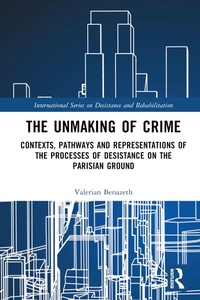
The Unmaking of Crime
Contexts, Pathways, and Representations of the Processes of Desistance on the Parisian Ground
1st Edition
Published on 29. November 2024
344 pages
978-1-040-14626-2 (ISBN)
Description

The Unmaking of Crime documents the pathways of offenders reforming their journey and desisting from crime, and assesses the opportunities and limitations of the criminal justice system in aiding this process. Starting with known factors involved in desistance - the influence of family, relationships, employment, or geographical relocations - it expands the lens to include new perspectives, such as the impact of drug abuses on the post-sentence period, the interaction of religion with delinquency, and the reconfigurations of citizenship.
Building on original qualitative research in Paris, the book considers a range of factors in the process of desistance, such as spheres of socialisation, the role of stigma and the opportunities offered or denied after a time in a criminal lifestyle, and the relationship between those seeking to desist from crime and key institutions and resources.
Building on original qualitative research in Paris, the book considers a range of factors in the process of desistance, such as spheres of socialisation, the role of stigma and the opportunities offered or denied after a time in a criminal lifestyle, and the relationship between those seeking to desist from crime and key institutions and resources.
Reviews / Votes
"Beginning with a Durkheimian understanding of crime and punishment, Benazeth has produced a fully French reconceptualization of the desistance concept that is theoretically sophisticated and critically nuanced in way that few can do as well as the French. A gift to criminology akin to the Statue of Liberty."Shadd Maruna, Professor of criminology, Queen's University Belfast.
"Prison overcrowding is a problem as old as the prison itself, but in the late modern period it has reached unprecedented heights and combined with long sentences and aging prisoners is creating a humanitarian disaster in many countries. In this much needed book, Valerian Benazeth points to a hopeful way out too often abandoned or overlooked by contemporary prison services, learning from the many former prisoners who have desisted from crime and no longer need prison bars to protect safety."
Jonathan Simon, Lance Robbins Professor of Criminal Justice Law, Berkeley University.
"Overall, Benazeth's book is exemplary. It provides non-French readers with a detailed account of France's cultural, institutional, and legal contexts. The work extensively engages with the international literature to frame and analyse its findings. The book is rich with nuance and detail, far beyond what can be fully conveyed in these limited lines. For instance, although the French legal system offers several mechanisms for expunging criminal records, Benazeth demonstrates that a criminal past nonetheless has a negative impact. In France, taking gap years is uncommon, and gaps in one's CV are not easily explained away. Furthermore, there are no robust systems for 'further learning education' and even menial positions often require high qualifications. As Benazeth shows, individuals who drop out of school are unlikely to ever secure stable employment."
Martine Herzog-Evans, University of Reims Champagne-Ardenne, France
More details
Series
Edition
1. Auflage
Language
English
Place of publication
London
United Kingdom
Publishing group
Taylor & Francis Ltd
Target group
College/higher education
Illustrations
3 Tables, color; 4 Tables, black and white; 24 Line drawings, color; 10 Line drawings, black and white; 1 Halftones, color; 25 Illustrations, color; 10 Illustrations, black and white
ISBN-13
978-1-040-14626-2 (9781040146262)
Copyright in bibliographic data and cover images is held by Nielsen Book Services Limited or by the publishers or by their respective licensors: all rights reserved.
Schweitzer Classification
Other editions
Additional editions
Valerian Benazeth
The Unmaking of Crime
Contexts, Pathways, and Representations of the Processes of Desistance on the Parisian Ground
Book
05/2026
1st Edition
Routledge
€57.00
Shipment within 10-20 days
Valerian Benazeth
The Unmaking of Crime
Contexts, Pathways, and Representations of the Processes of Desistance on the Parisian Ground
Book
11/2024
1st Edition
Routledge
€227.50
Shipment within 10-20 days

Valerian Benazeth
The Unmaking of Crime
Contexts, Pathways, and Representations of the Processes of Desistance on the Parisian Ground
Book
10/2024
Taylor & Francis
Unfortunately, price unknown
Available (delivery time upon request)
Person
Valerian Benazeth holds a PhD in Political Science from the University of Paris-Saclay (France) and is an associate researcher at the CESDIP Research Centre. Educated in France and in the United States as an exchange student (UTEP, TX), and then as a teaching assistant (Williams College, MA), he conducted one of the first empirical studies about desistance in France. His doctoral research integrated three years of fieldwork and received merit scholarships from the City of Paris and from the French Department of Justice. After serving for a time as the head of the research department inside the French Youth Justice Board, he resumed teaching at university in France.
Content
1. Introduction: beyond 'us' and 'them' 2. Understanding knowledge about desistance: The empirical and practical contribution of a continent of research 3. Methodology: retracing desistance journeys using in-depth interviews 4. Is there a French accent in desistance processes? 5.The economics of desistance: experimenting with the limits of its power to deconstruct the cult of money 6. Desistance and religion: a passport to redefine one's affiliations? 7. The intertwining of addictions in desistance processes: the role of an airlock or a bridge 8. Becoming an ordinary citizen again: another anchor for the desistance processes 9. The ambivalent effects of prison 10. Desistance and probation: the paradox of limited institutional effects 11. Desistance and electronic surveillance: leverage with varying degrees of success 12. Contextualising and extending knowledge about desistance
