

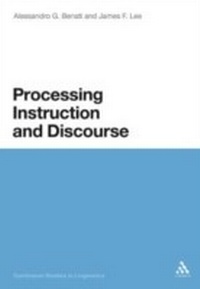
Processing Instruction and Discourse
1st Edition
Published on 4. January 2010
248 pages
978-1-4411-3685-5 (ISBN)
Description

Processing Instruction is an approach to grammar instruction for second language learning, contrasting with traditional grammar instruction in its focus on structured input rather than learners' output.
This book compares student assessment after traditional grammar instruction and after Processing Instruction to assess the positive benefits of this method of second language teaching. Rather than examining sentence-level tasks, the study looks at the relative effectiveness of Processing Instruction on discourse-level linguistic ability.
Case studies using empirical data from second language learners of Japanese, Italian and English are used to highlight the benefits to the learner of this method of enhanced input. This monograph will be of interest to postgraduates and academics researching second language acquisition and applied linguistics.
This book compares student assessment after traditional grammar instruction and after Processing Instruction to assess the positive benefits of this method of second language teaching. Rather than examining sentence-level tasks, the study looks at the relative effectiveness of Processing Instruction on discourse-level linguistic ability.
Case studies using empirical data from second language learners of Japanese, Italian and English are used to highlight the benefits to the learner of this method of enhanced input. This monograph will be of interest to postgraduates and academics researching second language acquisition and applied linguistics.
Reviews / Votes
"All readers -SLA researchers, language program administrators and teachers- will find in this volume a broad-ranging treatment of Processing Instruction and VanPatten's model of Input Processing that motivates it. Processing Instruction and Discourse summarizes in a most efficient way previous research on PI and reports on a number of new, fascinating empirical studies. This timely volume extends what we know about the effectiveness of PI to an impressive number of variables, including new structures, new languages, and to discourse. Importantly, it moves PI to a new context: from college language programs to primary, middle and high-school classrooms." - Associate Professor, Cristina Sanz, Georgetown University, USA 'The present volume addresses one aspect of processing instruction that merited further research, namely, the interplay between this type of instruction and discourse. It presents original research examining the impact of processing instruction on discourse-level interpretation and production tasks, as well the effects of presenting input to learners as connected discourse. This book is indispensable for researchers and students interested in processing instruction, but it is also an immensely useful collection of sources for those who are more broadly concerned with instructed second language acquisition.' - Professor Teresa Cadierno, University of Southern Denmark, DenmarkMore details
Edition
1. Auflage
Language
English
Place of publication
New York
United States
Target group
Professional and scholarly
ISBN-13
978-1-4411-3685-5 (9781441136855)
Copyright in bibliographic data and cover images is held by Nielsen Book Services Limited or by the publishers or by their respective licensors: all rights reserved.
Schweitzer Classification
Other editions
Additional editions
Alessandro G. Benati | James F. Lee
Processing Instruction and Discourse
Book
01/2012
Continuum Publishing Corporation
€56.00
Shipment within 15-20 days
Persons
Alessandro G. Benati is Professor in the School of Education, University College Dublin, Ireland. He has held positions in several British and overseas institutions. He is known for his work in second language acquisition, and he published ground-breaking research on the pedagogical framework called processing instruction. His research on processing instruction has been recently driven by the use of new online measurements (e.g., eye tracking, and self-paced reading). Alessandro has coordinated national and international high-impact research projects which have been influential in determining educational policy and had an impact in providing effective language teacher training programs. He is the author and co-author of several research monographs, peer-reviewed articles in high-ranked journals, and editor and co-editor of book series and scientific journals such as Cambridge Elements in SLA and Instructed Second Language Acquisition. He was a member of the sub-panel for Modern Languages and Linguistics for the Research Excellence Framework for England (REF 2021), AHRC Panel, and he is an Honorary Professor at Your SJ University (UK), University of Hong Kong (China), Adjunct Professor at Macquarie University (Australia), and Visiting Professor at Anaheim University (USA) James F. Lee is Deputy Head of School in the School of Humanities and Languages in the Faculty of Arts and Social Sciences at the University of New South Wales, Australia, where he teaches courses in language, linguistics and SLA. His research focuses on second language input processing.
Content
Acknowledgements
Preface
Part I: Processing Instruction: Theory, Practice and Research
1. VanPatten's Theory of Input Processing
2. Practical Model: Processing instruction
3. Processing instruction: experimental research
Part II: Processing Instruction and Discourse
4. Exploring the effects of processing instruction on a discourse-level guided composition with the Spanish subjunctive after the adverb cuando (with Erin M. McNulty)
5. Exploring the effects of processing instruction on discourse-level interpretation tasks with the Japanese passive construction (with Noriko Hikima, Japan Foundation London Language Centre, UK)
6. Exploring the effects of processing instruction on discourse-level interpretation tasks with English past tense
7. Exploring the effects of discourse-level structured input activities with French causative (with Wynne Wong, The Ohio State University, USA)
8. Conclusion
Bibliography
Index
Preface
Part I: Processing Instruction: Theory, Practice and Research
1. VanPatten's Theory of Input Processing
2. Practical Model: Processing instruction
3. Processing instruction: experimental research
Part II: Processing Instruction and Discourse
4. Exploring the effects of processing instruction on a discourse-level guided composition with the Spanish subjunctive after the adverb cuando (with Erin M. McNulty)
5. Exploring the effects of processing instruction on discourse-level interpretation tasks with the Japanese passive construction (with Noriko Hikima, Japan Foundation London Language Centre, UK)
6. Exploring the effects of processing instruction on discourse-level interpretation tasks with English past tense
7. Exploring the effects of discourse-level structured input activities with French causative (with Wynne Wong, The Ohio State University, USA)
8. Conclusion
Bibliography
Index
